June 3, 2024
During our last few days in Iceland, we experienced almost every kind of weather you can imagine…sunny skies, occasional rain, thunderstorms, fog, overcast, more sun, mist and then snow and bitter cold winds that nearly blew us over (literally)…and back to sunny skies…All Part Of The Adventure (APOTA)!
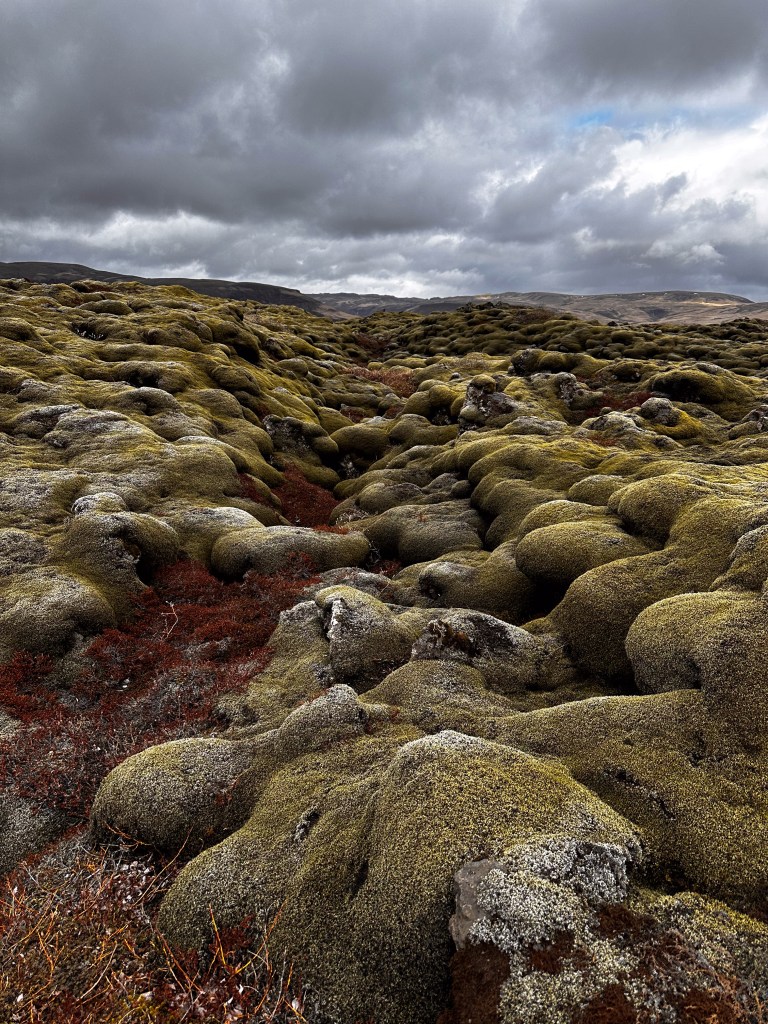
The whole time we were in Iceland, the temperature never got above 50 degrees. AND, if it was sunny and there was no wind, we were quite comfortable in a long-sleeved shirt, adding a vest if the wind came up a bit. AND, when it was raining or snowing (the day we traveled from our Geroi Guesthouse, through Vik to our next stop at Hotel Skogafoss), we got a taste of what winters might be like in this land of vastness and ice. At one point, the wind was blowing so hard midst the rain, sleet and snow, that while Gary was getting fuel, it blew his glasses right off his face! We did not realize how bad it was until shortly before that when Gary pulled off the road because he wanted me to experience first-hand what the moss felt like that we saw so many places throughout the southern and western parts of the country—mosses covered much of the lava rocks and hillsides. It was just a little “misty” at the time and he said, “No need to put on your coat,” so I opened the car door and the door blew out of my hands! (The rental car agency had warned us that winds sometimes were so strong that car doors could be blown off their hinges. Now I see why!) Wow!

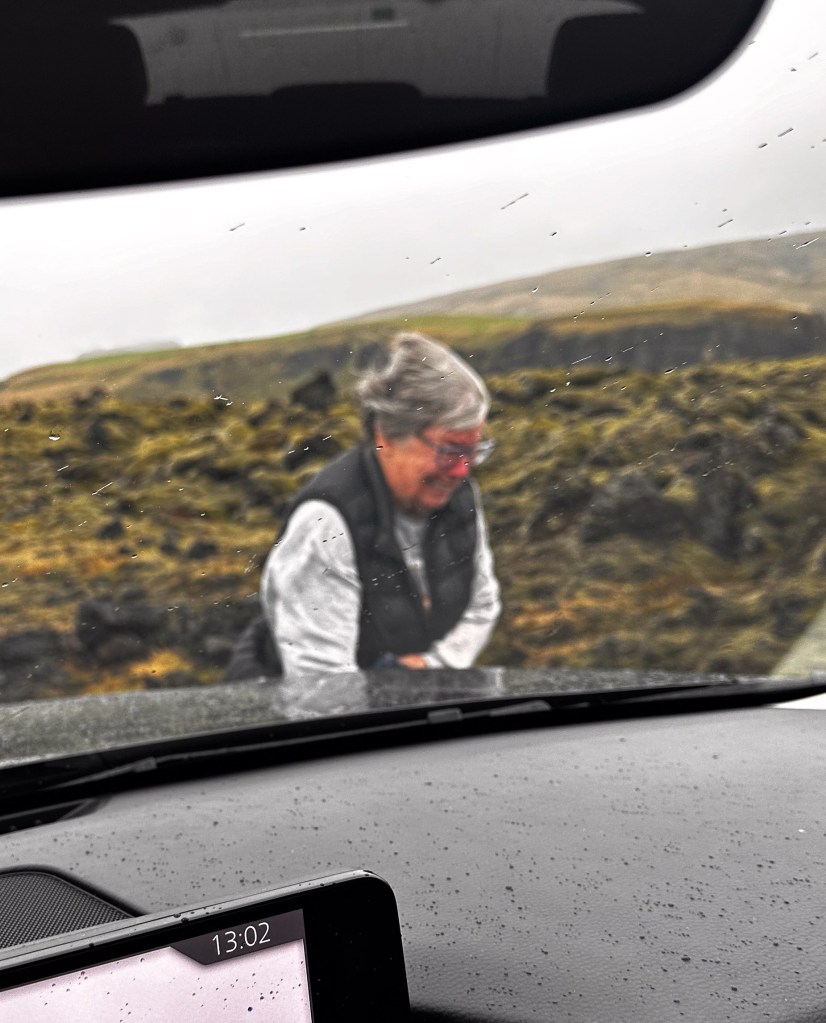
I figured as long as I was out of the car, I would just deal with the chilling wind and walk the 6-8’ over the lava to stick my fingers in the moss. AND, I had to fight to keep my footing. I pursued midst shrieks of dismay, finally got to the moss that was much deeper than my longest finger would reach—pretty amazing when we consider it takes nearly 70 years for each inch of moss to grow. (That’s why we were told never to walk on the moss!) As I turned around to get back into the car, I was really struggling against the wind and continuing to shriek. Gary took a video thinking I was expressing great awe and joy at what I’d experienced. Only when I managed to get back in the car, grunted trying to get the car door closed and started shaking did Gary realize it had NOT been a very joyous experience! Whoosh! It was brutal!!! Here’s what the moss on lava looks like normally (left)….it was very strange on this day to see snow covering the moss!

It was also very weird to see that the blowing snow was covering up the road signs most of the afternoon. We also had trouble with our defroster, which made it all the more of an “adventure!” We stopped for a much-needed hot lunch (and to get fuel) at a very strategically located pizza place. What welcome relief to get into a warm and toasty environment with a firepit! The place was packed!


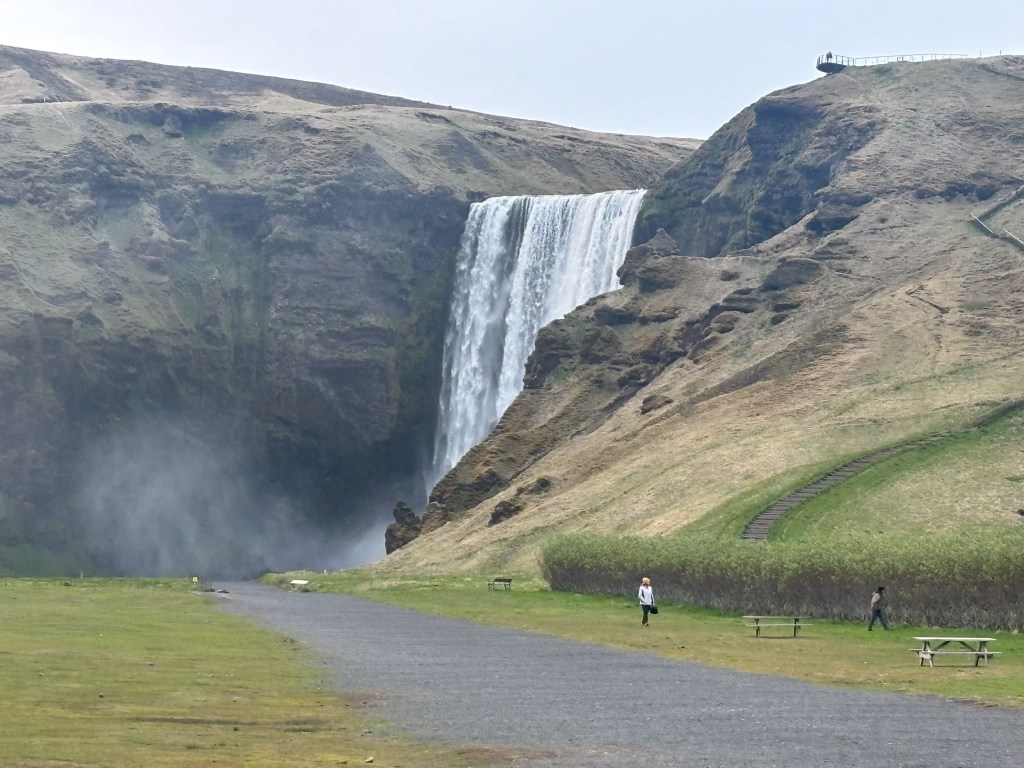
Not too soon afterwards, the storm let up a bit and the remaining 30 minutes of drive time was much easier, at last! This is the only day that I didn’t help with the driving …Gary has far more experience driving in bad weather, especially snow, and I’m so very grateful he had not only upgraded our rental car to a bigger, heavier 4-wheel drive (a Mazda CX90), but especially grateful that he was able to get us through this day safely. We were exceptionally relieved and glad to finally get to our next stop where we would stay for 2 nights at the Hotel Skogafoss right next to the stunning Skogafoss Waterfall (82’ wide and 197 feet high). Quite the day!
On our way here, we drove over the last of the single-lane bridges that appear around most of the Ring Road. We wondered why there were so many of them, especially when there was lots of open space on either side for a wider bridge, AND, we found it is much easier and quicker to replace a smaller bridge than a larger one if/when it is damaged or wiped out by brutal weather, floods or volcanic lava eruptions. Pretty clever!
It had rained quite a bit since Gary was in this area nearly 2 weeks ago, so everything was much greener, there were more waterfalls and there were lots of farm houses tucked into the foothills (except where the volcanic activity is more frequent—no farm houses there!) It was also fun to capture a photo of the Icelandic whooper swans seen many places along the Ring Road.


Now close to the end of our 800-mile drive around Iceland, the weather cleared and we spent the next day going to and from the Westman Islands by ferry (40 minutes), about 6 miles off Iceland’s South Coast. These islands are a pint-sized archipelago with jagged peaks and craggy sea cliffs filled with birds, including puffins. That day most of them were in the water fishing and would return late evening to their burrow/nests in the cliffs. By summer, this becomes Iceland’s largest colony of puffins…some say the largest in the world. That may be why puffins are the unofficial mascot for all of Iceland. We’re glad we saw a few, just like we did last year on the North Coast of Scotland. They are pretty special!
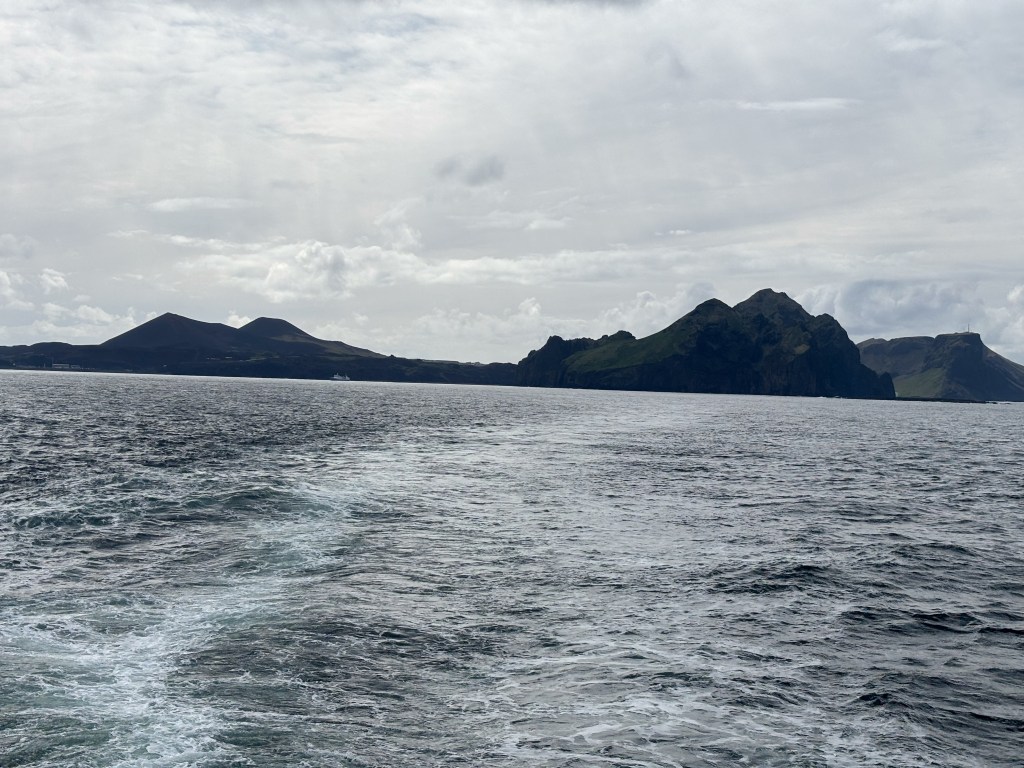

The Westman Islands are named for a trio of Irish slaves who fled to the islands after killing their owner. (In Old Norse, the Irish were called Westmen.) The islands are known for their seabirds and their busy fishing industry. We took a guided 2-hour drive around its one habited island called Heimaey (HAME-ah-AY) and were fascinated with the steep cliffs filled with an abundance of birds (fulmars, guillemots & kittiwakes) and their nests. It turns out that the “Islanders” rely on the seabird eggs for nutrition so kids are taught the age-old climbing and rappelling skills needed to collect these eggs.
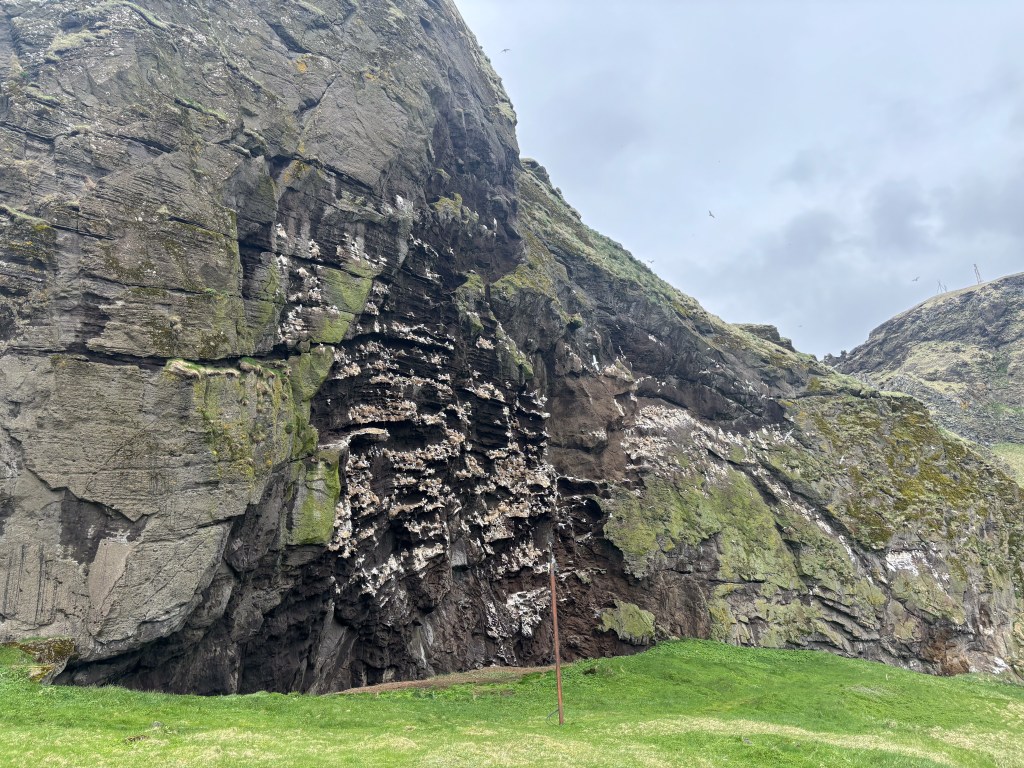

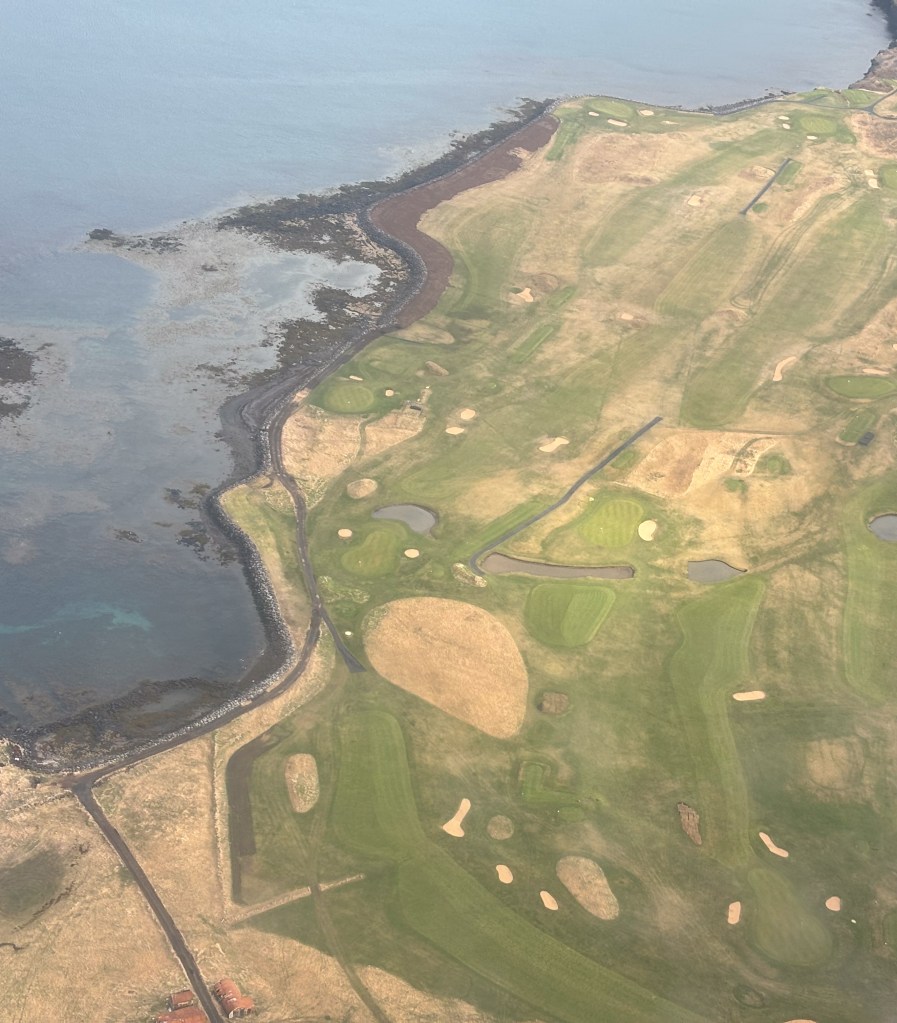
We also learned that the relatively new Eldfell (Eld-fehtl) volcano emerged on this island during a series of volcanic eruptions in 1973, expanding the island’s footprint by one third. Residents were evacuated and a third of the town was destroyed. We saw some of the half-buried homes and walked across some of the lava ash and rock on newly-formed hills and valleys. Fortunately the harbor was undamaged and, in fact, the eruptions narrowed the harbor’s mouth enough to make it a more sheltered anchorage. During our tour, we also came across an amazing golf course—yes golf! We were reminded that one of the first photos we took from the air approaching Keflavik Airport two weeks before was that of a golf course (below left). Gary couldn’t believe it, but during one of our tours we found out that golf is the fastest growing sport in Iceland and there are 67 golf courses! Who knew! There’s a sign on this island proclaiming their golf course to be the “Best Golf Course in Iceland.” The setting was quite beautiful and some of the holes looked quite challenging.

Our last day, on our way back to Reykjavik, we stopped at a place I found out about when we first arrived in Iceland—the Solvangur Icelandic Horse Center. The Icelandic Horse has been a trusted companion for Icelanders throughout history and I was fascinated with them from the moment I started reading about them upon arriving in Iceland. The Vikings brought their small Nordic horses with them in the 900’s. Due to isolation and strict rules, the breed has remained pure and has maintained its unique characteristics. They have become quite popular with equestrians throughout the world (about 2000 are exported each year), AND, once a horse is exported, it cannot return because of the strict rules. Despite its smaller size, the Icelandic horse is well known for being strong and hardy with great stamina and speed. It is surefooted enough to handle the rough Icelandic terrain and is renowned for its five gaits, including the unique “tolt,” a four-beat gait with light flowing movements, which is easy and comfortable to ride. The other gaits are walk, trot, gallop and flying pace.
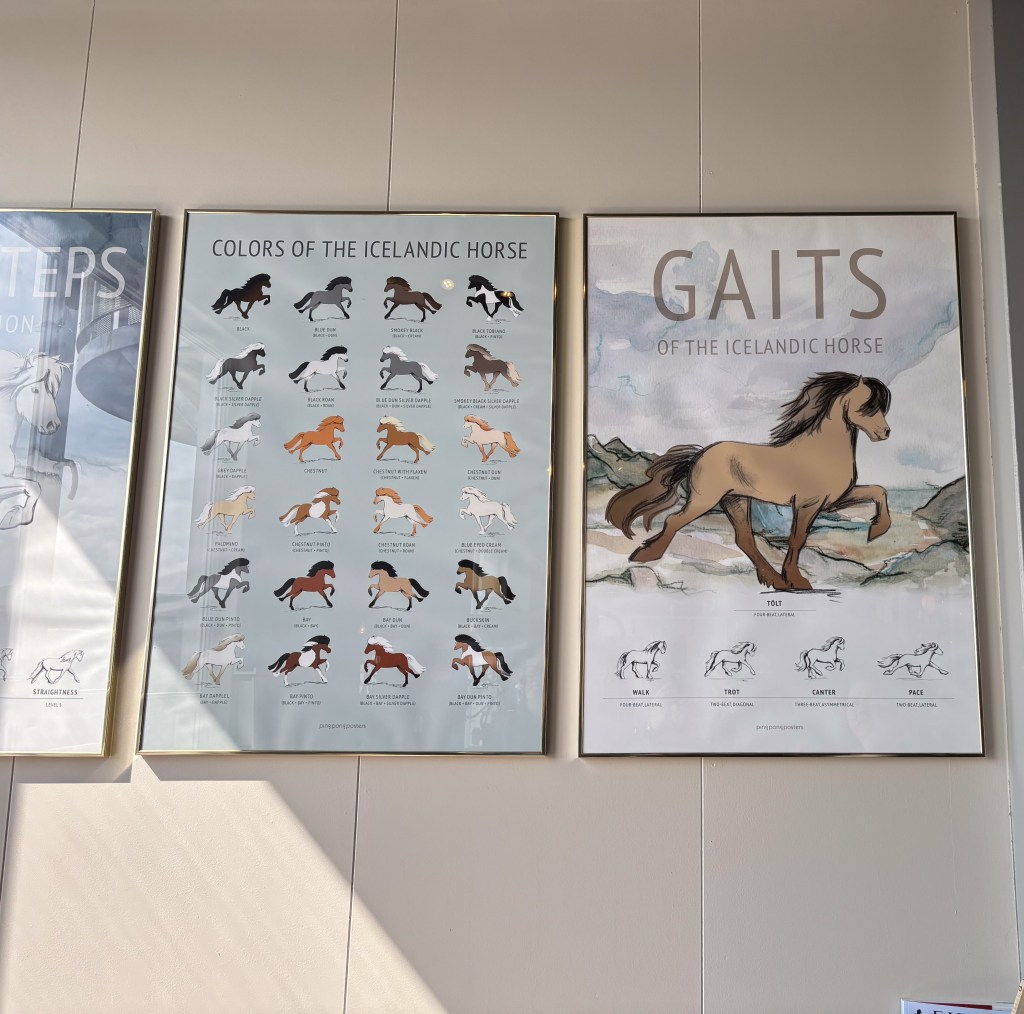
The horses vary in color from black to palomino, to silver dappled and a range of colors in between. They are intelligent, faithful and friendly companions, able to carry riders across grassy plains, up and down rocky slopes and through rivers and over fields of rough lava. We saw herds of them almost everywhere in Iceland (and petted a few!), except the Eastjords. Mostly they were grazing, but they also like to lie down! That was a surprise.


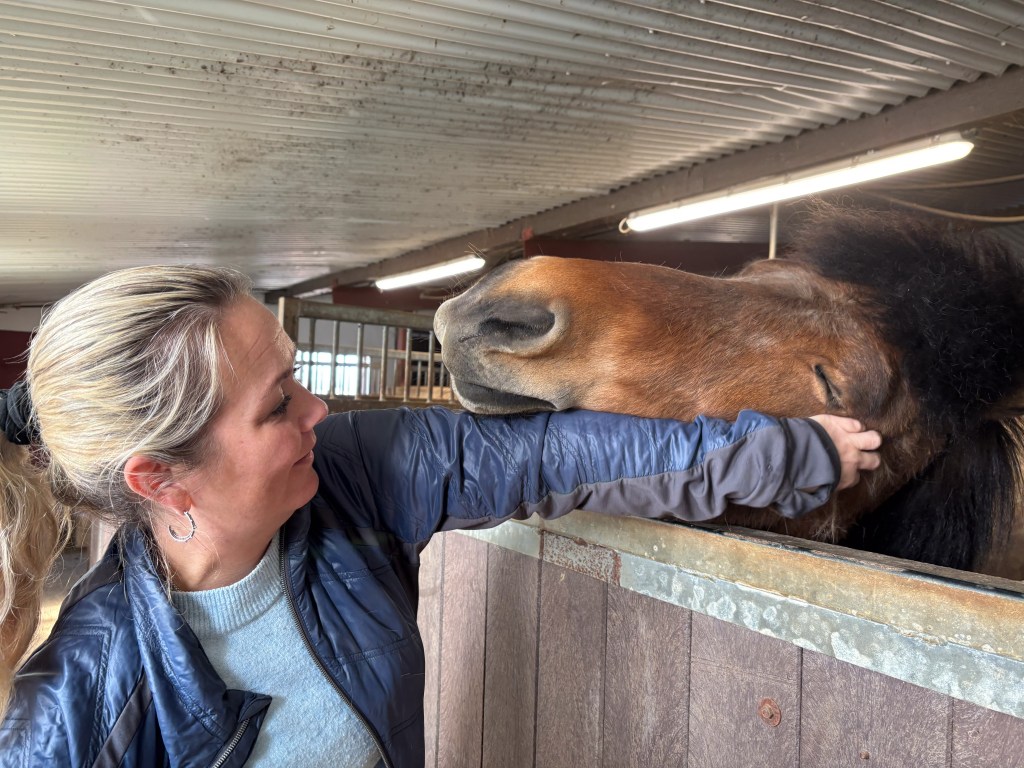
I was so grateful we had arranged for a “stable tour” of this amazing Horse Center. We had such a good time! The Center has about 60 horses, 40 of them out in pasture and the other 20 kept inside in their own pens. The co-owner, who is a former equestrian champion and now breeds and trains horses, teaches riding and judges competitions, introduced us to about 12 horses as if they were her children—each with a different personality. We were especially enchanted with a horse that loved to have his neck scratched. I spent quite a bit of time scratching his neck, but when the owner did the same thing, he was obviously in ecstasy!

The owner’s 14-year-old daughter competes on one of the most magnificent horses we’ve ever seen—a black stallion. Where most of the other horses were released from their pens to go out to the adjacent pasture on their own, mostly without halters, there was quite an uproar (and we were asked to stand back) when it was the stallion’s turn to go out. He did not like the halter and made quite a fuss until they released him to his special corral, where he pranced around, feeling his oats! (It’s spring!) We still enjoy watching the video of this amazing stallion (click on image below). It was very fun to be in this special place with these special horses! What a great way to spend our last full day in Iceland. It was very exciting!
Speaking of exciting, we LOVED every part of our trip, AND, we were very excited to be flying home soon, with a 4-day stop in Boston. We’ll fill you in on the rest of our journey (and do our best to briefly summarize our whole trip) in our next and final blog …hopefully soon!
 Cruising with Gary & Annie
I loved your Iceland adventure, Annie and Gary!
Blessings, Melody LeBaron
>
LikeLike