May 20, 2024
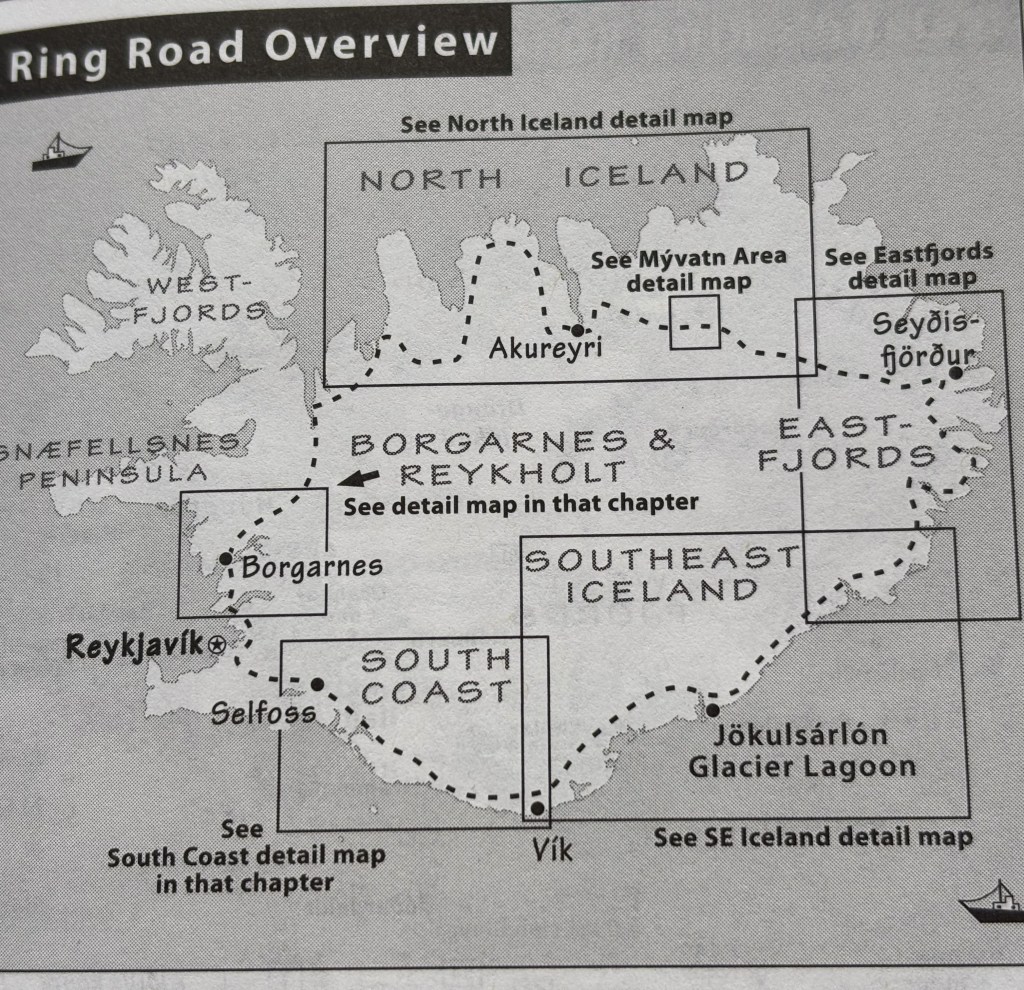
It’s been awhile since I’ve written anything about our continuing adventures. AND, what I’ve realized is that I simply haven’t found the words to even begin to capture all there is to share and describe about Iceland. We’ve been here for almost 2 weeks, having almost completed our drive around the “Ring Road”—all the way around this amazing country –and I haven’t known where or how to begin! Geographically, Iceland is divided into several sections, as shown on the map below (from Rick Steves). Perhaps this will help as we attempt to paint pictures of what we’ve experienced, one geographical area at a time.
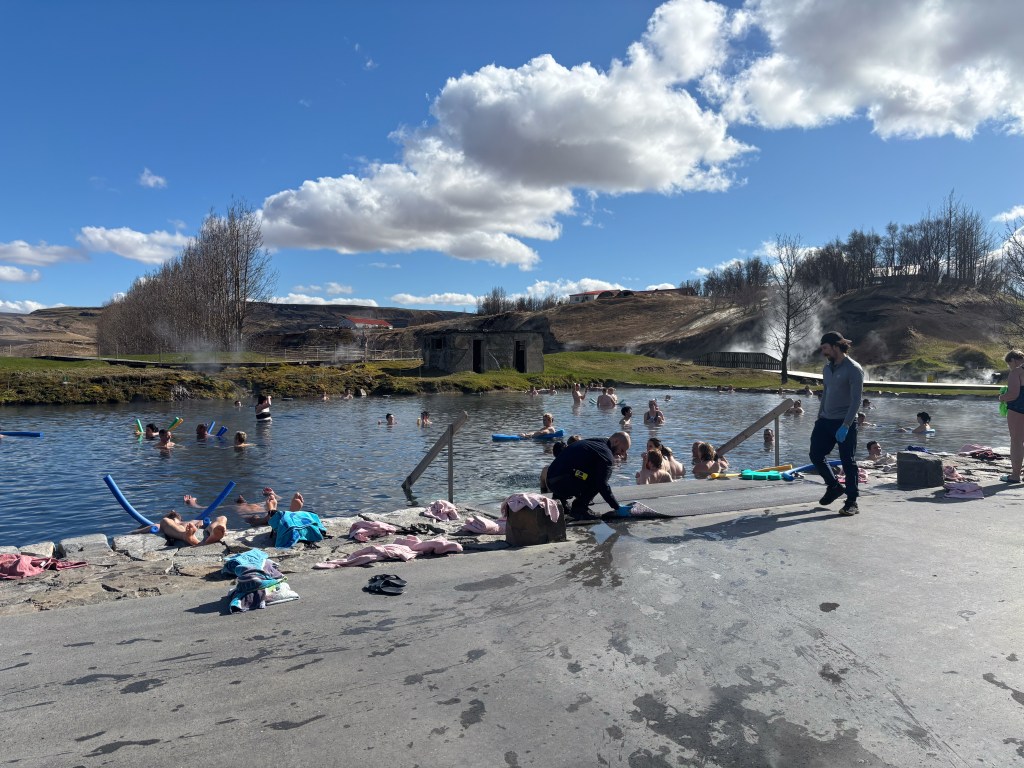
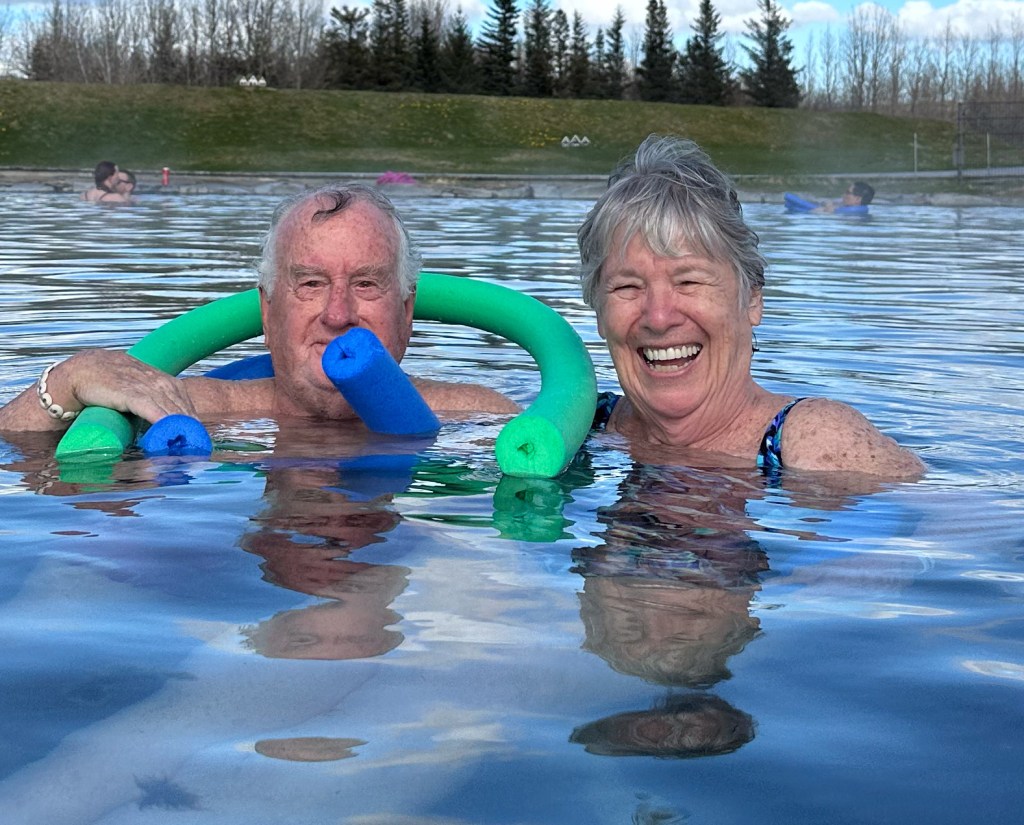
Iceland was first populated in the 9th century by Norse settlers, some of whom took Celtic slaves and wives from Ireland and Scotland along the way. There is evidence to suggest the island’s existence had been known for centuries and Irish monks may have come here to meditate and worship in solitude. Once the Vikings and their pagan ways arrived, the monks left. During the Viking Age, the Icelandic language developed from the Old Norse of Scandinavia. It is one of the hardest languages for outsiders to learn but is still spoken by most Islanders (even though most also speak English very well). Icelanders are quite proud of their Viking heritage and the many customs that come along with it. Iceland is also quite proud to be a “land of renewable energy” because energy generation comes from 100% renewable resources—mostly hydro, but also from wind and geothermal. In fact, geothermal energy provides heating and hot water for the majority of buildings in Iceland, plays an essential role in growing vegetables all year round in geothermal greenhouses and provides enjoyment in the form of geothermal pools all around the country. The Blue Lagoon near the country’s capitol is the most famous pool. We chose our first experience in a smaller, less known “Secret Lagoon” that was quite refreshing, delightful and much less crowded.
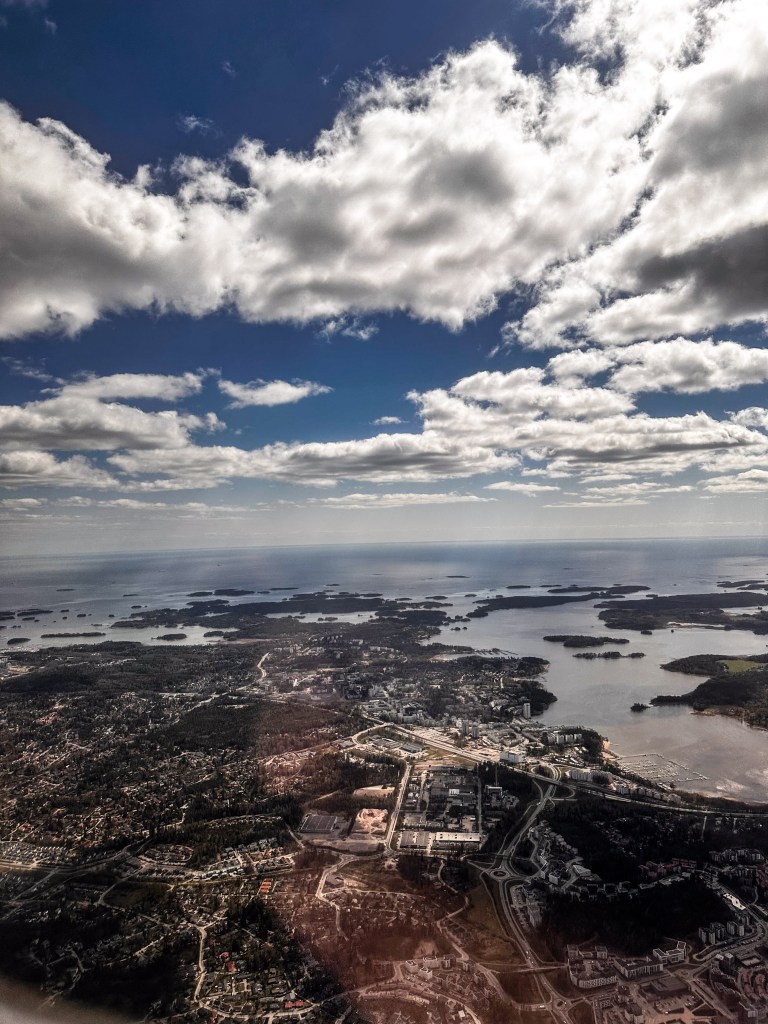
Gary and I flew from Venice, Italy through Helsinki, Finland (above right) to Reykjavik (RAYK-yah-veek), the northernmost and smallest capital in the world, where about 60% of Iceland’s population resides—70,000 in the city itself and another 70,000 in its 6 surrounding suburbs. It sits on the west coast of Ireland about 40 miles north of Grindavik, where the volcano has been erupting in recent months. (It stopped soon after our arrival and started up again the day after we left!)
Some of you might recall that it was in Reykjavik that American chess grand master Bobby Fischer defeated Russian grand master Boris Spassky for the world championship in 1972. In fact, Bobby Fischer is buried just south of Reykjavik. But it wasn’t until after the 2010 eruption of the Eyjafjallajokull volcano (“E-15” for the 15 letters after E, since no one could pronounce this) that Iceland caught the attention of the world and the tourist industry began to boom. You may also recall that the ash from this particular eruption polluted the air all over Europe and disrupted flights there for fear it would damage jet engines.
We rented a car at Keflavik International Airport and it was an easy drive to our elegant “Holt Hotel—The Art Hotel” near the center of Reykjavik. The owner’s father created this hotel to house his extensive art collection, which can be found throughout every room and hallway. There are over 50 original paintings by one of the most famous Icelandic artists, Johannes Kjarval (sample below) and a huge variety of elegant furnishings and other art. We loved it!


The second day we took the very popular 8-hour guided “Golden Circle Tour,” and this was the perfect way to begin to get acquainted with the Iceland we came to love and appreciate, with all its natural contrasts and splendor, fascinating history and stark beauty. Often there would be flat, brown grasses for miles (and sometimes a lake) and then an amazing mountain, volcano or glacier beyond.
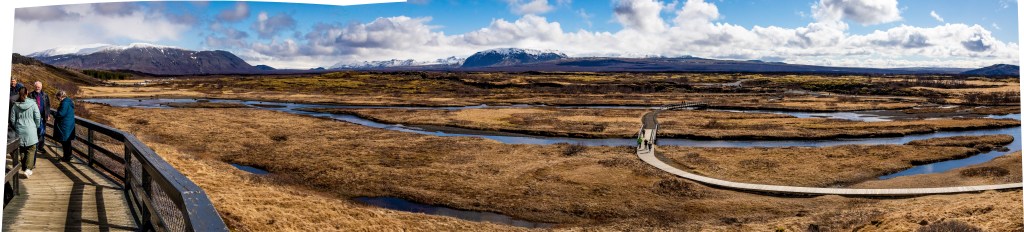

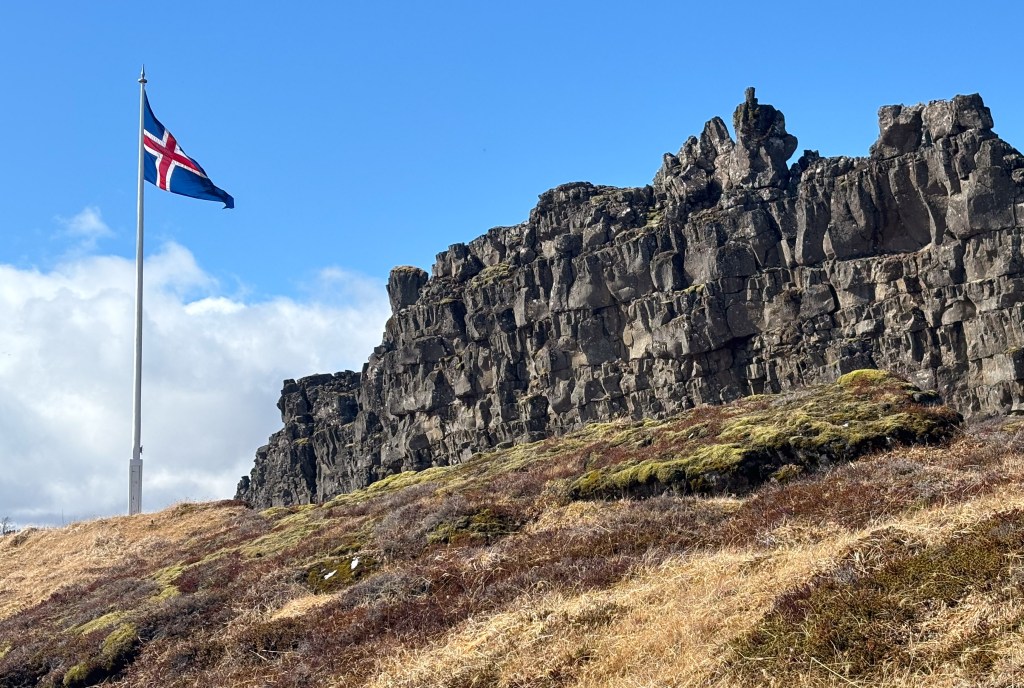
We were especially intrigued with a visit to Thingvellir, a dramatic gorge marking the pulling apart of the Eurasian and North American Techtronic plates. This creates great tension and causes most of the 185+ earthquakes that take place each day (and rarely felt). This is also the site of the country’s annual assemblies in the Middle Ages (and the first Parliament) and where many gatherings and festivals take place today (note the Icelandic flag: red for fire, blue for water, white for ice).

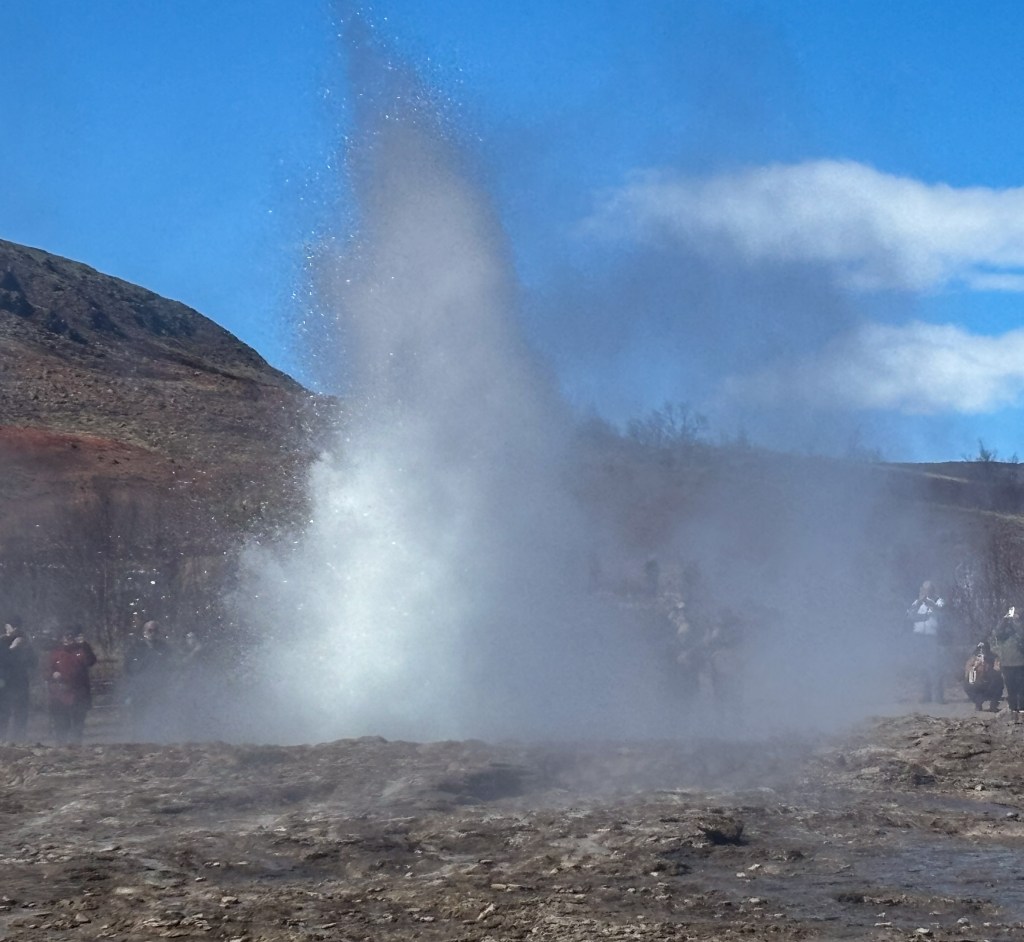
We visited a bubbling geothermal hillside and also got to see where locals use the geothermal heat to bake bread! They bury it in the hot soil, forming a cone (above, right), and in 24 hours, it’s done! On this tour, we also saw Strokkur, Iceland’s most active geyser (shoots steam 260’) as well as the amazing Gullfoss, one of Iceland’s many impressive waterfalls (105’). One of my favorite parts was stopping to meet and pet a few Icelandic horses that I’ve heard and read so much about recently (more about these later). It was also on this day trip that we enjoyed a favorite Icelandic ritual of the thermal bath at the Secret Lagoon (first photos above).

For the next three days Gary the Photographer went on a Photo Tour of Iceland’s South Coast. He thought he was going to be in a group, but it turned out he was the only one and he was thrilled to have a private tour! His guide was a very talented photographer named Kevin who took him to glaciers, lagoons, and the amazing black Diamond Beach, where icebergs end up tossed there by the waves when the tide comes in. He also photographed waterfalls and volcanic fields covered with lava and often with moss. We’ll share lots more about this when we both visit the amazing Southeast Coast on the Ring Road (Part III).
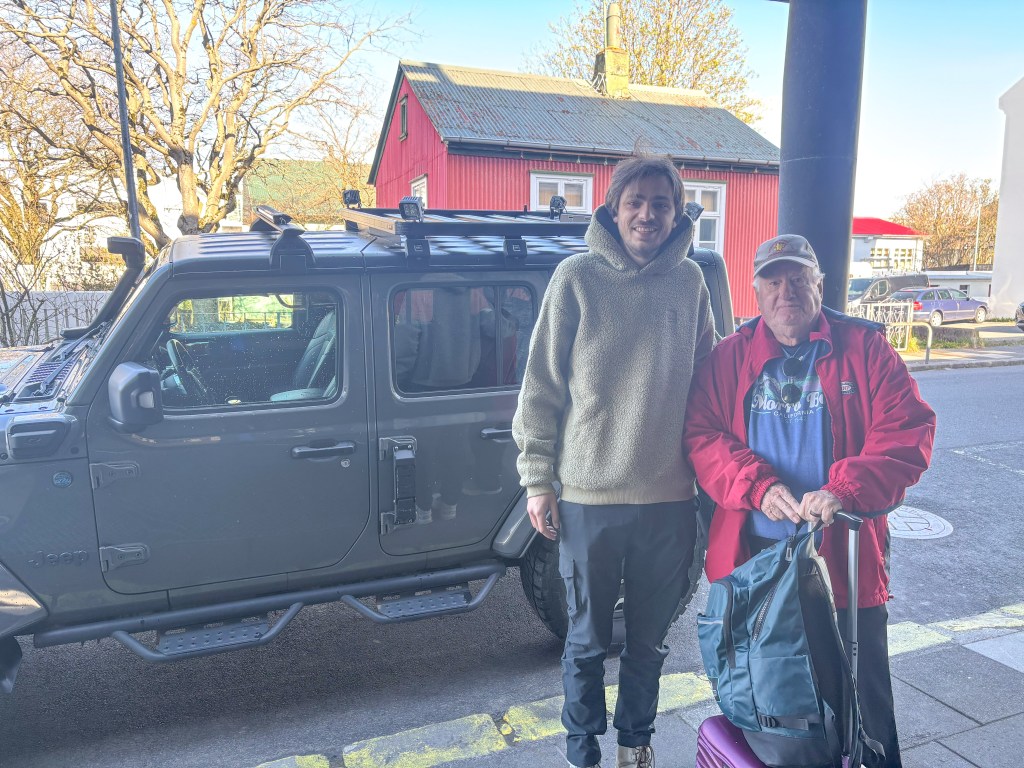


While Gary was gone, I took quite a bit of time to simply “be” after so many weeks of traveling at a fairly steady pace. It was supposed to rain the last two days so the first day I took a taxi to the Reykjavik Park & Zoo. I wanted to see an arctic fox and reindeer! I just Googled this to make sure I had the name of the zoo right and discovered a pretty perfect description: it was “quite underwhelming”—very small with just a few animals compared to most zoos I’ve been to. However, it was very fun to walk around and see 3 reindeer, several herds of goats, some more Icelandic horses, cows, pigs, rabbits, a falcon, some frogs and a very cool iguana. I think I was the only one there who didn’t have a stroller, but it was fun to watch and hear the children’s joy and awe at animals they were seeing for the first time. (Unfortunately I didn’t get to see the arctic fox who was holed up in his den, but I heard there’s one at the Santa Barbara Zoo—about 2 hours south of where we live—so maybe I’ll get to see that one day.) I love animals and it was a fun way to get some walking in. Another day, I walked to a nearby restaurant to have some Icelandic lamb soup. This has turned out to be one of our favorite meals all the way around the country. Another discovery was a delicious breakfast treat called Skyr (“skeer”), like a very thick and creamy yogurt—plain, vanilla, strawberry & blueberry. Yum!!

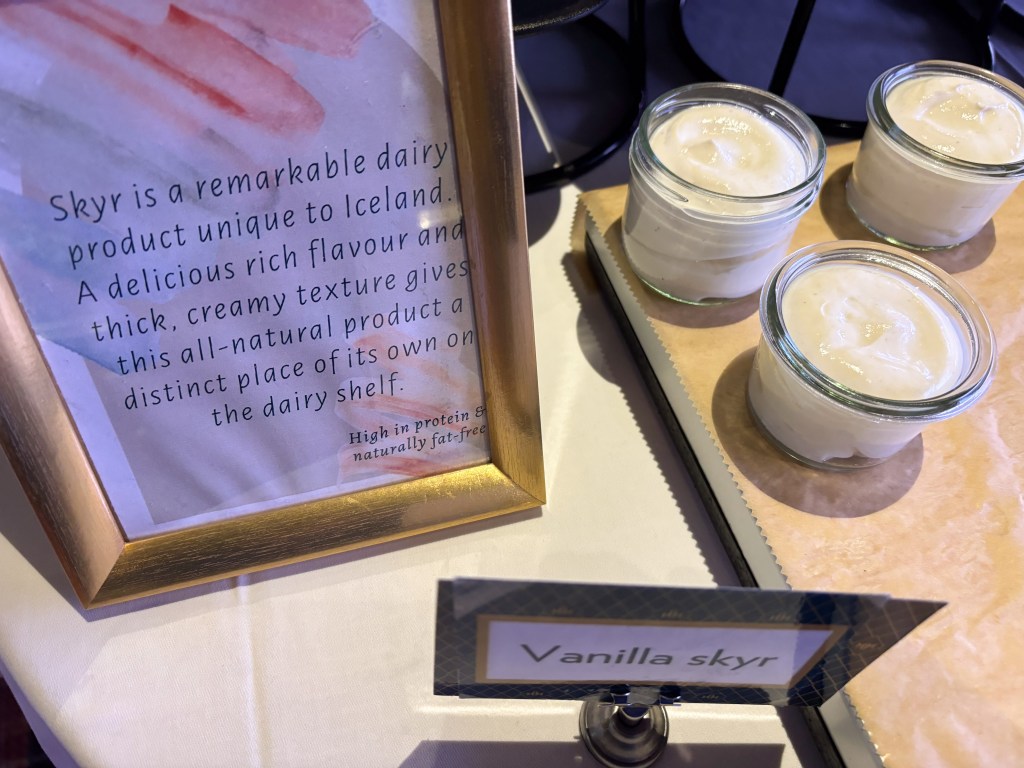
One of the most fun parts of these three days was Gary’s return from his private photo tour. He was the “happiest tired” I’ve ever seen. So full of awe and wonder, photographing many things he’d never seen before for 3 full days (without his usual naps or stretch-outs) with an amazing young guide. He was both exhausted and exhilarated, with child-like glee, and we look forward to sharing a gallery of his/our photos from this amazing experience in our next blogs. (We’ve decided to organize these Iceland blogs geographically, starting in Reykjavik and traveling all the way around the island clockwise, so these amazing photos will appear after we’ve traveled on the Ring Road through the North and East because they were mostly taken on the Southeast Coast, which is on our way back around to Reykjavik. Hope this makes sense!)
Our final full day in Reykjavik had always been planned as a well-deserved day of rest. However, not too far from our hotel was the iconic Hallgrimskirkja Lutheran Church (HAHTL-greems-KEER-kyah)—a remarkable 250’ high concrete structure completed in the 1980’s and named for a 17th century Icelandic poet Hallgrimur Petursson who wrote a series of 50 hymns called The Passion Stories.

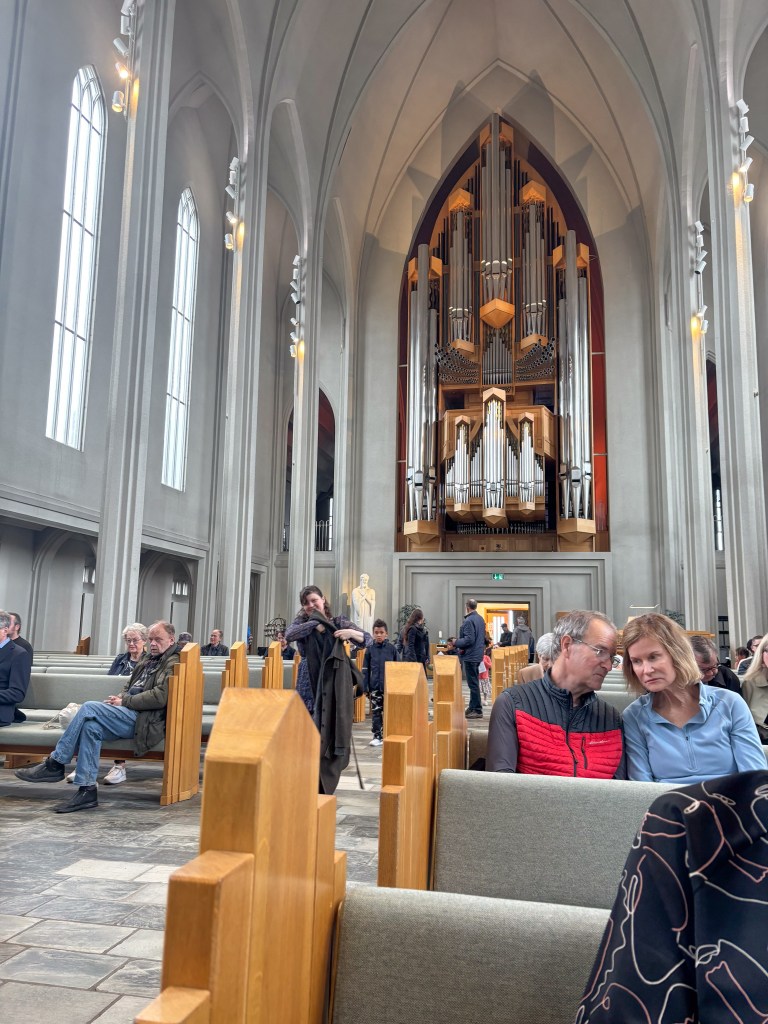
The outside of this cement building is a basalt-column motif soaring skyward recalling Iceland’s volcanic origins. We had heard about its massive concert organ with its 4 keyboards and 5275 pipes. I’d hoped we could hear an organ concert but none were scheduled until summer. So I got the idea we could go to a church service on Sunday morning to hear this amazing instrument. AND, it turned out it was their monthly “family service” where everything was geared toward the children. There were blankets and stuffed animals laid out on the floor at the front of the church, trays of dirt to play in with plastic toys. There was a choir of tweens leading all the singing. The minister spoke to the children in between songs and encouraged them to sing and play. At one point, each child was given a large scarf and encouraged to toss it up in the air. Such joy!
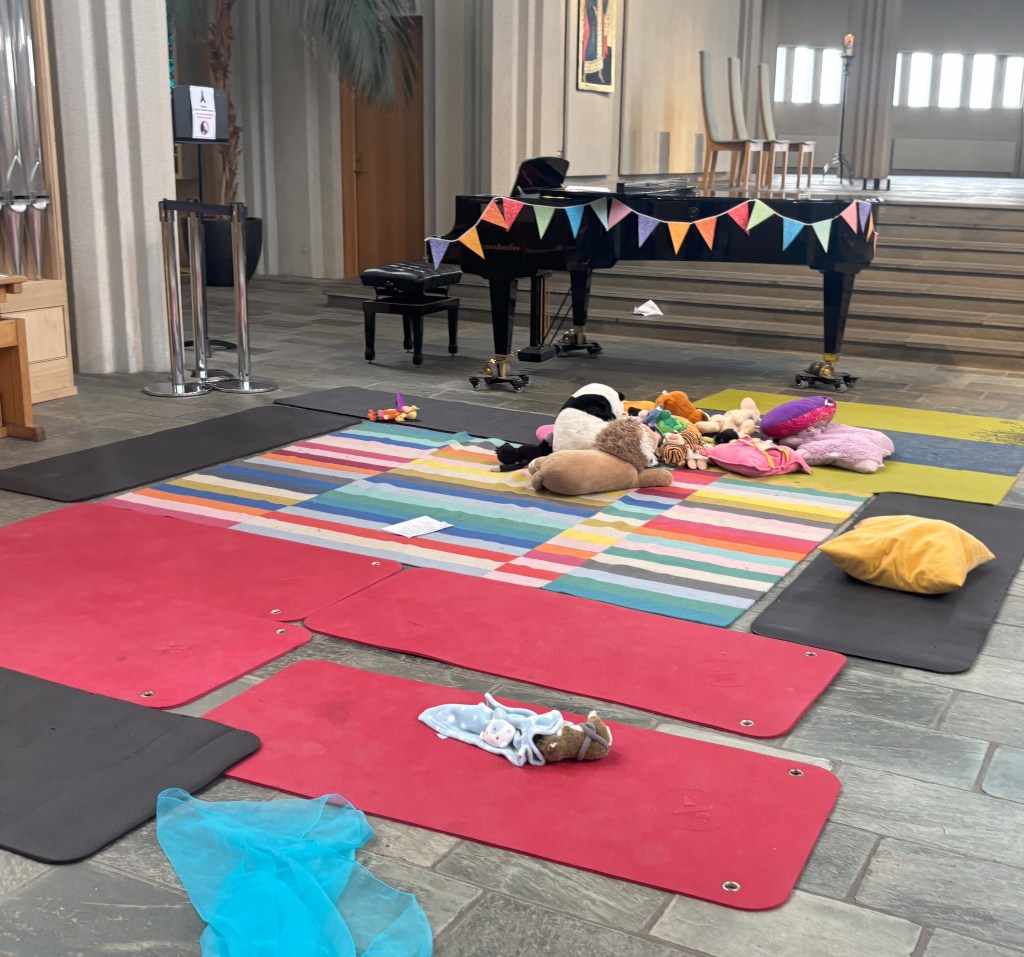

The church itself was surprisingly austere—all cement, no art to speak of (except two small posters of angels or saints beyond the pulpit)—and the whole service was in Icelandic. We couldn’t understand a single word that was said, but we really didn’t have to. The whole experience was one of pure love and pure joy…it was so easy to feel the presence of the Divine. A smaller organ near the front was used to accompany all the singing, so it was only at the beginning and at the end of the service that we heard the large organ. However, after the service several tweens took their turn at the keyboard, each playing a song on the big concert organ, which is at the rear of the church. Because the organ is so important, all the seats in the church are designed so that the back flips over and congregants can face the organ. It was all pretty amazing and VERY uplifting. Thinking about this Sunday service experience still warms our hearts and souls.
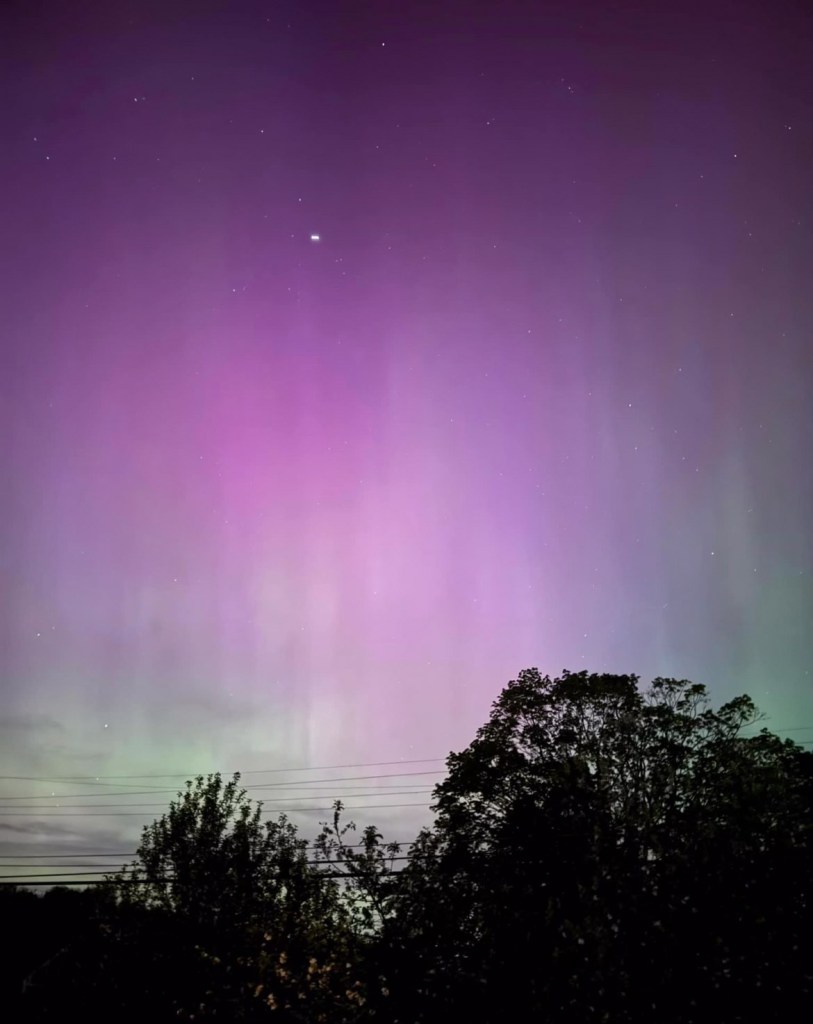
Gary got a good nap in all afternoon, recovering nicely from his 3-day photo tour, so we then went one more place that turned out to be a “must.” Many of you know that Iceland is most famous for its prolific show of the Northern Lights (Aurora Borealis) usually from October to April. (In spring and summer months the sun sets after 10pm and rises before 4am, so there aren’t any dark skies.) Younger daughter Laurie Alice (which, in our family, we’ve always rhymed with Aurora Borealis!) has always wanted to see the Northern Lights—definitely at the top of her bucket list. She was so hopeful we might get to see them and take some photographs to send her. AND, early Saturday morning, May 11, there just happened to be a huge solar storm (first in 20+ years) that allowed people in many parts of the world (even California) to see the Northern Lights where they are rarely viewed. Laurie and family knew this was a possibility, AND, here are some photos she and her daughter Emmy took that night from their driveway in Tolland, Connecticut (about an hour west of Boston, 15 min. north of U.Conn)! They even captured the International Space Station flying over (below, right). What an experience they had!


Since we couldn’t see the Northern Lights in person, we went to a show about them at Reykjavik’s Aurora Northern Lights Center, where we not only saw spectacular videos and photographs of this phenomenon but also learned about some of the legends and superstitions that attempted to explain these once-mysterious dancing lights. We also learned more about what causes them. I like the explanation on Google: They are created when energized particles from the sun slam into and interact with the gases in the Earth’s upper atmosphere—the ionosphere—(at speeds of up to 45 million mph!). Our planet’s magnetic field protects us from this violent onslaught, redirecting the particles toward the poles (there are Southern Lights too). That’s what creates these amazing visual displays of colorful light waves. The recent displays beyond the far North were caused by an unusually powerful solar storm.

On our way to this show, we drove along the sea wall of the North Atlantic Ocean to see the iconic metal sculpture of a Viking ship called “Sun Voyager.” Beautiful! Everything we did this day was a perfect ending to our 6-night stay in Reykjavik. And now we’re ready to start our 800-mile journey around Iceland’s Ring Road. Here we go!
 Cruising with Gary & Annie
Beautiful! Gary’s photo tour sounded spectacular. Love, Elizabeth
LikeLike