As we continue cruising on the rivers—first the Rhine, then the Main, through the Main-Danube Canal and now down the mighty Danube—it’s hard to remember the details of all that we’ve seen and experienced since our last blog. Thank goodness we have the Viking printed itineraries and Daily News to remind us what is scheduled and what we have done. I’ve also learned to jot down information in the “Notes” on my iPhone to capture more as we go along, but it’s taking time to get it all organized in my mind to share with you.
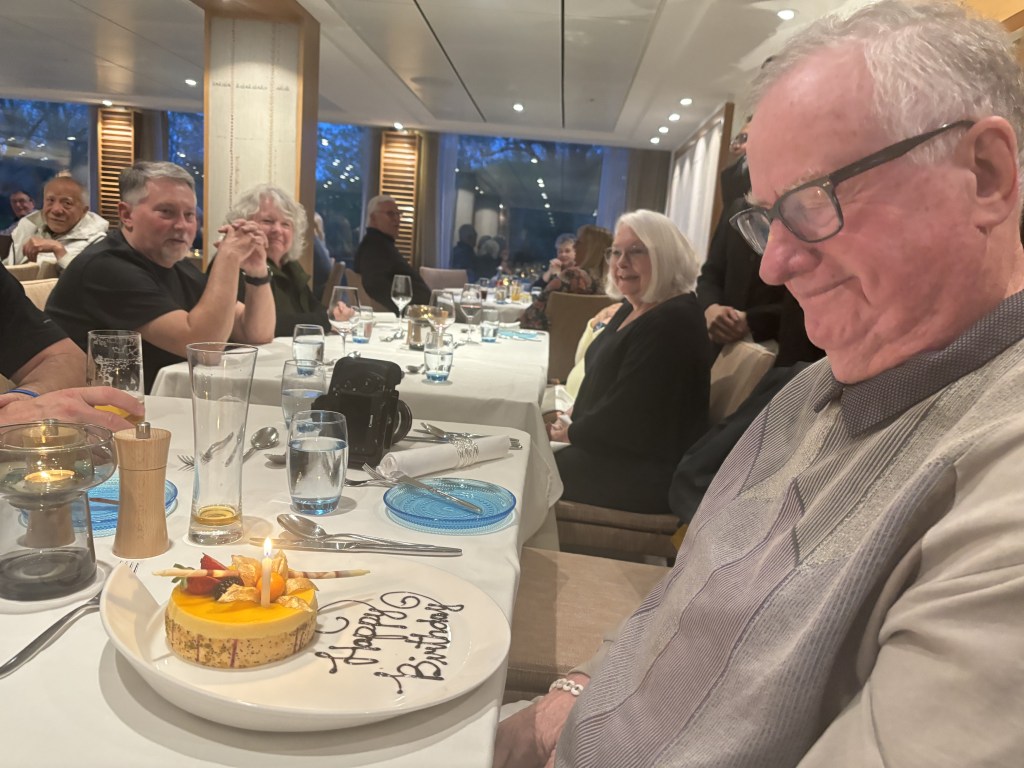
After leaving Miltenburg, we spent a glorious day. First of all, it was Gary’s 81st birthday (April 2) and we had lots to celebrate. All 190 passengers plus all the wonderful servers sang to him at dinner and our table shared a delicious mango custard birthday cake.
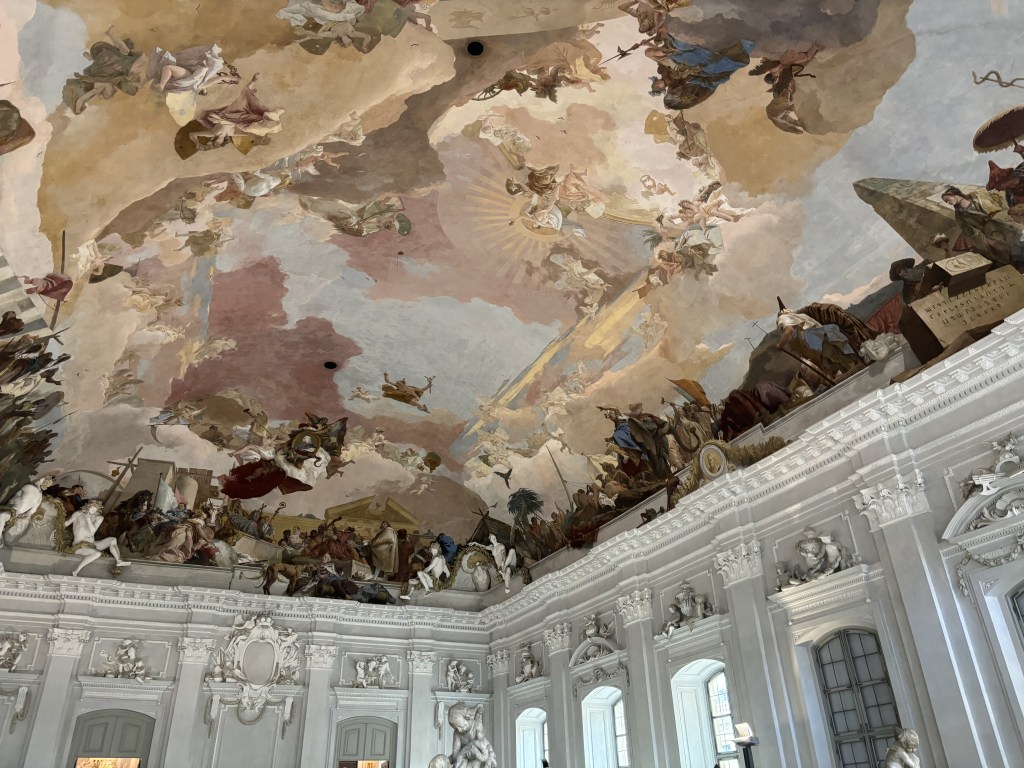
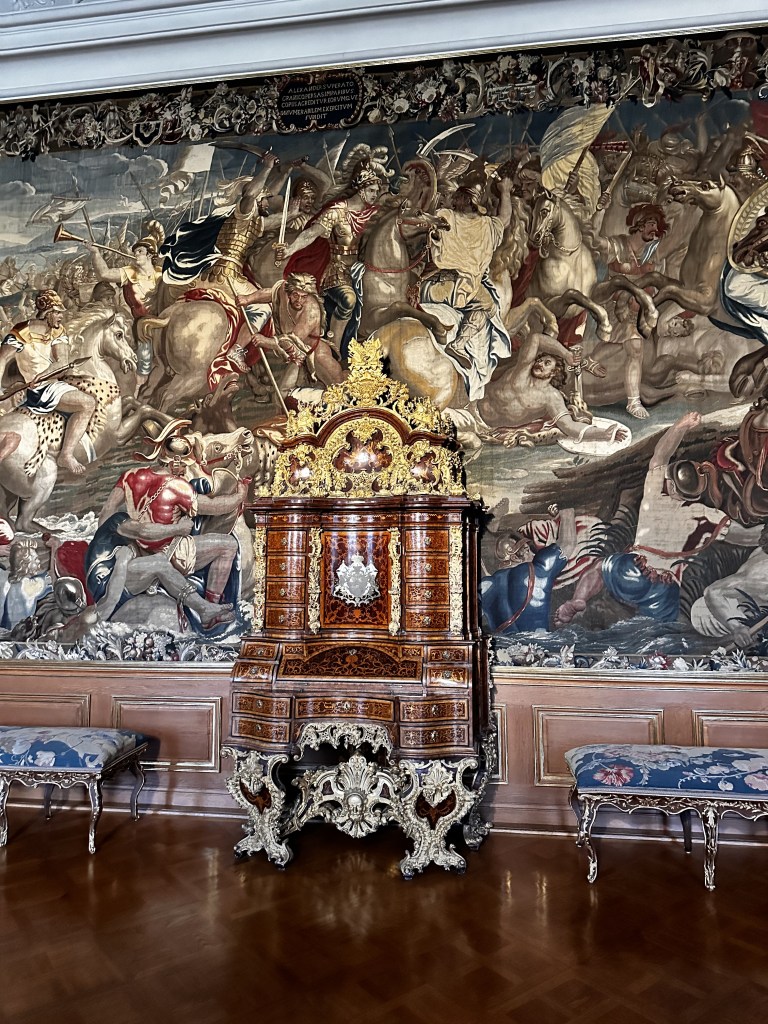
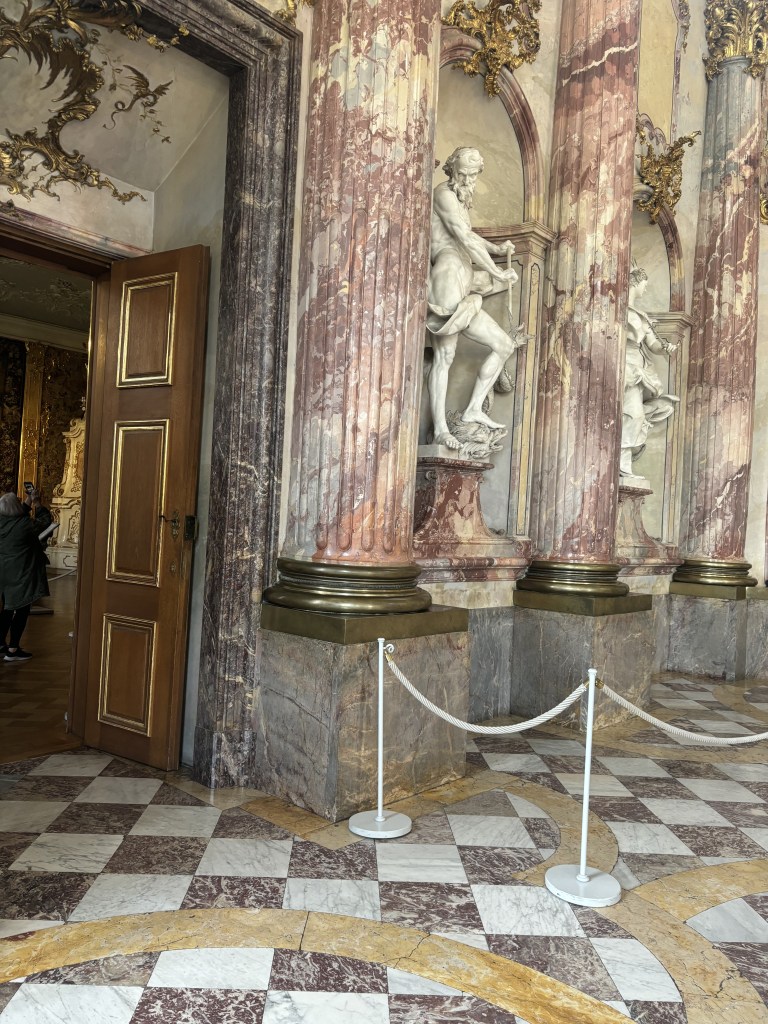
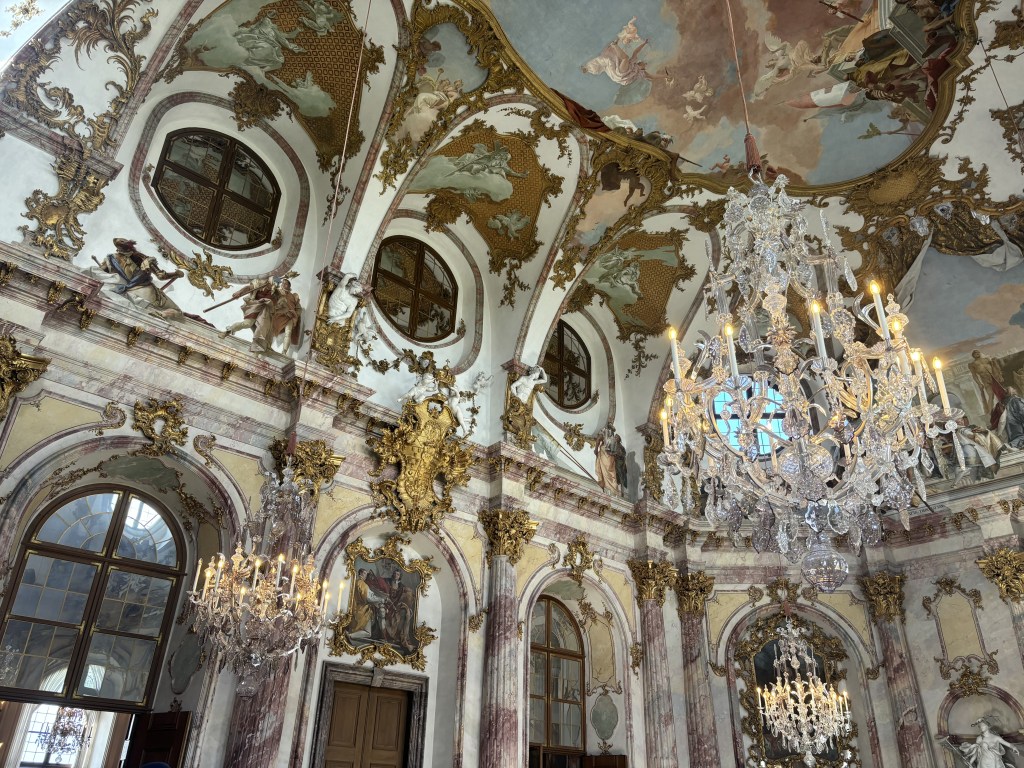
We spent Day 6 in Wurzburg, a town neither of us had ever heard of. The primary focus of this guided walking tour was going through parts of the 360-room “Residenz” of the Wurzburg prince-bishop, one of the most important baroque palaces in Europe. It took 60 years to complete (from 1720-1780) using the same architect who built Versailles (Louis Le Vau) and many superior craftsmen (many from Italy). The palace was badly damaged in WWII bombings, but its meticulous restoration was completed in 1987, once again using superior craftsmen. We’ve never seen such lavish and ornate décor, with its rich (over-the-top!) array of furniture, tapestries, paintings and other 18th century treasures. The overhead ceiling frescoes were stunning, including the 6400 square foot “Four Continents” fresco by Venetian artist Giovanni Tiepolo (below)—the four continents at the time being Africa, America, Europe and Asia. The details and symbolism in this amazing painting were quite remarkable.
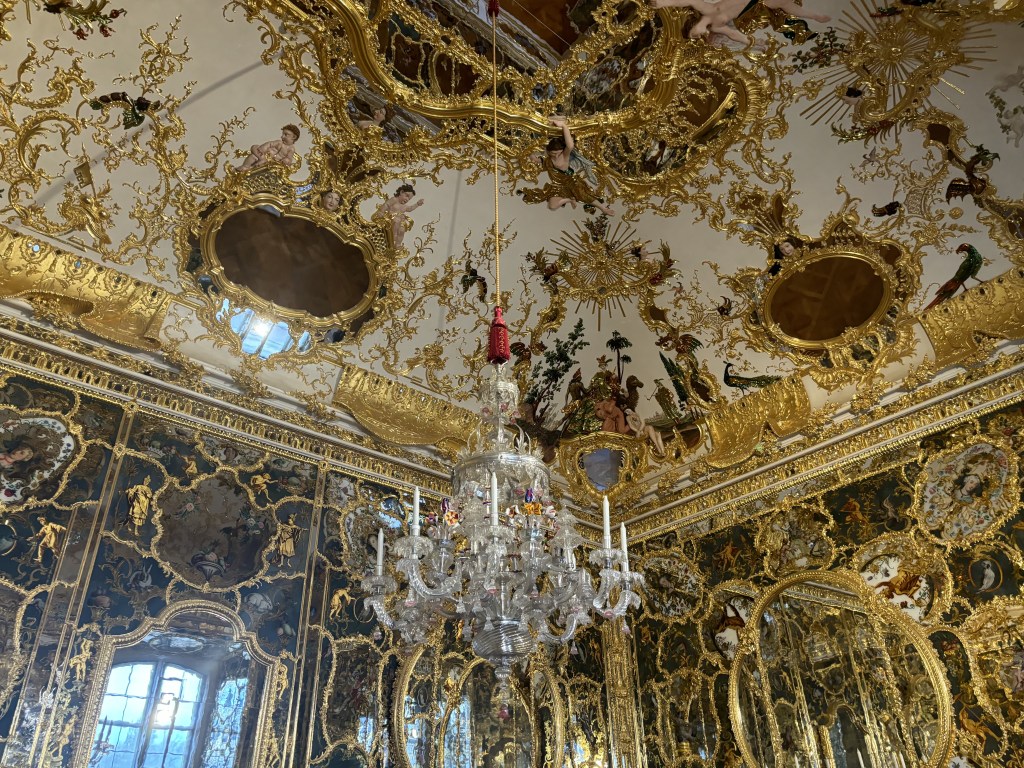
The gold ornamentation, rococo-like wall décor and crystal chandeliers were everywhere as were huge pillars painted to match the real marble flooring. We only saw about 15 rooms and each one seemed more lavish than the next. Frankly, it was a bit overwhelming, but certainly worth the visit. We also have come to realize that the restoration of palaces was partially the result of the reformation—the Catholic church (and the Hapsburgs) wanting to show off its creations of paradise and tributes to the Most High and not lose its members to other religions emerging.
As part of our self-care, Day 7 became a day of rest for both of us. We missed a walking tour of Bamberg, known for its “smoky beer” (rauchbeir). It is one of the few cities not destroyed during WWII, so we missed many medieval structures remarkably preserved.
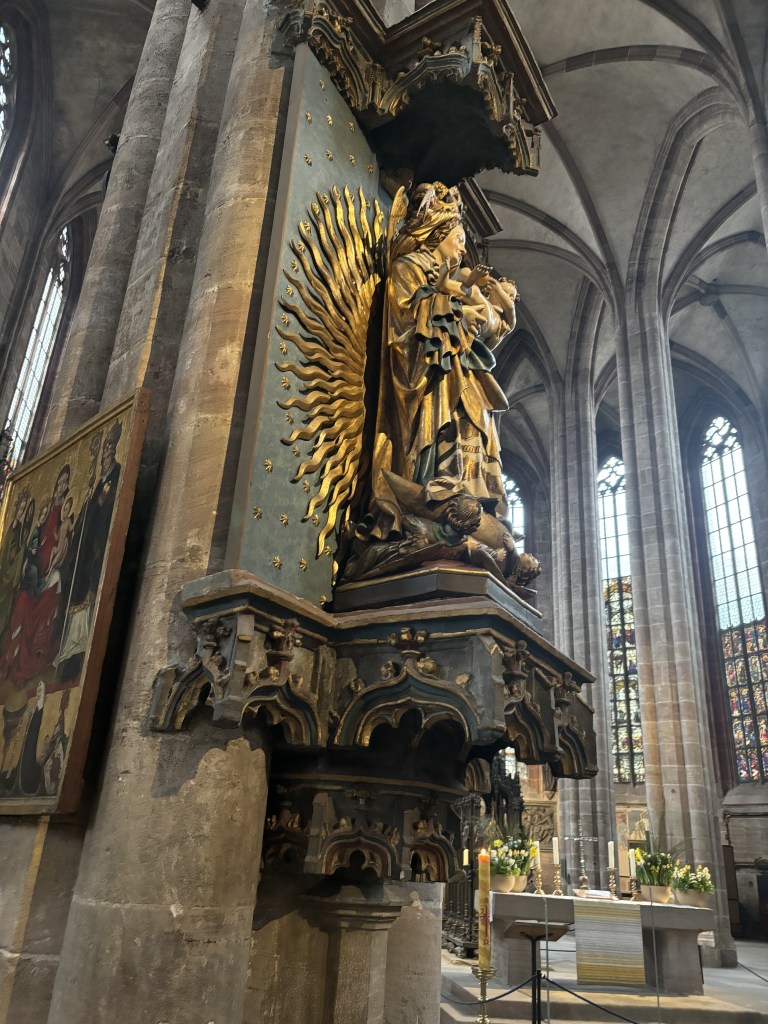
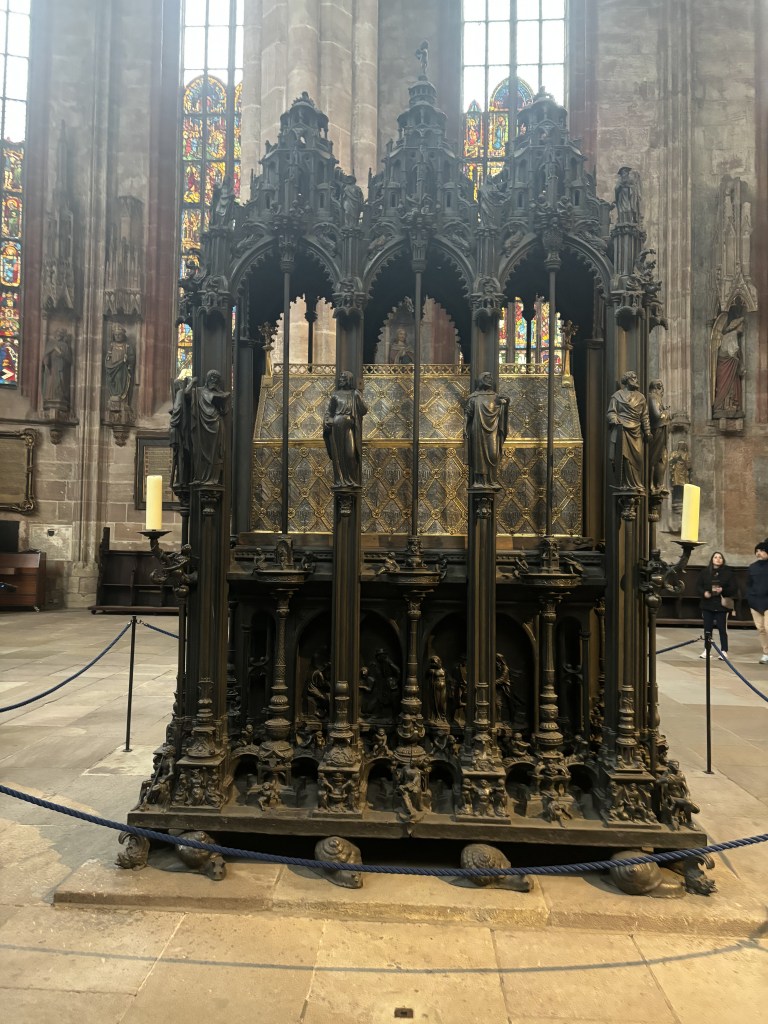
After a leisurely morning, the highlight of Day 8 was a fascinating walking tour called, “Surviving the War—Art in Nuremberg.” We thought it was about paintings, but it was far more than that. We actually went underground to one of the many heavily-insulated bunkers (ceiling, below, middle) that had been converted from a medieval beer cellar. This is where many treasures from centuries-old churches were hidden, together with the Holy Roman Emperor’s Crown Jewels (which are now in Vienna–long story). We also saw a video showing how many of the church statues & tombs too large to move were encased in wood then surrounded by sand to protect them from damage.
We then visited the Gothic church of St. Sebald (below left) where saved works of art have been returned to their original home and where larger wood-encased statues survived roof collapses and bombings. It was also fascinating to learn about all the tunnels, secret passages and subterranean shelters that helped many survive the WWII bombings. Nuremberg is the 2nd largest city in Bavaria, filled with half-timbered houses and Gothic churches with intricate spires. It is most famous as the site of the Nazi war crimes trials. Most of it was destroyed by Allied bombers in WWII, but later painstakingly reconstructed using the original stone.


SIDE NOTE: We’ve discovered why some German cities end with “-burg” and others end with “-berg.” Burg means castle so any city ending in -burg has a castle; -berg means on a hill (no castle) so that’s why the spelling is different.
We chose to rest again on Day 9 (in Regensburg). We missed “the oldest city on the Danube,” but I injured my knee late last fall and it’s not yet completely healed, so pacing is an even more important part of self-care. It’s been frustrating at times to be one of the slower walkers (since I’m usually at the head of the pack), but I’ve done a pretty good job of adjusting (most of the time!). Besides, I wanted to make sure I was ready for our special shore excursion on Day 10, a trip to Salzburg, Austria, the City of Mozart and “The Sound of Music.”
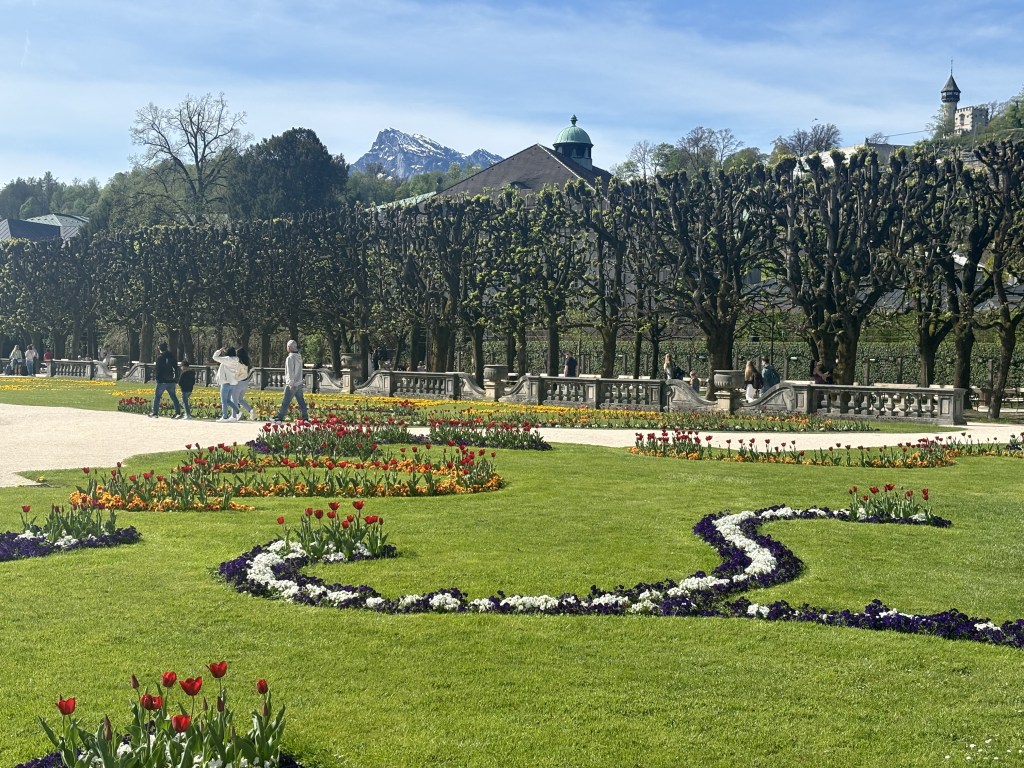
Our 2-hour bus ride from Passau to Salzburg was well worth it, especially when, beyond the rolling and beautiful countryside and charming villages, we first saw the snow-covered Alps up ahead of us. What a glorious site! (These were the mountains the Von Trapp family fled to from the city, and we saw several places here where filming took place, as well as the cemetery that inspired the movie scenes that took place in a cemetery.) What fun! For the third time (first in Edinburgh, then in Cologne), we came across hundreds of padlocks fastened to fences, often on bridges (also below). Lovers write their names on a padlock, lock it on a public fixture and throw away the key. During our free time, we toured part of this sweet town in a horse & carriage—something we always enjoy. What made it even more delightful was having lunch at Austria’s oldest restaurant while four very talented, classically-trained musicians sang many songs from The Sound of Music. It was wonderful as we all sang along!



One more photo from Salzburg. In the middle of a large square, there is a beautiful statue of the Virgin Mary. If you stand back far enough (as photographer Gary did), you can make it look as if the angels holding a gold crown (on a wall over 50′ behind the statue!), are placing that crown upon the head of the Virgin Mary! Pretty awesome, huh?!? (The advantage of having a good tour guide!)
On Day 11 we felt good enough to take a guided tour of the charming city of Melk (midway between Strasburg & Vienna) that lies at the confluence of the Danube and Melk Rivers. It’s at the base of the Wachau Valley (famous for its wines, and beautiful to cruise through). We spent most of our time at the 900-year old Benedictine Melk Abbey, another stunning example of baroque architecture, with its 365 windows, expansive balconies and extensive library still used by scholars from all over the world for its rare manuscripts, diaries and more than 125,000 volumes. We also learned about the extensive Rules of St. Benedict including the Four Cardinal Virtues (Wisdom, Justice, Fortitude & Temperance), and The Basic Rule: Pray, Work & Read. It was here that we saw the most extraordinary example of visual illusion art called “trompe l’oeil,” (pronounced “tromp loy”). The fresco on the ceiling (below) was painted to look very high, but it was actually flat! The French term literally means, “deceives the eye,” which is a perfect description. We were definitely deceived, in a most wondrous way!


Having completed our 100-mile journey through the Rhine and the Main-Danube Canal, we are now on the beautiful Danube River, “the river of superlatives,” because of its power and beauty—in its earliest times a symbol of genius and the vital, creative force of progress. It is also known to be more treacherous, with fast currents. There is less barge traffic and it is harder to navigate, but quite delightful for passengers to enjoy, and we’ve seen many other Viking long ships specifically designed to cruise all of these waters. The Canal itself was originally conceived by Charlemagne in 793AD, but many attempts over many centuries were made and failed. The construction of this Canal took place from 1960-1992. Its importance to river traffic is enormous because it permits traffic to flow between the North Sea and the Black Sea, allowing both people and freight to move across the continent by water, traversing 11 countries, 2 time zones, past ancient capitals, modern dams & locks and broad agricultural valleys.
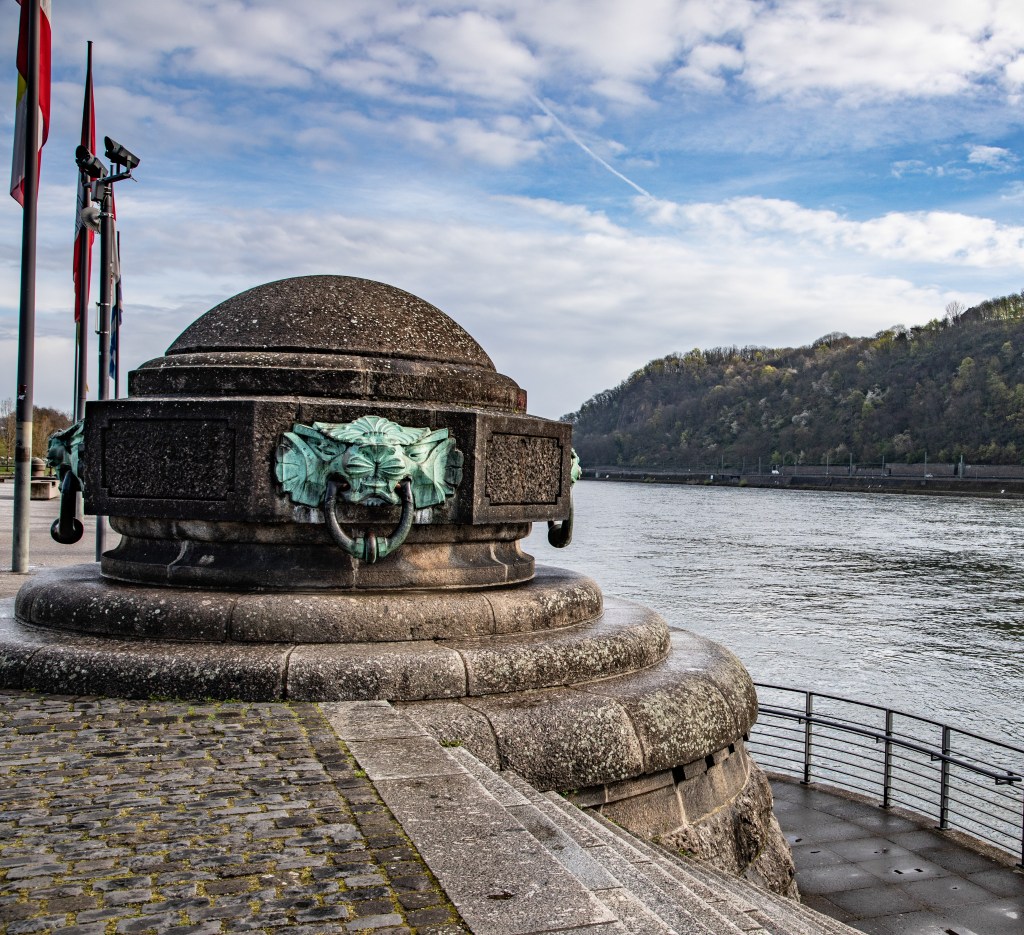

Since leaving Amsterdam, we have gone through 67 locks—some quite small (with only inches to spare between our ship and the concrete walls) and others large enough to fit 4 Viking ships (463’ long and 36’ wide). In some, we only went up or down a few feet, in others, up to 90’. We LOVED going through the locks—it brings back lots of memories of our earlier America’s Great Loop Adventure where we went through 153 locks (mostly quite small)—50 in the eastern United States and 103 in Canada. Seeing the variety of “bollards” (used to tie up a boat) brought back even more memories. The photo above, right, includes part of our Viking Vali long boat.
We’re about two-thirds of the way through our Viking River Cruise, with final stops to come in Vienna (2 nights) and Budapest, so we’ll close for now.
Thank you again for cruising along with us. This has been quite the journey, through beautiful country sides, amazing cities and where a lot of history has taken place. Stay tuned for our final report on this phenomenal River Cruise…and beyond!
 Cruising with Gary & Annie
Sounds like you are having a wonderful trip!!! We are enjoying your journey through your posts.
<
div>
<
div>
<
div dir=”ltr”>
<
blockquote type=”cite”>
LikeLike
Hello you two sweet people! Greetings from Iceland….a MUST to put on your bucket list….can’t find the words to describe nor take pictures to truly capture the startling and gorgeous contrasts…fire and ice, vast flatlands–almost always with some sort of mountain or glacier or both in the distance. Amazing place and a real photo challenge.
Hope you guys are doing well and treatments are effective. We’ll give you a call soon after we get back (May 26). We’ve just started the Ring Road all the way around Iceland – 800 miles in about 8 days. Great fun. Sending gobs of love and many hugs! xoxoxo A
LikeLike