16 July 2023, Nairn
As we left the Inner Hebrides Islands and started north toward the top of Scotland, we first headed for the town of Ullapool, once again taking roads less travelled…often single-track. This meant that sometimes the GPS on our iPhones got a little confused (and sometimes so did the navigator—that would be me), but a “wrong turn” early on brought us to the marvelous Duncraig Castle and its sweeping lawns on 500 acres by the water. We got to meet its owner who turned it into his family’s personal home a year ago. Quite the lifestyle!


We drove through many forests and enjoyed beautiful ferns and waterfalls beside the road…and then a lake would appear…then more ferns and waterfalls. Yum!


We were delighted when we landed at the very elegant Harbour House B&B on the outskirts of the small village and port of Ullapool. It is only 45 miles west of Inverness (where we planned to stay after visiting the Orkneys—Scotland is quite skinny here), but it also broke up the long drive we were taking to reach Scotland’s northeast coast. We loved looking around in this sweet town and especially enjoyed the views from this lovely location.


The next day was our longest travel day of the whole trip—almost 200 miles —but, as usual, we broke it up with stops along the way, through forests and fields, more forests, more fields. Our first stop was a walk down to the Falls of Shin where salmon make their way up over these huge boulders to spawn (sometimes as high as 11 feet!). They find their way back here (where they were born) with their sense of smell! We didn’t see any salmon, but we loved the sound of the falls and enjoyed the thistles along the walkway—the official flower of Scotland.


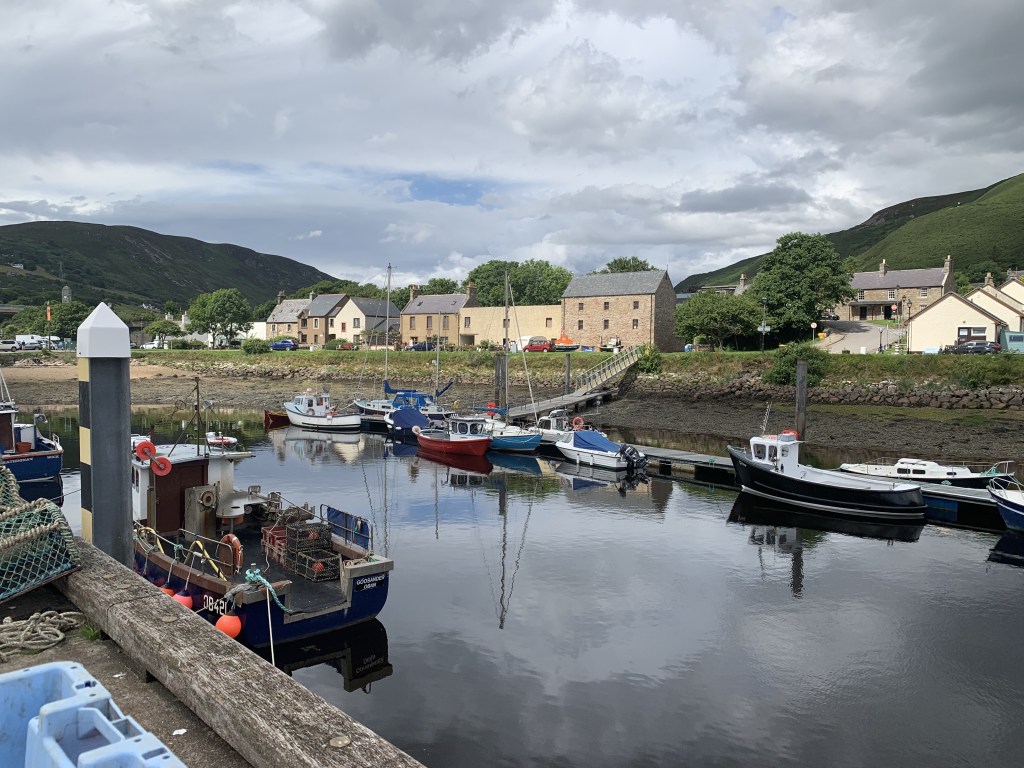
We then made a few stops along the northeast coast of Scotland, especially if there was a harbor (we do love boats and Gary loves chatting with the local boaters). We especially liked the towns of Golspie, Helmsdale and Wick, and briefly saw Dunrobin Castle, but we were most excited when we finally reached the town of John O’Groates—the northeastern-most point of Scotland, some 876 miles away from its counter-point at Land’s End in Cornwall (where we were mid-June). It was fun to experience this and have our photo taken once again.


We finally got to our B&B outside of Thurso and chose to eat in that night. Being “the Girl Scout” (always prepared), I make sure we have food with us—fresh fruit, protein bars, crackers, cheese (bless Laughing Cow that doesn’t have to be refrigerated), etc. We were to meet the 1 p.m. ferry the next day, so we hoped to see the Queen Mother’s Castle of Mey (which she restored and resided in frequently for nearly 50 years before her death in 2002), but it was closed. However, that meant we had time to visit Dunnet Head and its lighthouse (the most northern point of mainland Britain). There were locals there with binoculars who encouraged us to watch for puffins—one bird we’d hoped to see on this trip. There were several species of birds flying around and landing on the cliff ledges near the viewing platform and we finally saw our first puffin. Gary was clicking his iPhone camera like crazy, having no idea what he had captured. Later we discovered he got a puffin in flight! We were VERY excited!!!


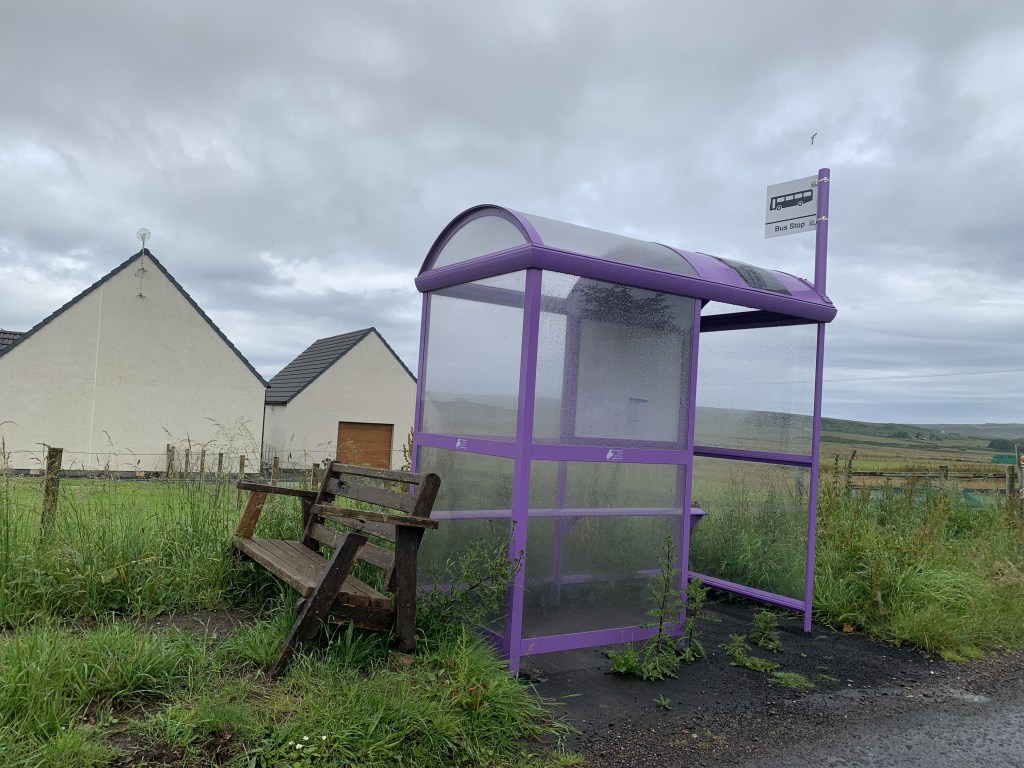
After a nice lunch at the Park Hotel in Thurso, we headed for the nearby ferry in Scrabster that would take us to the Orkney Islands, making sure we were there 30 minutes before its departure. However, when we got there we found out that the gates to the ferry close 30 minutes before departure. So we missed the ferry (even though it hadn’t left the dock yet). We were pretty upset, but recovered fairly quickly, grateful there was space on the next ferry at 7:00 p.m. This allowed us to explore some of the north coast of Scotland toward the east (and a quirky town called Tongue) that was also beautiful, filled with single-track roads and small villages, with sheep, cows and Shetland ponies grazing nearby. It turned out to be a fun way to spend the afternoon. We also noted that all the bus stops in Northern Scotland are purple!


We then made sure we were at the ferry landing in Scrabster 2 hours before our 7pm departure and were surprised that more than 50 cars were already lined up there. We were not going to miss this one! (The ferry can hold up to 178 vehicles at a time—even trucks and buses.) We were told that the waters here can be quite rough because this is where the Atlantic Ocean meets the North Sea. Fortunately the waters were pretty smooth both going and coming back from the Orkneys. We also saw several lighthouses as we drove along the coast, as well as those at the Scabster ferry landing and on our way to the Stromness ferry dock.


We were very happy to finally land at the Lanadisfame B&B just a mile from the ferry dock. Knowing we now had only one full day to see everything we could, we were pleased to find out that nothing was more than 40 minutes away from where we were staying. That meant that what we’d hoped to see in 2 days (had we not missed the first ferry), we could see in one. Yay!
Our first adventure was to the northwest corner of the main island called Brough of Birsay where we were told there were lots of puffins. It was cold and windy with intermittent rain and it’s the only time on our whole trip that we had to wear lots of layers from head to toe. We hiked across a beach and a causeway (that is under water at high tide), climbed up a monster hill (that doesn’t look very steep in the photo on left) to the lighthouse and then hiked down to viewing points on the other side where the cliffs and nesting puffins might be visible (with no guard rails or fences). Gary and I chose different points and HE got the best photographs. Once I’d finished and looked up to see where he was (a tiny speck in photo at left), I must admit to being a bit nervous and then quite relieved when he stepped back and we started the hike back to the car. We were actually quite proud of ourselves for making it up the hill and back down. And so pleased that we got to see more puffins. It was quite the chilly and exciting adventure!


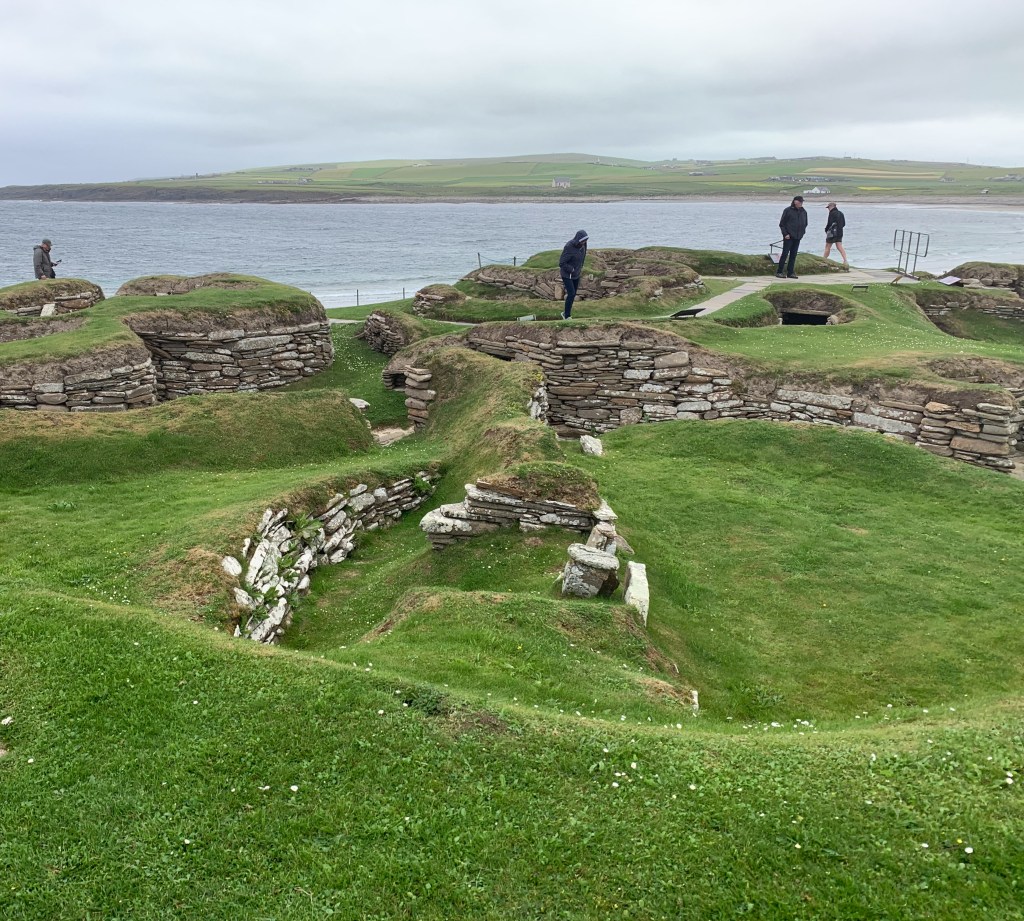
Our next stop was the Skara Brae, an amazing well-preserved Neolithic village where people lived over 5,000 years ago, between 3180 and 2500 BC (making it older than Stonehenge). It was covered for hundreds of years by a sand dune and exposed by a great storm in 1850. Archeological excavations began soon afterwards and now 10 rooms are visible and fascinating. Tools, furniture and artwork were left behind providing valuable clues about how they lived their lives. We could almost feel the excitement of those involved over the years in this amazing archeological dig.


After a nap, we headed for the other side of The Orkneys, to Kirkwall (its biggest city) to see the magnificent St. Magnus Cathedral, and then we drove another 20 minutes to see “The Italian Chapel.” The story of its construction is quite remarkable. It was built by Italian prisoners of war who were captured in North Africa and brought to the Orkneys by the British during WWII to build 4 rock barriers (to keep the German U-boats out of the North Sea). They transformed 2 Nissen metal huts (we would call them quonset huts) into a highly ornate Catholic chapel, with amazing art work and clever use of materials.


With all we learned about the Orkneys, one thing that surprised us was that they (and the Sheltand Islands farther north) originally belonged to Norway but were given to the Scottish Crown over failure to pay a dowry. The people there do not consider themselves Scottish, but they are a part of the UK and mostly of Viking and other Norse descent. Regardless, the Orkneys are amazing and beautiful in a very different way…there are very few trees…it is mostly flat fields and pastures…lots of cows and sheep…and from almost everywhere we could see the waters. Their “simple beauty” felt very relaxing and serene.


Gary suggested we close this blog with an “An Orkney Blessing” we found at St. Magnus Cathedral:
May the song of the birds fill your heart with joy and the vigorous Orkney winds energise your soul.
May all your days be filled with the vibrancy and colour of the wildflowers.
May the outpourings of the Holy Spirit in your life be as boundless as the tumbling waves upon the shore.
May the glorious Orkney sunsets bring you deep peace and the rainbow’s promise strengthen your faith and hope in God, now and always. Amen.
 Cruising with Gary & Annie
First of all, I LOVE the Orkney blessing. Thank you, Gary❤️. What fabulous photos and fabulous finds in the Orkneys! We loved seeing the ruins at Skrae Brae(?? Not correct!), and that beautiful v resourceful Italian church. You are not missing thing! Sure can identify with missing a ferry…😵💫
I did five voluntary work camps (IVS) in Gt Britain after college and my favorite was prob a month on Fair Isle ( between Shetlands and Orkneys). You two are amazing! … think you both must be at least 80 years old, eh? Thank you for taking us a long with you❤️
LikeLike