ST. ANDREWS & EDINBURGH + SCOTLAND SUMMARY

23 July 2023, Edinburgh and 29 July 2023, Los Osos, CA

We spent the last 4 nights of our Ireland/UK travels in Edinburgh, AND, as usual, we stopped on our way there (and went out of our way) in order to see two places. We had seen dozens of signs for deer (specifically red deer) along the roads of Scotland and a few for otters, and we never saw either species. However, we discovered that The Scottish Deer Centre was on the way to St. Andrews (in the “Kingdom of Fife”) so we stopped in and found exactly what we were looking for and then some. Not only did we find red deer (which were quite beautiful), but several other kinds of deer as well, together with those shy little otters, which look like a small version of our river otters but live primarily on land next to the water. They also had a moose that we could see off in the distance. In Scotland they are called Eurasian Elk. We also got a kick out of seeing a funny little “Wild Haggis” (center–native to the Scottish Highlands).


We then made our way east to the famous St. Andrew’s Old Course—the oldest and most iconic golf course in the world (established in 1552!). We ate in their club house (Gary posed outside) where I ordered a “Coronation Sandwich” that I’d seen on menus several times. It was originally created for Queen Elizabeth’s coronation—a chicken sandwich with a curried mayonnaise and currants. It was quite good! We then found our way to the 18th hole where there was a fabulous Pro Shop. I had forgotten how many golf tournaments we’ve seen on TV filmed at the very spots we were standing, overlooking the 18th green, its famous Swilcan Bridge and the North Sea. It was pretty impressive!


Finding our way to our hotel in Edinburgh took longer than expected and we were pretty weary by the time we finally found our convenient Motel One (below, top left, with the top of St. Giles Cathedral above it), right on the edge of Old Town and an easy walk to the Royal Mile and Edinburgh Castle. It was hard to muster the energy to unload our rental car, get everything up to our room and return the car to the airport (half hour west with no direct roads), but we did it! Whew! We spent most of our time pretty close to our hotel, but also enjoyed another Hop-On/Hop-Off tour with a live guide who entertained us with stories about the history of the area. The architecture is quite unique, there are lots of statues and monuments and hundreds of churches and steeples. We also got a different view of the huge Edinburgh Castle, revealing that it sits on a massive rock formation making it even more formidable.  


We walked up the Royal Mile to the Castle and only then discovered that all the tickets were sold out, but we got to see the large stadium in front of it where lots of concerts are held as well as the renown annual Royal Edinburgh Military Tattoo held each August. There were lots and lots of people everywhere we went, but we got used to it.


Our favorite “find” in Edinburgh was St. Giles Cathedral, founded in 1124, with its fascinating steeple and beautiful interior. While we were taking in the stunning stained glass windows, we heard some beautiful music coming from the front. It was a rehearsal for a concert that night by “The Piccadilly Sinfonietta” featuring Victoria Lyon on violin, a piano and other stringed instruments playing pieces from Mozart, Bach and Vivaldi. I’ve never been much of a fan of the violin, but this music was mesmerizing and we sat and happily listened for over an hour. It definitely enriched our experience of this sacred place. Only later did we discover that this is the same Cathedral where, on July 5, King Charles formally dedicated himself to the people of Scotland (his Scottish Coronation), using the crown, the sword and the scepter—known as The Honors—the oldest Crown Jewels in Britain. It is also the first place that Queen Elizabeth lay in state after her death last year before going to London. (She died at Balmoral Castle which has been the Scottish home of the Royal Family since 1852.)

ST. GILES – IN AND OUT + STAINED GLASS


It was fun to take in the sights in this beautiful city before heading home. Knowing we were going to have a long day of travel the next day (and would be sitting on airplanes and shuttle buses for more than 15 hours total), we decided to take a long walk and ended up at one of Scotland’s National Galleries of Art. We found ourselves in an exhibition called “Grayson Perry: Smash Hits” covering pieces from his whole 40-year career. There was a warning posted: “Contains language and imagery of an adult nature and explores themes including sex, racism and politics.” It was one of the most “interesting” art exhibits we’ve ever seen, primarily featuring large ceramic pieces and huge tapestries originally generated on a computer, all with profound and varied messages conveyed in amazingly imaginative ways. I can’t say that we’ve become fans of Grayson Perry, but we’re both glad we chose to see this exhibit. It was pretty eye-opening and we certainly appreciate his creative talent.


We won’t bore you with the “adventures” of our travel home, including speed-walking from customs to our plane (going from Dublin to LAX) as we heard “Final Call, Gary Walker” over the P.A. system, but let’s just say we are VERY happy to now be sleeping in our own bed, using our own awesome shower and enjoying the peace, beauty and serenity of our Central Coast of California home. Whew! We’re gradually getting back into a non-travel rhythm of sorts, but it’s taking awhile, and that’s okay.

Before we tally all the statistics and reflect on our whole Ireland/UK trip in a final blog, we DO feel a need to share some afterthoughts about Scotland. What an amazing place! One of Gary’s photography guides probably sums it up best:

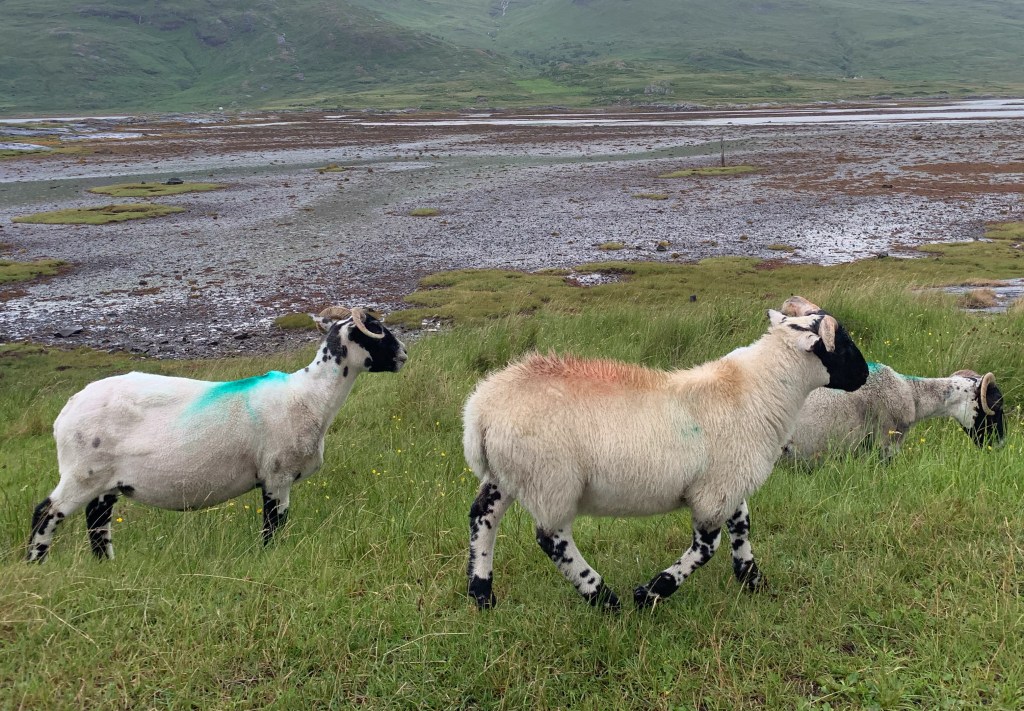
“Scotland is a landscape photographer’s paradise—vast highlands, countless lakes (and waterfalls), a rugged coastline and impregnable castles (thousands of them). Insanely picturesque, unbelievably gorgeous, amiable people, a unique culture and fantastic architecture.” (Italics mine.) To that we would add more about the wonderful Scottish people we met—so welcoming and friendly and willing to share local knowledge (the best kind there is). In Edinburgh we probably heard more languages spoken and more cultures represented than we have experienced anywhere we have traveled. And, of course, everywhere we went we saw beauty…sometimes dramatic, sometimes serene and always nourishing. Another thing we loved is that we saw thousands of sheep, hundreds of cows and more than a dozen Highland “coos”…and they all added to our joy and well-being.

We want to share one last photo with you here. It was late in the afternoon when we returned from our art gallery walk our last day in Edinburgh and the light was quite amazing. Photographer Gary recognized it immediately and went out seeking more opportunities for the perfect photograph. What he found was quite amazing and a perfect “ending” to our Scotland/Edinburgh stay:


We loved Scotland almost as much as we loved Ireland! We are filled to the brim with heart-warming memories and so many moments of astonishing beauty. Stay tuned for our afterthoughts on our whole trip. It’s fun to be able to share our adventures with you.

MORE OF NORTHERN SCOTLAND

22 July 2023, Edinburgh

The intermittent rain and cold continued as we departed the Orkney Islands, but at least this time the fog lifted so we could see and photograph the iconic Old Man of Hoy rock formations as we left the harbor at Stromness.

We had originally planned to take the ferry from Kirkwall all the way to Aberdeen (7 hours), but the ferry was full for several days before and after our desired departure date (even though we inquired several weeks in advance) so we went with Plan B and drove to Inverness, about 2 hours south, allowing us to see more of the beautiful northern Scotland landscape. Do you see the low range of distant mountains in the middle photo below?
I was sure we were seeing east across the North Sea to Norway and thought that was way cool. Gary was pretty sure I was wrong. Well, it turned out that Norway is about 200 miles east of Scotland and the curvature of the earth doesn’t allow us to see that far. What we were looking at were the North Sea and hills to the south, on what I’ll call the Aberdeen Peninsula where we would be staying over the next week. If you look at a map of Scotland, there are lots of indentations along both the west and east coasts. Sigh! So I got an opportunity to use one of our favorite expressions and said to Gary, “You’re right, dear!”

It happened to be my birthday, July 13 (#83!), and Gary treated us to a stay at a very elegant, 5-star “boutique hotel” in Inverness called Ness Walk Hotel. It’s the first time ever that, as we walked in the door, we were asked to sit in a very comfortable chair in a very beautiful small living room and were offered a glass of champagne while they checked us in. As you can imagine, the service was impeccable, the food delicious and it was a wonderful way to celebrate. AND, their breakfast included many choices that were NOT part of the Irish/English/Scottish Breakfast! Thank you, sweetheart!


The next day we were delayed a bit with a flat tire again—love those single-track pot holes! But then we had a wonderful drive to the Speyside area—named for the Spey River that runs through most of it—(on the Aberdeen Peninsula). It is often referred to as The Whisky Capital of the world where there are dozens of distilleries. We stayed outside of Aberlour (home of Walker’s shortbread—closed over that weekend) at the Craigellachie Speyside Hotel—a charming old Victorian structure built in 1892. It was convenient to several side trips, and we enjoyed the warm hospitality.


With this now being “high season” for tourists, several whisky tours were already booked, but we were very pleased to join a factory tour of the Strathisla distillery—the oldest working distillery in Scotland (since 1786) producing 2.4 million liters per year of all their whiskys, including Chivas Regal. Together with nearby Glenlivet, it is now owned by a French ”drinks giant,” Pernod Ricard. Here are some quick facts: (1) whisky is made from barley, water & yeast; (2) The flavor is determined in the stills; and (3) 100% of its color comes from the cask(s) it is aged in. We had lunch in Dufftown at The Whisky Capital Inn. When we came back to our hotel later that day and ate in its Copper Dog pub, there was a sign on the blackboard that said, “Today’s rain is tomorrow’s whisky!” It’s been raining quite a bit so it looks like there’ll be lots of whisky made around these parts, along Speyside’s “Malt Whisky Trail” and beyond!


From Speyside, we headed toward our next stop in Nairn, but on the way we visited 2 other places on the Moray Firth, a triangular inlet of the North Sea. First was The Scottish Dolphin Center where resident bottlenose dolphins are often seen at the mouth of the Spey River, together with seals, occasional orcas and many species of birds. We didn’t see anything, but we love dolphins and it was nice to leave a donation there. We also discovered a cathedral and 2 castles along the way, each with its own unique history and architecture. The ruins of Elgin Cathedral were fascinating, as were those of both Ballindalloch & Dufus Castles.


We then went on to Findhorn, which I’d heard of for a long time. The Findhorn Foundation is “a center of transformational learning—shepherding individual and collective awakening.” I often read from the daily inspirations of Findhorn founders Peter & Eileen Caddy and was looking forward to seeing their facility. What we found was the small, rather funky seaside town of Findhorn and then the trailer park where it all started, with some unique condos and other housing. We never did find its headquarters and retreat facilities, but by then we were getting a bit weary and anxious to get to our next stop. I did find some gardens and a labyrinth, but things were pretty quiet. Oh well!


We were thrilled with our next stop, “one of the best boutique guest houses in The Highlands,” Invernairne Guest House. It is just west of the beautiful little village of Nairn, overlooking the sea. With panoramic views, beautiful gardens and impeccable hospitality, we fully enjoyed our 2-night stay and highly recommend this wondrous place.


On we went to Stirling—one of our longer drives (3.5 hours) –to get to our last stop before Edinburgh. On the way, we made two stops. The first at a special shopping village near Pitlochry recommended by the owner of Invernairne called The House of Bruar. Gary bought me 2 beautiful cashmere sweaters (birthday gifts) and bought himself an awesome, soft leather vest (called a waistcoat in the UK). These were the only things on our shopping list for this trip so we were very happy to find just what we wanted. We also stopped at the public library in Perth hoping to find out more about the McNear family whose roots were said to have started here (I am a McNear on my mother’s side). We didn’t find out much, but it felt good to simply be in this town and acknowledge that ancestors live(d) here. Along the way, we continued to enjoy the beautiful combination of fields and forests so common to this part of Scotland. And, when we made a “wrong” turn, we even found 2 beautiful old stone bridges and a pig farm complete with little metal huts for each adult (and baby piglets!!!).


We stayed at a nice Holiday Inn Express in Stirling for 2 nights and rested up for a busy couple of days.  The next day we first went to the famous Falkirk Wheel (which we hadn’t heard of until friends told us it was “a must”). We could have just had lunch overlooking the Wheel and watched how it worked, but we found out we could go on a boat that would take us up on the Wheel and then back down, so of course we chose that option! The Falkirk Wheel is the only rotating boat lift in the world, installed in 2002 to connect renovated canals and waterways between Glasgow and Edinburgh, connecting the western waters to those in the east. As you can hopefully see from the photos below, the wheel is an amazing feat of precision engineering.

Our boat entered a “gondola” filled with water at our starting level, then, in perfect balance, our gondola was lifted up counter-clockwise to the next level of water 79 feet above, while the second gondola gradually rotated around and ended up where our boat had started. Our boat went up the channel a ways, turned around and entered the gondola at the top. The Wheel then rotated around and took us back to where we started. Hope that makes sense! Regardless, it was pretty amazing. It was also fun to watch the next boat go through the same process and get a better view of how it all worked. The Falkirk Wheel is practical but also revered for its aesthetics. It is quite something to see AND ride in! Fun facts: The wheel is 115 feet high, contains 1300 tons of steel work and 50,000 bolts, each of them tightened by hand!  


Just a few miles away, we then drove to “The Kelpies”–the largest equine sculptures in the world created in 90 days by sculptor Andy Scott as a dramatic entrance to the new Scottish Canal. It was hard to miss this amazing metal sculpture of two horse heads, paying homage to the working horses of Scotland. Each is 100 feet tall, made up of 18,000 pieces of metal including 484 steel plates. It was a bit of a walk to get up close to them, but they were even more impressive when we looked at these magnificent works of art from different angles. Amazing!


With only a few more days left to enjoy the wonderful country of Scotland before heading home, we’ll share more soon about our last stops and summarize our Scottish experiences. Thank you again for traveling along with us. Hope you’re having a good summer!

NORTH SCOTLAND & THE ORKNEYS

16 July 2023, Nairn

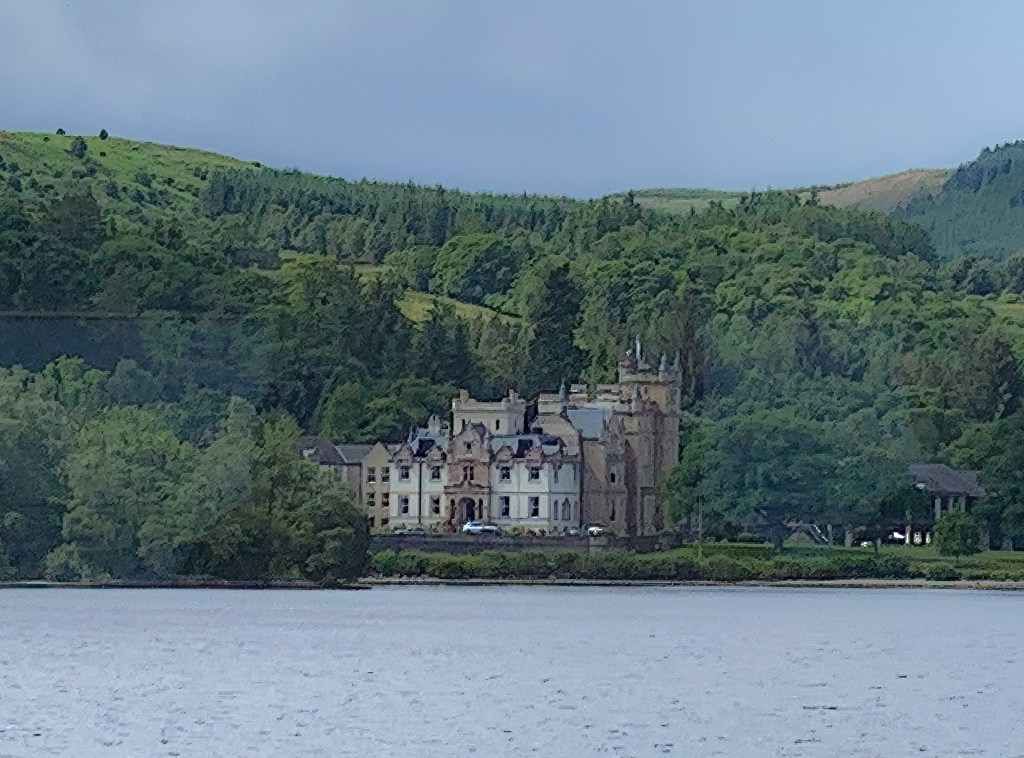
As we left the Inner Hebrides Islands and started north toward the top of Scotland, we first headed for the town of Ullapool, once again taking roads less travelled…often single-track. This meant that sometimes the GPS on our iPhones got a little confused (and sometimes so did the navigator—that would be me), but a “wrong turn” early on brought us to the marvelous Duncraig Castle and its sweeping lawns on 500 acres by the water. We got to meet its owner who turned it into his family’s personal home a year ago. Quite the lifestyle!


We drove through many forests and enjoyed beautiful ferns and waterfalls beside the road…and then a lake would appear…then more ferns and waterfalls. Yum!


We were delighted when we landed at the very elegant Harbour House B&B on the outskirts of the small village and port of Ullapool. It is only 45 miles west of Inverness (where we planned to stay after visiting the Orkneys—Scotland is quite skinny here), but it also broke up the long drive we were taking to reach Scotland’s northeast coast. We loved looking around in this sweet town and especially enjoyed the views from this lovely location.


The next day was our longest travel day of the whole trip—almost 200 miles —but, as usual, we broke it up with stops along the way, through forests and fields, more forests, more fields. Our first stop was a walk down to the Falls of Shin where salmon make their way up over these huge boulders to spawn (sometimes as high as 11 feet!). They find their way back here (where they were born) with their sense of smell! We didn’t see any salmon, but we loved the sound of the falls and enjoyed the thistles along the walkway—the official flower of Scotland.


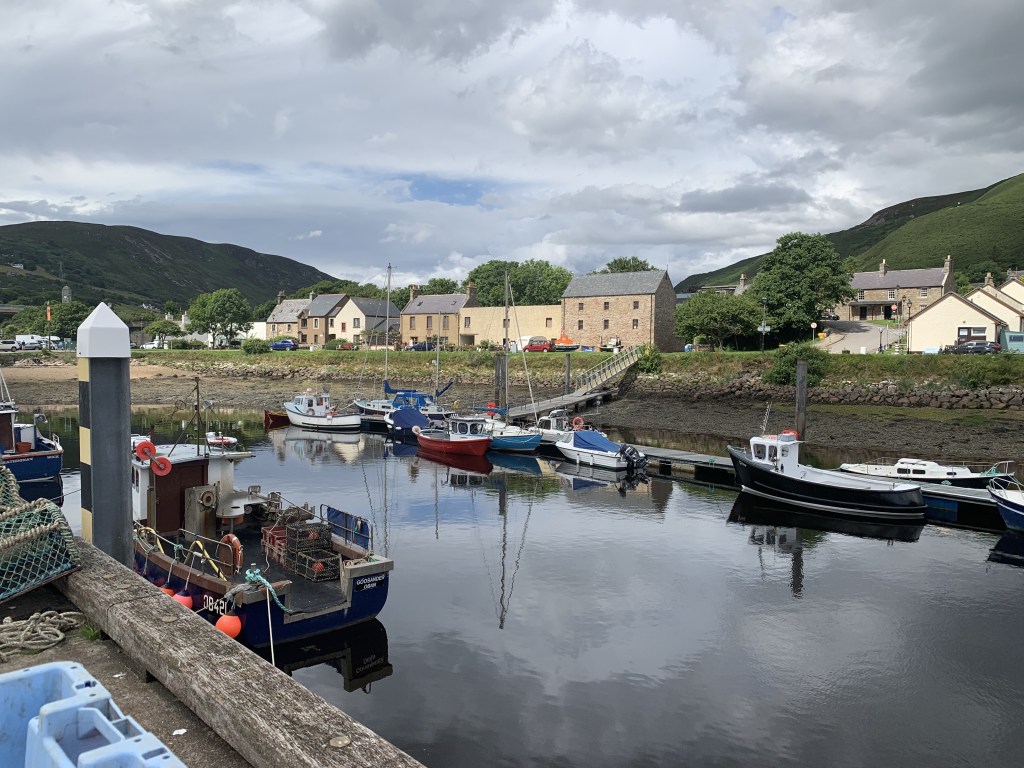
We then made a few stops along the northeast coast of Scotland, especially if there was a harbor (we do love boats and Gary loves chatting with the local boaters). We especially liked the towns of Golspie, Helmsdale and Wick, and briefly saw Dunrobin Castle, but we were most excited when we finally reached the town of John O’Groates—the northeastern-most point of Scotland, some 876 miles away from its counter-point at Land’s End in Cornwall (where we were mid-June). It was fun to experience this and have our photo taken once again.


We finally got to our B&B outside of Thurso and chose to eat in that night. Being “the Girl Scout” (always prepared), I  make sure we have food with us—fresh fruit, protein bars, crackers, cheese (bless Laughing Cow that doesn’t have to be refrigerated), etc.  We were to meet the 1 p.m. ferry the next day, so we hoped to see the Queen Mother’s Castle of Mey (which she restored and resided in frequently for nearly 50 years before her death in 2002), but it was closed. However, that meant we had time to visit Dunnet Head and its lighthouse (the most northern point of mainland Britain). There were locals there with binoculars who encouraged us to watch for puffins—one bird we’d hoped to see on this trip. There were several species of birds flying around and landing on the cliff ledges near the viewing platform and we finally saw our first puffin. Gary was clicking his iPhone camera like crazy, having no idea what he had captured. Later we discovered he got a puffin in flight! We were VERY excited!!!


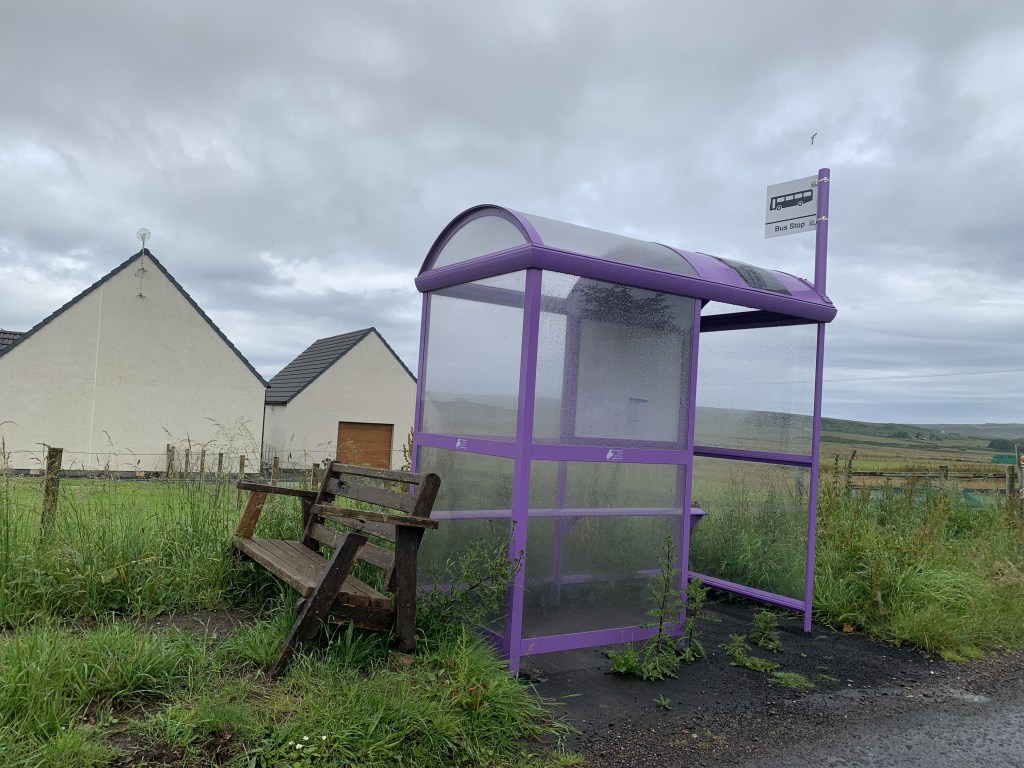
After a nice lunch at the Park Hotel in Thurso, we headed for the nearby ferry in Scrabster that would take us to the Orkney Islands, making sure we were there 30 minutes before its departure. However, when we got there we found out that the gates to the ferry close 30 minutes before departure. So we missed the ferry (even though it hadn’t left the dock yet). We were pretty upset, but recovered fairly quickly, grateful there was space on the next ferry at 7:00 p.m. This allowed us to explore some of the north coast of Scotland toward the east (and a quirky town called Tongue) that was also beautiful, filled with single-track roads and small villages, with sheep, cows and Shetland ponies grazing nearby. It turned out to be a fun way to spend the afternoon. We also noted that all the bus stops in Northern Scotland are purple!


We then made sure we were at the ferry landing in Scrabster 2 hours before our 7pm departure and were surprised that more than 50 cars were already lined up there. We were not going to miss this one! (The ferry can hold up to 178 vehicles at a time—even trucks and buses.) We were told that the waters here can be quite rough because this is where the Atlantic Ocean meets the North Sea. Fortunately the waters were pretty smooth both going and coming back from the Orkneys. We also saw several lighthouses as we drove along the coast, as well as those at the Scabster ferry landing and on our way to the Stromness ferry dock.


We were very happy to finally land at the Lanadisfame B&B just a mile from the ferry dock. Knowing we now had only one full day to see everything we could, we were pleased to find out that nothing was more than 40 minutes away from where we were staying. That meant that what we’d hoped to see in 2 days (had we not missed the first ferry), we could see in one. Yay!

Our first adventure was to the northwest corner of the main island called Brough of Birsay where we were told there were lots of puffins. It was cold and windy with intermittent rain and it’s the only time on our whole trip that we had to wear lots of layers from head to toe. We hiked across a beach and a causeway (that is under water at high tide), climbed up a monster hill (that doesn’t look very steep in the photo on left) to the lighthouse and then hiked down to viewing points on the other side where the cliffs and nesting puffins might be visible (with no guard rails or fences). Gary and I chose different points and HE got the best photographs. Once I’d finished and looked up to see where he was (a tiny speck in photo at left), I must admit to being a bit nervous and then quite relieved when he stepped back and we started the hike back to the car. We were actually quite proud of ourselves for making it up the hill and back down. And so pleased that we got to see more puffins. It was quite the chilly and exciting adventure!


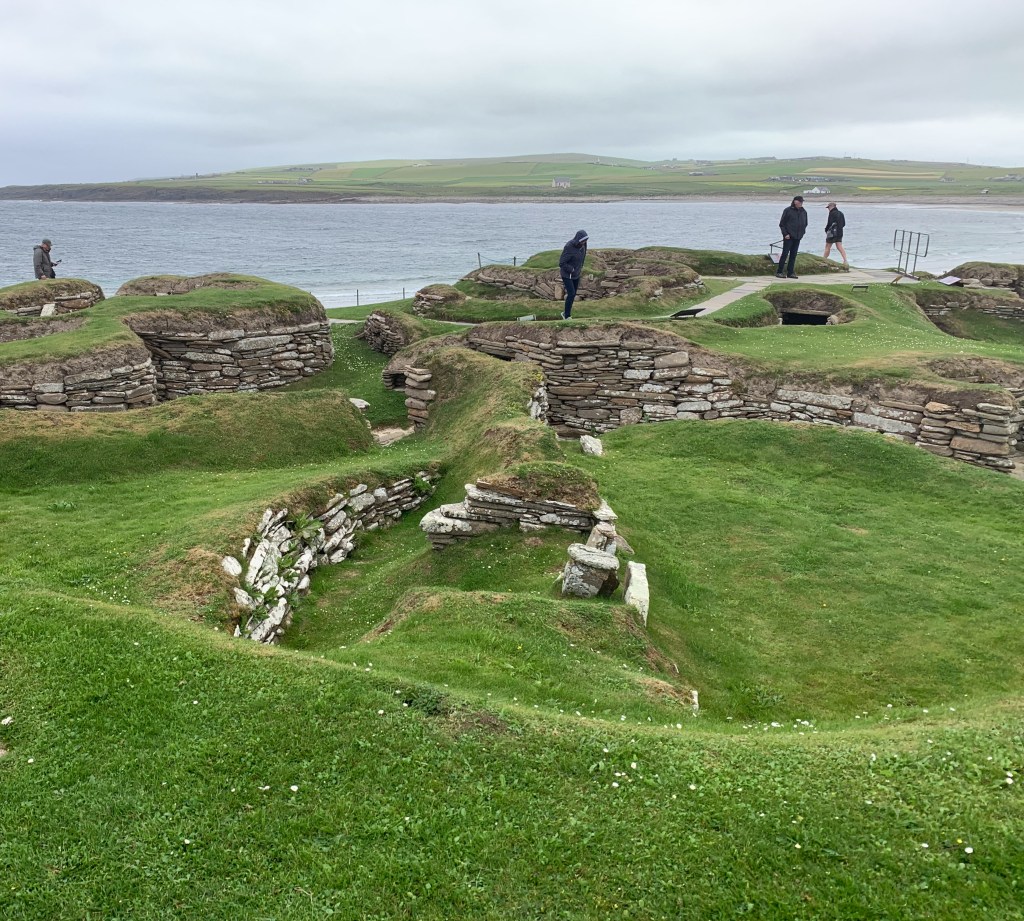
Our next stop was the Skara Brae, an amazing well-preserved Neolithic village where people lived over 5,000 years ago, between 3180 and 2500 BC (making it older than Stonehenge). It was covered for hundreds of years by a sand dune and exposed by a great storm in 1850. Archeological excavations began soon afterwards and now 10 rooms are visible and fascinating. Tools, furniture and artwork were left behind providing valuable clues about how they lived their lives. We could almost feel the excitement of those involved over the years in this amazing archeological dig.


After a nap, we headed for the other side of The Orkneys, to Kirkwall (its biggest city) to see the magnificent St. Magnus Cathedral, and then we drove another 20 minutes to see “The Italian Chapel.” The story of its construction is quite remarkable. It was built by Italian prisoners of war who were captured in North Africa and brought to the Orkneys by the British during WWII to build 4 rock barriers (to keep the German U-boats out of the North Sea). They transformed 2 Nissen metal huts (we would call them quonset huts) into a highly ornate Catholic chapel, with amazing art work and clever use of materials.


With all we learned about the Orkneys, one thing that surprised us was that they (and the Sheltand Islands farther north) originally belonged to Norway but were given to the Scottish Crown over failure to pay a dowry. The people there do not consider themselves Scottish, but they are a part of the UK and mostly of Viking and other Norse descent. Regardless, the Orkneys are amazing and beautiful in a very different way…there are very few trees…it is mostly flat fields and pastures…lots of cows and sheep…and from almost everywhere we could see the waters. Their “simple beauty” felt very relaxing and serene.


Gary suggested we close this blog with an “An Orkney Blessing” we found at St. Magnus Cathedral:
May the song of the birds fill your heart with joy and the vigorous Orkney winds energise your soul.
May all your days be filled with the vibrancy and colour of the wildflowers.
May the outpourings of the Holy Spirit in your life be as boundless as the tumbling waves upon the shore.
May the glorious Orkney sunsets bring you deep peace and the rainbow’s promise strengthen your faith and hope in God, now and always. Amen.

SCOTLAND – THE HIGHLANDS & THE ISLE OF SKYE

12 JULY 2023 – Orkney Islands

The ooo’s and ahhh’s continued as we made our way to the Isle of Skye, taking a different ferry to the mainland and first staying overnight at a half-way point, Fort William (in the shadow of the tallest mountain in all of the UK, Ben Nevis at 4413 feet). We had a lovely view of Loch Linnhe out of our B&B window and got a really good night’s sleep.


The next day we’re very glad we took time to see the nearby “Neptune’s Staircase”—a series of 8 locks through a channel that connects the west coast of Scotland to its east coast, through Loch Ness. We stopped and chatted with some of the boaters locking through. Two large sailboats were heading to Norway, which really blew us away until we looked at a map and realized that Norway is directly east, across the North Sea from the coast of Scotland! We spent nearly an hour hanging out at this Staircase as it brought back so many glorious memories of the 153 locks we went through on America’s Great Loop. AND, after chatting it up with the lock master for awhile, Gary was asked if HE wanted to open the next lock gate! (Duh!) Wish you could have seen him grinning as he pulled the levers and watched the gates to the next lock magically open! See why we’re glad we stopped here?!? 🙂


Glowing from such an unexpected and fun experience, we made our way to the Isle of Skye with great anticipation …another of the Inner Hebrides Islands. Enroute we also found a fun sign we had to photograph in “InverGARRY” and then stopped to see Eilean Donan Castle (one of thousands of castles in Scotland). It was built in the 13th century (probably as a defensive measure against the Vikings), destroyed in 1719, and left in ruins for 200 years until it was lovingly restored (1912-1932) “to her former glory” by a descendant. We were fascinated by the history of this site and the amazing collection of Scottish paintings and memorabilia. The current descendant owners still live in it part time.


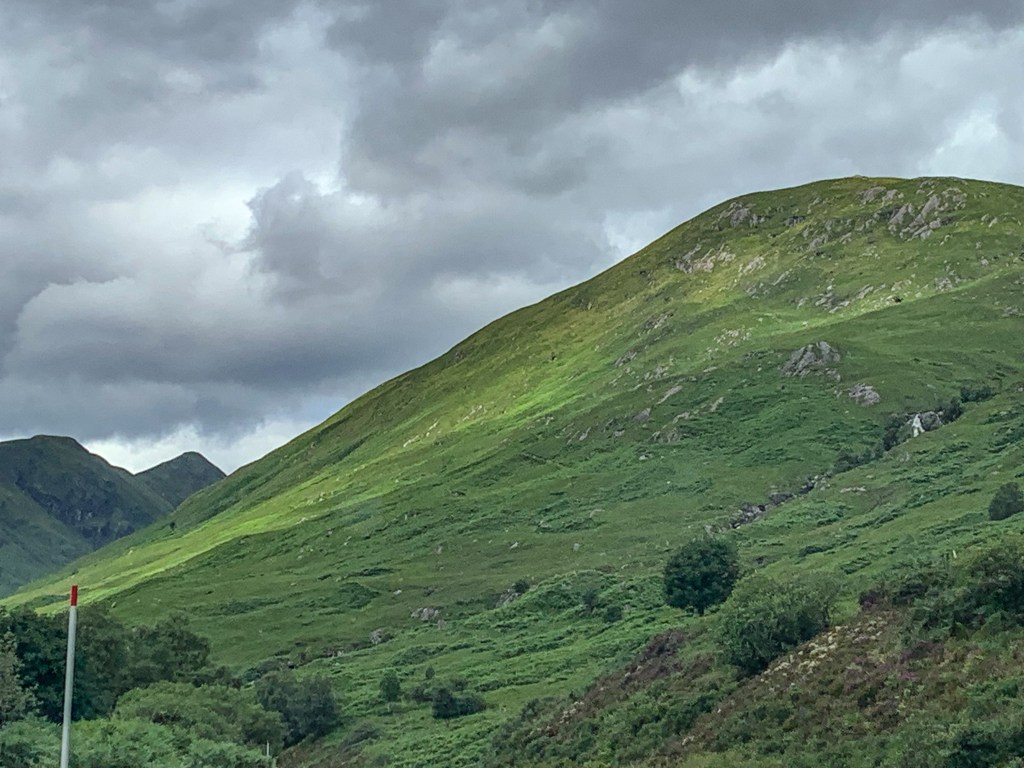
As we got closer to the Isle of Skye and made our way across the Skye bridge toward our B&B outside of Portree, (Skye’s largest town), we found ourselves saying “WOW” around every corner. We were finally experiencing firsthand what we’d seen and read about this amazing place—“one of the most renowned photograph locations in the world because of its rugged landscapes, indented coastline and mountain interiors.” We found Skye to be one of the most interesting places we’ve ever been, with sweeping grasslands, large mulls (some starting right beside the road), dramatic cliffs and crazy rock formations. Some have called it “the most other-worldly place on earth.” AND, we found it almost impossible to capture it well with our cameras.


The next day we drove all the way around the Trotternish Loop in North Skye, hiking to Fairy’s Glen, visiting the Skye Museum of Island Life and getting up close and personal with a Highland “Coo!”


The coastline was filled with every combination of land- and seascape…farmlands and pastures, rocks, waterfalls, cliffs, beaches and phenomenal mountains, including the iconic “Old Man of Storr” rock formation (one from each side, last 2 photos below).


And almost all of this was done on single track roads, which actually are becoming our favorite way to travel. The high number of passing places, the low speed limit and the courtesy extended by almost every driver makes it easy to do what we’re now calling the “S.L.O. Dance Mambo!” It really is a dance—driving a combination of curves and straight-aways, watching for cars (and sometimes buses) coming the other way, with an added element of reknown Skye potholes and sharp edges alongside the roads. Whee! We felt quite accomplished when we’d complete a drive from one place to another, stopping frequently to take photographs. It really was quite fun!


Although we were disappointed to have to cancel our 2-night stay on the Isle of Lewis (ferries were full for more than 2 weeks), the Isle of Skye was the perfect place to stay another 2 nights. Most places were “full for the summer,” but we found a hotel at the entrance to Skye that could accommodate us. As we headed south, we visited some mid-points including the Donvegan Castle & Gardens, once a Viking stronghold and one of the only Highlands fortress to have been continuously occupied by the same family (MacLeod) for over 800 years. The interiors were elegant.

(Sidenote: We’ve learned that the Vikings raided, settled in and for a time controlled much of the North of Scotland and the Western Isles between 800 and 1266.)

It was fun to drive along the landmark Cuillin Hills and explore the southern end of Skye, sometimes called “The Garden of Skye.” Apparently there are times when the rest of the Isle is quite bleak and barren (which we can’t imagine because it was ALL so green due to the rains), but the Garden of Skye (also called the Sleat Peninsula—pronounced “slate”) is green year round because of its many forests, ferns and varied dense natural vegetation. It is not visited as much and most of its roads are also single track. We ended up finding quaint little harbors, villages and rain forests along our favorite “roads less traveled.”


AND, as we headed to Kylerhea to find “the otters” and a very small ferry, we added another description, namely, “roads less maintained.” The quantity of ruts and potholes had us laughing most of the time, and high-fiving when master-driver Gary would avoid a bunch of them!  We also were thrilled to find some more waterfalls and enjoyed all the wildflowers as we bounced along! This was a fun way to spend our last day on the Isle of Skye before heading up North.


The Isle of Skye is definitely another one of our favorite places!

SCOTLAND–THE LOWLANDS AND THE BEAUTIFUL ISLANDS OF MULL & IONA

04 JULY 2023 Fort Williams, Scotland

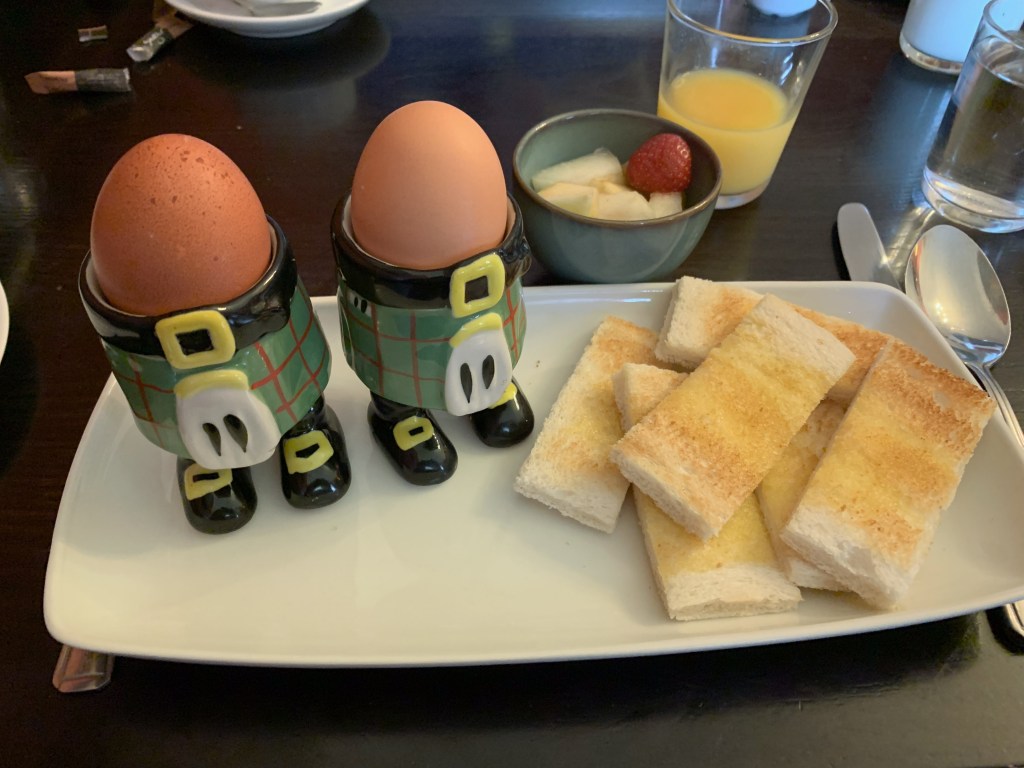
On one of the wettest days of our Ireland/UK adventure, we made our way from Keswick, England into and around Glasgow (Scotland’s largest city) to the western suburb of Paisley (where Paisley shawls originated). There was lots of traffic and even flashing signs on the motorway warning of standing water. Bless Gary for being so good at driving in all sorts of conditions! We were very glad when we found the lovely old Ashtree House Hotel where we stayed for two nights. What fun it was to be able to order something other than the famous “Irish Breakfast,” which later became the “English Breakfast” and (yes, you guessed it) is also the famous “Scottish Breakfast!” I ordered soft-boiled eggs and we couldn’t help but chuckle as we ate our first breakfast in Scotland!

By this time, our “pet frogs” had returned (Gary’s worse than mine) so we decided to pass up touring Glasgow and take it easy for a couple of days. We did take one afternoon to go on a 2.5-hour cruise of lower Loch Lomond—the largest expanse of water in Great Britain (22.5 miles long and 5 miles across at its widest, nicknamed the Queen of the Lochs). It is quite beautiful and we could see why much of this land is dedicated to large hunting and fishing lodges (built by super-rich tobacco barons in the 19th & 20th centuries), as well as the very exclusive Loch Lomond Golf Club (right). We also admired Ben Lomond, one of 282(!) “munros” in Scotland—mountains over 3000 feet. 


On our way from Paisley to Oban (our next stop), we drove along the entire length of Loch Lomond and discovered that the northern part has several small villages and marinas. There are also far more power boats here (very few sailboats)…just the opposite of Lake Windermere in the Lake District. We also stopped at the amazing St. Conan Kirk, built by an unconventional architect who wanted to build it for his mother so she wouldn’t have to travel so far to go to church! A wedding was taking place soon, but we managed to see most of the inside, together with some amazing views of Loch Awe from the garden…a nice break from driving.


Oban is a wonderful little harbor town but reminded us of summer traffic on Pacific Coast Highway as we crept along past shops, bars/pubs, guesthouses, hotels and restaurants. We stayed at The Scot, on the edge of all this—a great hotel but without a restaurant, so we had to go out more than we’d hoped, often in the rain. Gary’s cough had gotten worse so he used the National Health Services (NHS) hotline and was seen by a doctor at the local Oban hospital. We were relieved to learn that his chest and lungs were clear, but it will be very nice when his cough gets much better. (By the way, England’s NHS provides free services to tourists as well! Wow!) On a happier note, this is where I finally discovered a drink that I like, Strawberry-Lime Apple Cider!


We’ve now found another “favorite” place…The Isle of Mull in the Inner Hebrides Islands! (FYI: A mull is a hill or mountain bare of trees.) There were many amazing mulls on Mull! It’s a 45- minute ferry ride from Oban and we spent 2 nights at the very nice Mull Hotel & Spa near the ferry landing at Craigmure. The first day we drove west to the fun little town of Tobermory (the unofficial capital of Mull). We walked around a bit and had a nice lunch at a local pub, stalling until our hotel check-in time (3pm). We got back to the car and had a dead battery. We called Enterprise’s roadside assistance and were told it would be up to 4 hours before someone could assist us…sigh! Actually, because we were so far out in the boonies, we were grateful there was any service at all.  We were very glad to see the “Roadrunner Service” show up after 3.5 hours (with jumper cables) and we finally made it to our hotel for dinner! (All part of the adventure, right?!?) Another curious thing: We kept seeing signs warning us of otters crossing the road. We never did see any. 


The next day it was expected to rain all day, but we knew it was the only day we had to drive to the Isle of Iona—a very sacred place—about 35 miles from our hotel plus a short ferry ride. It took nearly 2 hours to get there because it was frequently raining and we followed a “single track road” (one lane). Fortunately the Scots have cleverly created these roads with frequent pullouts where cars can pass one another (on the left in right photo below), so it’s much easier than those we found in Ireland & England. Once you get how it’s done, it’s really quite a dance and everyone is courteous and careful. Gary got really good at these single tracks! 

The other advantage of having to go very slow is that there is astounding beauty on either side of the road that’s a bit easier to take in. In fact, we both agreed that we have never seen a place that had such a variety of beauty…around each turn would be another amazingly bright mull, or a seascape, or a lake, or a herd of sheep. AND, on the way to Iona we finally saw a small herd of Highland Cows (which the Scots call “coos”).


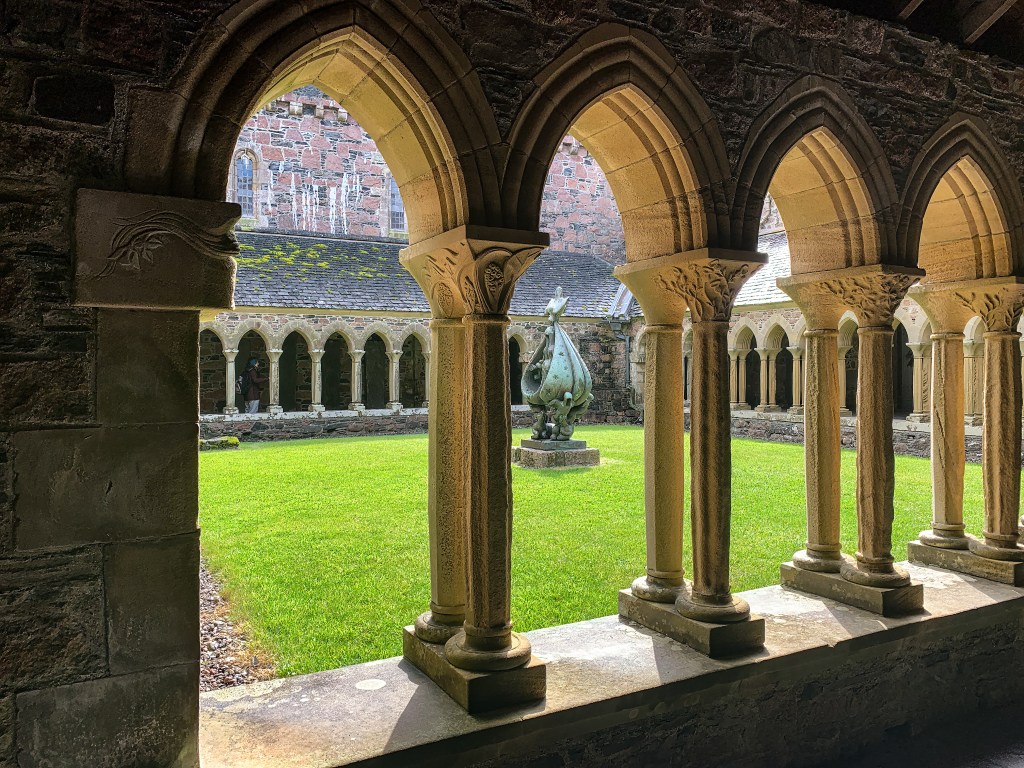
The Isle of Iona is tiny (1 by 3.5 miles) and just a 10-minute ferry ride from a little town on the SW edge of Mull called Fionnphort. Iona has a rich history as a place of pilgrimage and is regarded as the birthplace of Christianity in Scotland. It is the site of an ancient abbey and monastery founded by St. Columba. It is also believed to be the location where the famous Christian manuscript, The Book of Kells, was written (later taken to Kells, Ireland, to avoid its destruction by the Viking raiders, and now on display where we saw it at Trinity College in Dublin). The Abbey was rebuilt in the 20th Century and now serves a sacred communal community where guests can also stay. It’s a very peaceful place with a phenomenal museum housing some of the sacred remnants, some as old as A.D.563. It was very moving to stand in the sanctuary and among the ancient stone crosses that have been preserved and to imagine the work of the early monks and the prayers that have been said there for so many centuries.


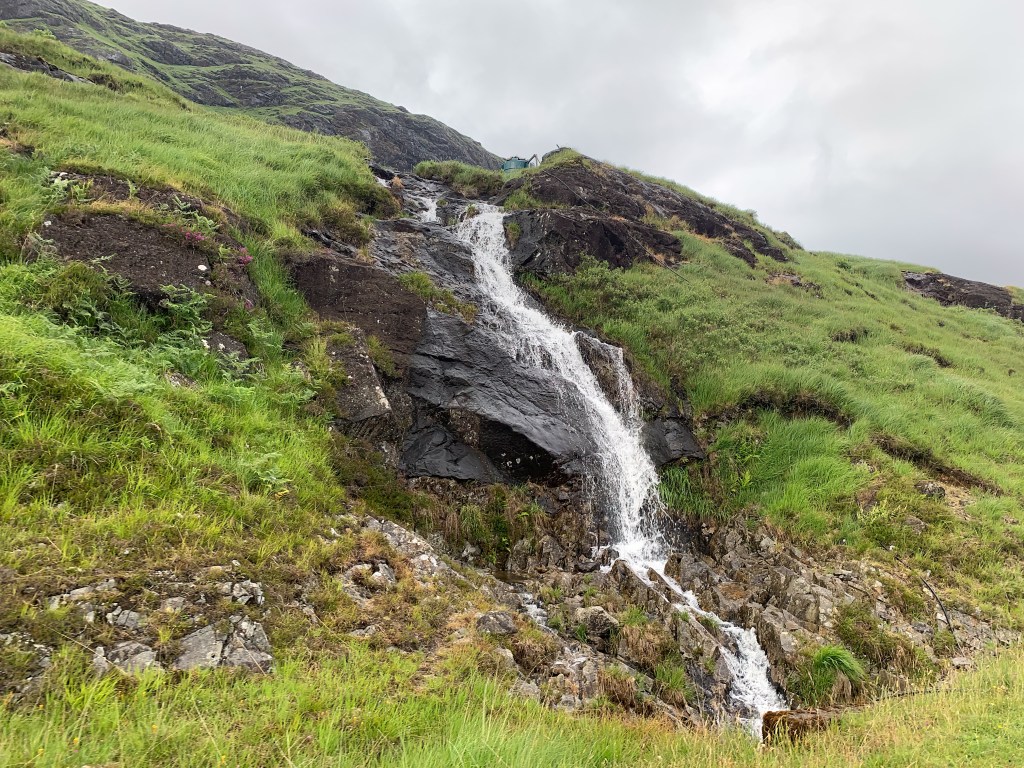
On the way back from Iona, we were treated to even more ooos’ and ahhh’s, with different views of the mountains, lakes and sea. AND, because is had been raining most of the day, the hillsides were covered with waterfalls, some streaming down hundreds of feet, others flowing right next to the road. More magic and a perfect way to end a wonderful soul-nourishing day. 


The morning that we reluctantly left the Isles of Mull and Iona, there was a wonderful sign at the ferry dock. This is the first time we’d seen or heard the term “HASTE YE BACK” and we knew, if we ever returned to Scotland, we would come back to these beautiful Lower Hebrides Isles.

THE LAKE DISTRICT (NW ENGLAND)

28 JUNE 2023, Paisley, Scotland (west of Glasgow)

English trains are very quiet so it was a real treat to take the train from Tiverton Parkway in Devon, 238 miles north to Leeds (4.5 hours). We stayed around the corner from the train station at a very nice Hilton so we could easily take the next train the following morning from Leeds to Carlisle (“the most beautiful train ride in the UK”), another 137 miles. The train stations were quaint and fun to pass through and it was a delight to once again enjoy the beautiful countryside, with countless pastures filled with sheep and cows, rolling green hills and high mountains in the distance. 


We then rented our third car of the trip and headed to Keswick (pronounced Kezik for some reason), which is at the northern end of The Lake District. Again, it was quieter here than in the heart of the tourist area farther south—a lovely, very walkable town—and we loved the B&B we stayed in (Dorcester House). It was here that we started experiencing intermittent rain almost every day for the rest of our trip, but we knew this was likely so we finally got to use the raingear we brought.


We especially enjoyed spending half a day on Lake Windemere—the largest natural lake in England (10.5 miles long and 1 mile at its widest). What made it even more fun is that we were on a boat—a tour boat, but we always enjoy being on the water! The first 2 hours we cruised down to the south end and back (to about the middle), then stayed on the same boat to cruise up to the north end and back. The west side of the lake was much less populated, with a few large manors and some campgrounds, together with the largest contiguous woodlands in all of England (said to include every tree species that grows in England). The east side was far more populated with lots of marinas and far more sailboats than we expected as well as many classic wooden boats. What a delight it was to spend time on the water and take in the spectacular scenery. 


Are you a fan of Beatrix Potter? I was raised reading her books and so were my two girls, so we loved the Tales of Peter Rabbit, Squirrel Nutkin, Mrs. Tittlemouse, Benjamin Bunny and others. A lot of Lake District tours were filled when we tried to book them, but alas we found a half-day van tour featuring the world of Beatrix Potter. We first drove to the home where she first visited the Lake District at age 16, a Victorian neo-gothic villa estate called Wray Castle. There was a later family photo there—Beatrix is on the far right.


After that, we got to go inside the beloved home she created for herself—a charming 17th Century farm house called Hill Top Farm that still contains all of her own personal furnishings, collections and family heirlooms. In both the house and the surrounding gardens, we could see that many of the drawings in her books incorporated features of her home and garden (note the white gate below right, as an example). 

We were disappointed when we got to nearby Hawkshead (where poet William Wordsworth once studied) that the Potter Gallery was closed for repairs, as this is where many of her original drawings were displayed, but we did see some of them in her home. We loved being in her garden where some of the same plants are growing (including Peter Rabbit’s vegetable garden). There was a fun quote near the entrance to her home where plants were climbing up the walls. Here Beatrix Potter wrote: “The flowers love the house, they try to come in. Houseleek grows on the window sills and ledges; wisteria climbs the wall, clematis chokes the spout’s casings…. But nothing more sweet than the old pink cabbage rose, that peeps in at the small-paned windows.”


One of the things we were told on this tour was that Beatrix Potter was home-schooled and had a very lonely childhood, with very few friends. So the animals on her family’s farm became her friends. The more she got to know them, the more she wanted to draw them, and that’s how her books began. She especially loved sheep and she also was responsible for reviving several breeds of sheep that would have become extinct in the early 20th century. (We also discovered Herdwick sheep, originally introduced here by the Vikings, and loved their unusual coloring-below center). 


After enjoying this tour so much, I really want to read more about Beatrix Potter. Not only was she an amazing artist, story teller and lover of animals, but she so loved the beauty and charm of her beloved Lake District that when she died, she bequeathed all of her properties (4000 acres and 14 farms) to England’s National Trust so it would remain unspoiled and available for the public to enjoy forever. Bless Beatrix!! Here are scenes from some of her properties:


We made two other stops around Keswick before heading to Scotland. The first was to The Pencil Museum! In the 1500’s shepherds discovered a high-quality graphite in the nearby hills and used them to mark their sheep. The first pencil factory opened at this Museum’s site in 1832 (now called the Derwent Cumberland Pencil Company), and by 1953, they were making 14,000,000,000 pencils a year, enough to circumnavigate the earth 62 times! Who knew!?! We also got to see “the world’s largest colored pencil,” 26 feet long and weighing 984 pounds! 

We especially liked seeing how pigments are created for colored pencils. If you wonder why the good ones are so expensive, know it is a very scientific and lengthy process to get each color precisely the right texture and hue! And did you know there were pencils created during WWII that hid a secret map and compass inside so soldiers could find their way out if they got caught behind enemy lines? As we’ve said before, we never know what we might learn on these adventures!!!

Our last stop as we left Keswick for Scotland was the Castlerigg Stone Circle, one of the oldest stone circles in England, laid out 5,000 years ago (Neolithic), overlooking a beautiful valley, beneath some of the highest peaks in the Lake District. There are many debates about the purpose of stone circles, often associated with astronomical, solar and lunar events. It is believed that Castlerigg may have been a meeting place where residents engaged in trade and/or religious ceremonies before a ritual exchange of stone axes (found in some of its few excavations). It was a bit misty during our morning visit, which made it all the more mystical…a nice way to say farewell to the stunning Lake District.

SOUTH WEST ENGLAND–PART II

22 JUNE 2023, Leeds, England

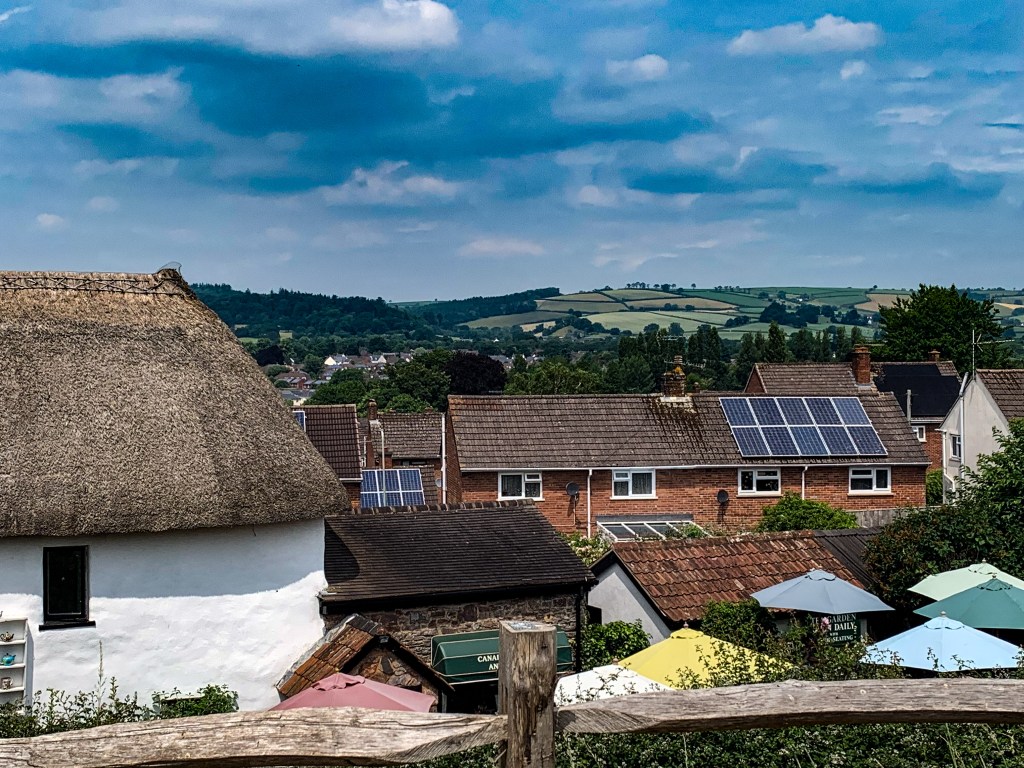
Continuing our time with dear friends Karyl and Paul, the four of us spent 3 days traveling to and around Cornwall (about 2 hours west), taking in the rugged coastal beauty, the charming small hillside towns (with VERY narrow streets in and between many of them), the rolling hills covered with light green and yellow grasses and often divided by bright green hedges or lush dark green trees. Everywhere we looked, the scenery was breathtaking. We also loved the stone houses, some with thatched roofs.


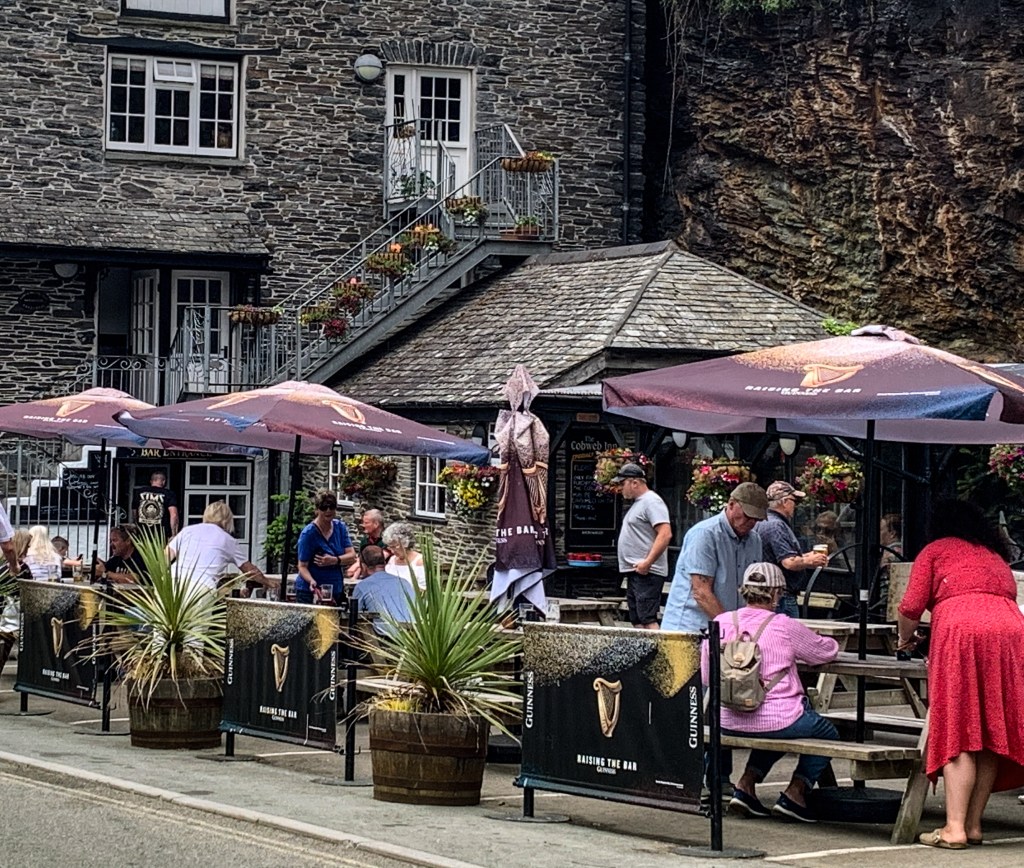
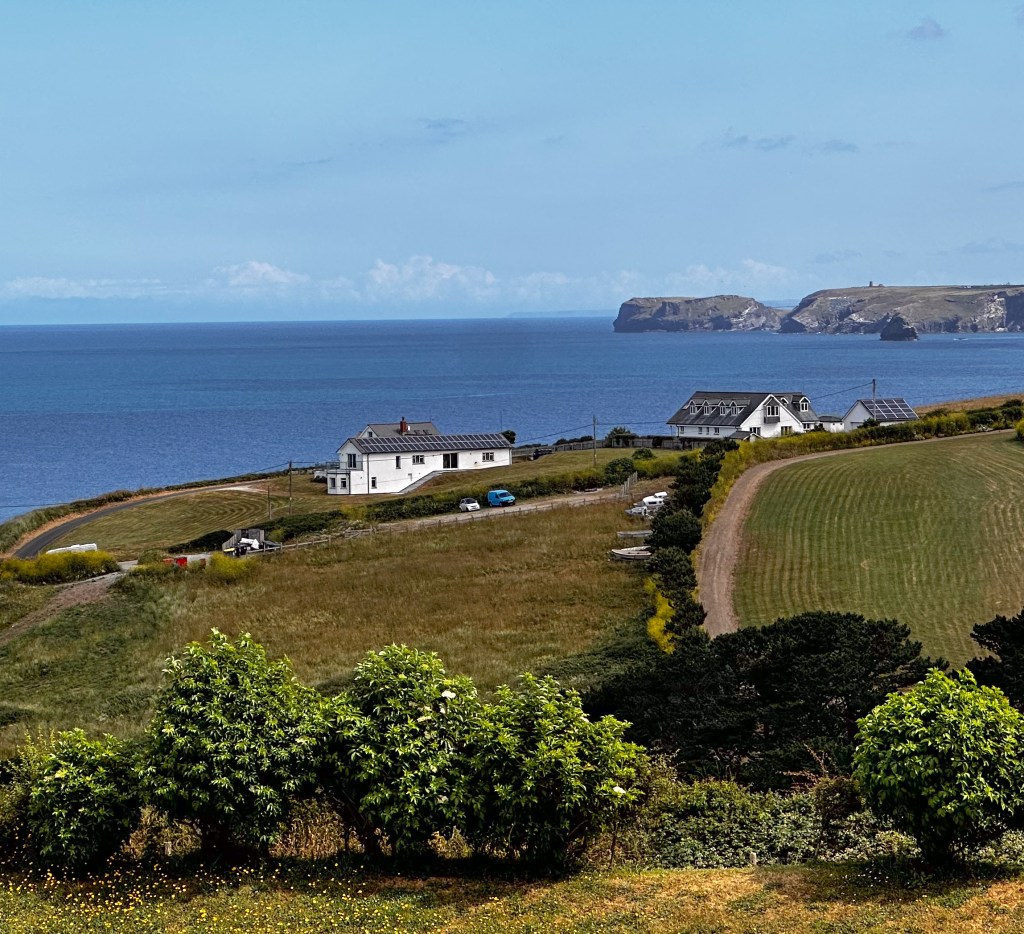
Our first stop was in the small town of Boscastle in North Cornwall where we had a wonderful “carvery” lunch at a local pub, watched a school fund-raiser’s “Duck Races” and visited the Witchcraft Museum…very interesting. We then went on to our first overnight stop at Tintagel, the mythical birthplace of King Arthur, and a world-wide center for tin mining in the 18th Century. I loved all the stone walls. We also walked to an amazing hotel called Camelot Castle, with spectacular views of the Atlantic Ocean and coastline.


Having watched a fabulous movie together called “Fisherman’s Friends” (about a group singing sea shanties who were discovered in Port Isaac and are still quite famous in the UK), we’d hoped to have lunch in Port Isaac, but there were so many tourists we couldn’t even find a parking place. (I guess it must be the beginning of tourist season—this was the first town we’d been in that was so crowded.) So we went on to another delightful fishing village called Padstow that we absolutely loved….fewer people (with many, many dogs!), a working harbor with an old lock, lots of  little shops and pubs on small, twisting streets. Lots of character as well as delicious food at one of Rick Stein’s seafood restaurants (very famous chef in the UK).


From there we drove to our next destination, the funky harbor town of Newlyn and then to nearby Land’s End—the most south-westerly point of Britain’s mainland. It’s become quite a tourist attraction, but we got there late afternoon and there were very few people. We’re told it’s very windy there most of the time, but we enjoyed a gentle sea breeze. It’s pretty amazing to realize that there is only the Atlantic Ocean between Land’s End and New York City (3,147 miles). It is also 874 miles to John O’Groats, the north-eastern-most point in Scotland (where we plan to be in a few weeks!). We’re really glad we were able to experience this part of England…and are so very grateful that Karyl & Paul were willing to plan this whole segment and drive us there.


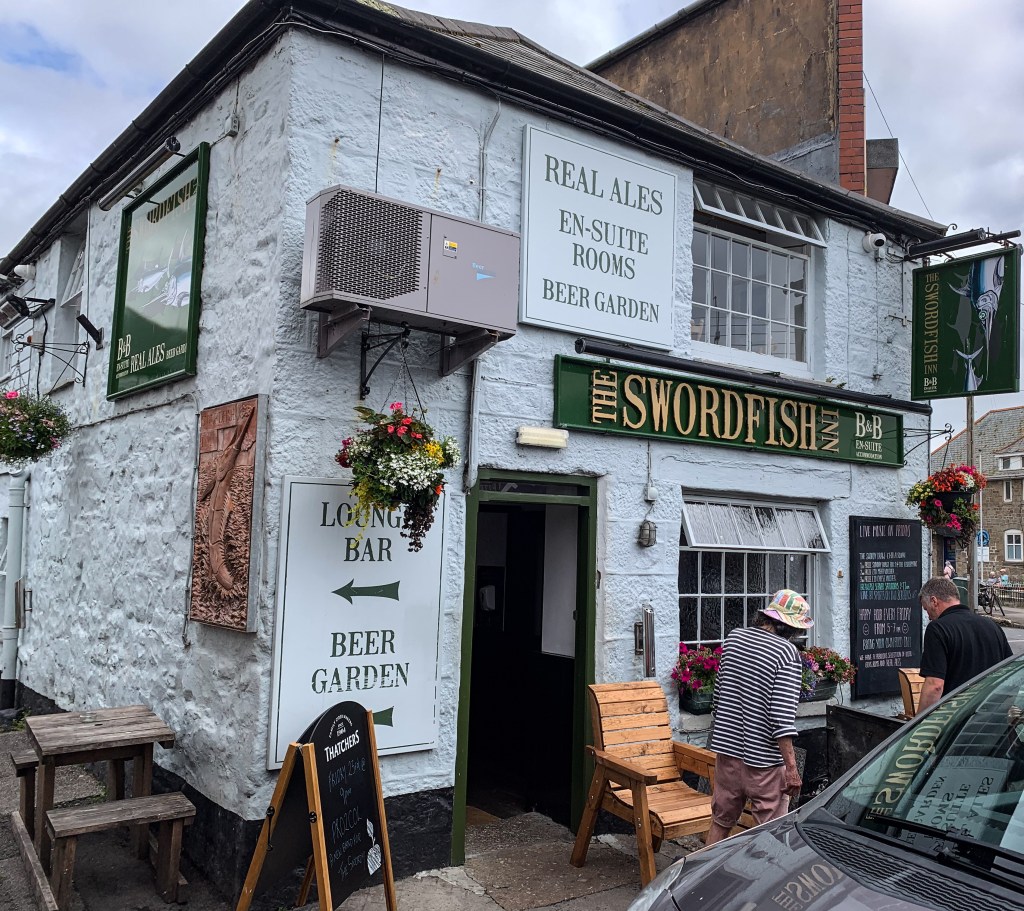
In Newlyn, we stayed above a bar called The Swordfish Inn right across from the harbor (our window is above the sign, below) and then walked up the hill to a charming restaurant overlooking the harbor (Fisherman’s Arms). Gary enjoyed one of his favorite meals—fresh lobster right out of the bay nearby. They called it a “crawfish.” See for yourself!


The next morning we were delayed in leaving because there was a truck blocking our way (above) delivering over 30 kegs of beer to the Inn (plus several cases) and taking back the empties. They deliver this amount every week!

On our way back to Collumpton we enjoyed more of the wonderful rolling hills that became even greener and lusher as we crossed back from County Cornwall to County Devon. We stopped for lunch in the picturesque village of Bickleigh where we were greeted by a beautiful peacock. The town is famous for its 14th Century bridge over the River Exe. It is here that Paul Simon was inspired to write his famous “Bridge Over Troubled Waters.”


We loved Cornwall, but we were happy to get back “home” to Karyl & Paul’s. We were all a bit weary after our 500+ mile road trip and took good naps. Gary, K & P went off to a church meeting that evening and then had a lively discussion about religion, politics and lots more before retiring. I took time to simply “be” and went to bed early…all part of my self-care!

Our last day, we joined K&P at a monthly meeting of their U3A group (University of the 3rd Age), “an international movement whose aims are education and stimulation of mainly retired members of the community—those in their third age of life.” It was a delightful crowd and they had an amazing variety of special interest groups. I wonder if there’s anything like this in the USA. I think it started in France, but there are apparently groups over much of the world. Has anyone ever heard of U3A? Their tagline is “learn, laugh, live”…right up my alley! We then had the best dinner of the whole trip at The Olive Well (a 2-block walk)  and then did a brief Solstice Ritual in the bountiful garden before packing and getting ready for the next chapter of this amazing “holiday” (the Brit word for vacation).  On we go taking two days by train to get to England’s Lake District.

SOUTH WEST ENGLAND–Part I

22 JUNE 2023, Leeds, England

South West England reminded us a bit of Ireland…lovely, rolling green hills and lots of sheep (in some places). Most of the roads from Oxford to Devon were Motorways (dual carriageways), but the land was flatter and there were very tall shrubs on both sides of the road so we couldn’t see as much scenery. The weather was much warmer (low 80’s—very hot to the Brits) and we even had a few thunderstorms and a bit of hail.

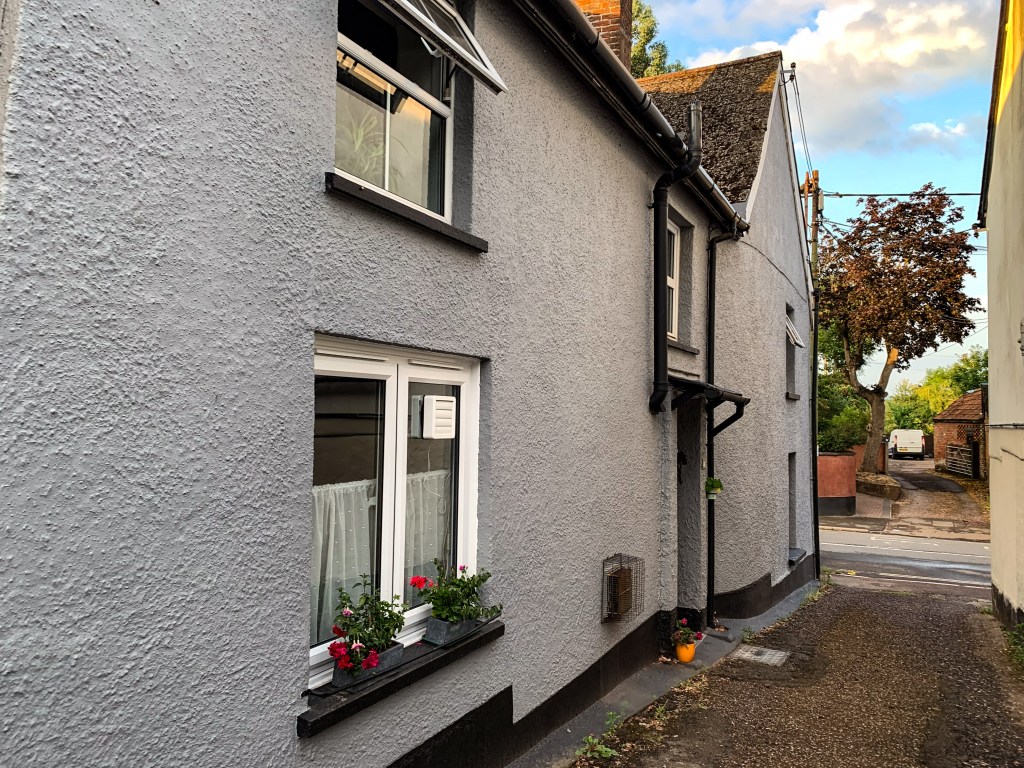
In Devon, the home we stayed in is over 100 years old, right on the edge of Collumpton’s village center. The walls are nearly two feet thick so it stays very cool most of the time. There are so many interesting arches, wooden beams and features that add so much character. It is quite charming. And the garden is a world unto its own, with four separate levels of beautiful roses, annuals, perennials and vegetables plus a fish pond, a hot tub and several spaces to simply relax and smell the flowers (one of my favorite things to do!).

Almost everything is within walking distance, which is a very fun lifestyle. We walked to dinner, to the butcher (to finally get some THICK steaks—so far, most steaks have been very thin—even the rib-eyes). We walked to the barber shop, the nail salon and the beautiful Anglican St. Andrew’s Church that serves as the community’s center. Everyone is friendly and there are also lovely pots of flowers. When walking to get my haircut, there was a fishmonger’s truck parked on the sidewalk, selling fish caught that morning.


And the best part of being in Collumpton was being with Karyl Huntley-Sadler and her husband Paul Sadler. I’ve known Karyl since 1995 when she became minister of the Golden Gate Center for Spiritual Living in Corte Madera, CA (10 miles north of San Francisco, in Marin County where I lived for almost 20 years). We became quite close through the years (she with Gary too) until I moved to San Jose, CA to be with Gary. We’d stayed in touch some, but only recently reconnected more deeply. We’d only met Paul a couple of times, but from the very beginning we all found ourselves to be quite compatible. He’s a sweetheart too! Our whole visit was filled with wonderful conversations, yummy food (including Karyl’s homemade trifle, below), much laughter and much love. Paul was a bit under the weather most of the time, yet still we all had such a good time.


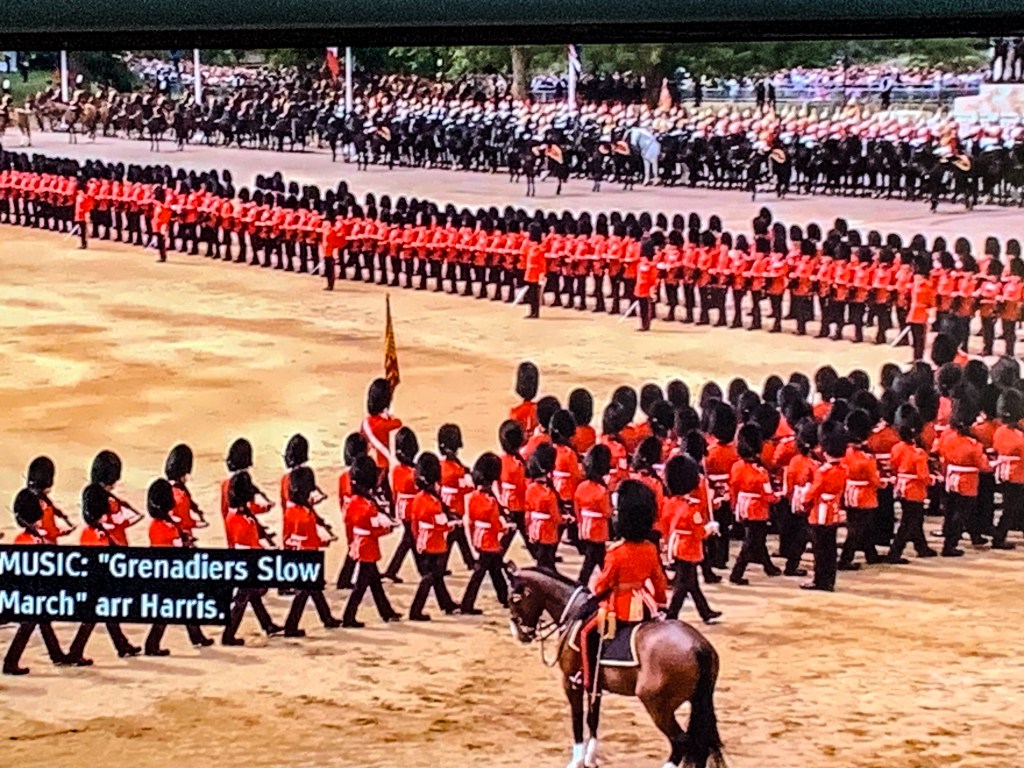
While taking it easy, we were able to watch the Trooping of the Colors—an annual UK celebration of the Monarch’s birthday held in June when the weather is best, regardless of the actual birthday date (Queen Elizabeth=April, King Charles=November). It was especially fun to watch this pageant in the UK with someone who was born in the UK (Paul). This year the troops being honored were from Wales, which had more meaning to us since we’d just been there. For the first time in over 35 years, the Monarch (Charles, at age 74) reviewed the troops on horseback, together with his sister Anne, his brother Edward and his son (and heir to the throne) William. Their spouses rode in horse-drawn carriages as did the adorable children of William & Kate, George (9), Charlotte (8) and the very cheeky Louis (5). Watching the precision marching of 1500 soldiers, 400 horses & 300 musicians (many on horseback guiding their horses with their feet!) was quite a treat! Afterward, the Royals watched a fly-by from the balcony of Buckingham Palace.


Two days after we arrived in Devon, we drove to Glastonbury—a place Gary visited long ago that really moved him. The Abbey was much larger than I expected and has legendary status as the earliest Christian monastic site in Britain and one of the most decorative–originally adorned with lavish sculptures and carvings, paint and gilding, colored glass and floors carpeted with patterned tiles. In its adjacent museum, we read: “…certainly the more grandly constructed a church is the more likely it is to entice the dullest mind to prayer….” It makes me sad to see once-magnificent structures like this stripped of its valuables (under Henry VIII) and in ruins, but it still felt very sacred. I also love that in the 10th Century one of its great abbots, St. Dunstan, devised the coronation ceremony that is still used today. I was deeply moved at the nearby Chalice Well and its surrounding gardens and water features. There were several places where it was easy to find deep peace and tranquility and that felt really good. Glastonbury has become a place where Christian and pagan beliefs seem to mingle. People come here from all over the world for rituals, personal enrichment and festivals. It’s quite an experience!


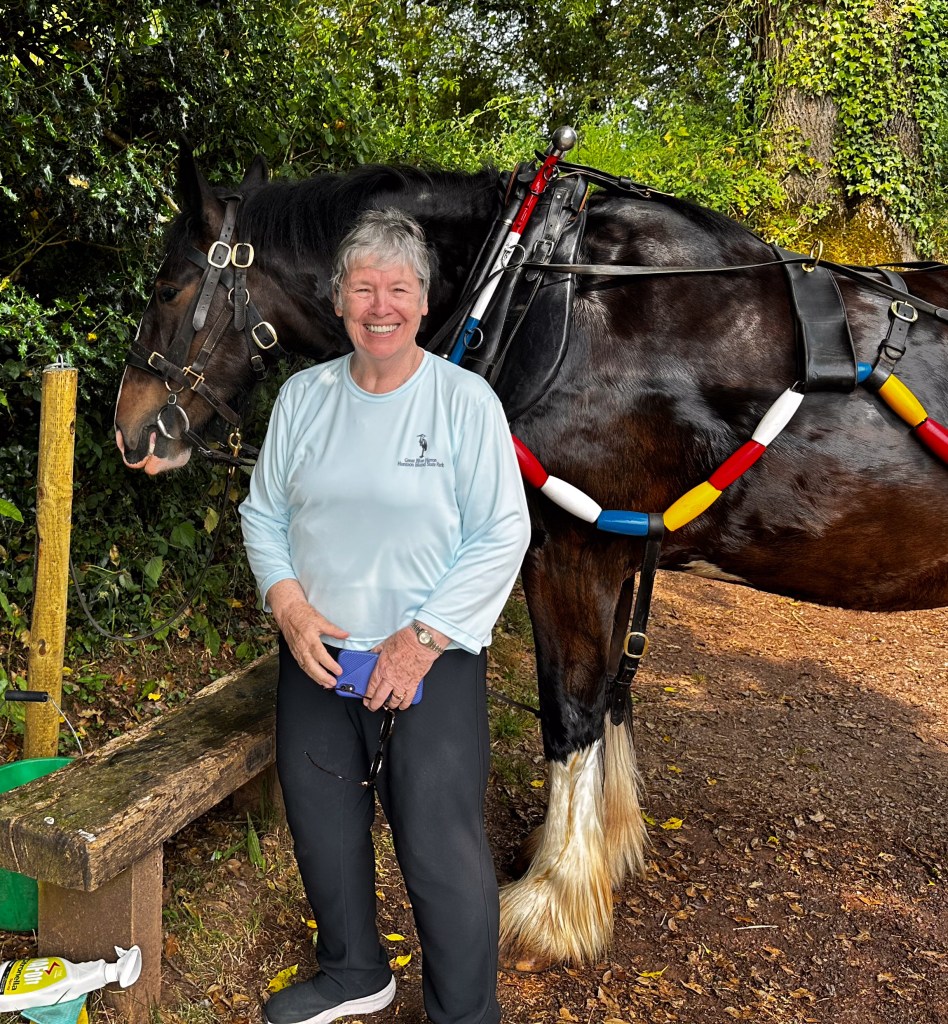
The next day we drove to nearby Tiverton and its Great Western Canal where we first had “cream tea” at a charming tea garden (scones with strawberry jam and “clotted cream”—butter the consistency of a hard cream cheese is close to what it is—quite yummy). We then took a 2.5 hour barge ride down a lovely canal that was built in 1814. What made it extra special was being pulled by a huge Shire horse walking along an adjacent towpath—the last of the horse-pulled barges. Would you like a 60-second meditation? Click on the video below, recorded when everyone was asked to be silent for 15 minutes, and simply listen to the sounds of nature (and the clip-clopping of the horse). It was magical!


Because this part of our Ireland/UK adventure was filled with so many fun and meaningful experiences day after day, we’re breaking our South West England blog into two parts. Besides, it’s about time we gifted you with a shorter blog or two. Most of them have been pretty long, but hopefully you are enjoying them all.

In Part II we’ll talk about our 3 fabulous days in Cornwall. Stay tuned!

HEREFORD AND OXFORD

15 June 2023, Collumpton, Devon, England
We were surprised that most of the roads between the
Wales border and our first stop in Hereford were barely two
lanes wide. (We’re very glad we’ve had so much practice on
these!) We’ve since discovered that going through most little villages
everywhere we’ve been, the roads are often very narrow
with cars parked half on the curb and half in the road, which
is fine unless there’s a car, truck, tractor (!) or bus coming the other
way. Fortunately, most drivers everywhere are very courteous and
stop or pull over if passing is a bit tight. In fact, on this entire trip
we’ve not seen any reckless drivers or car accidents. Yay!


Hereford is a much bigger city than expected, especially
since it was described in our travel book as “this pretty
market town.” The roads seemed quite complicated to us,
but our GPS helped us twist and turn as we made our way
around. Hereford is dominated by the beautiful Hereford
Cathedral at its center. We had a bite to eat in its café and
then spent over an hour in awe of its massive pillars and
semi-circular arches towering high above, its stunning
stained glass windows and a variety of interesting tombs
inside. We also loved all the nooks and crannies and little chapels.
This “great medieval monument” seems unusually
sturdy. In 1056 Welsh invaders razed the Saxon church that
stood there and a couple of centuries later the Normans
replaced it with an attack-proof version.


The main reason we chose to stay in Hereford for two nights
is because my maiden name is Hereford (pronounced Hare-
a-ferd) and my parents were in touch with a distant cousin
who lived at “Old Sufton” in the suburb of Mordiford. I wrote
ahead to introduce myself (enclosing a 1988 Christmas card my
parents had received from Major Robert Hereford—Bobby–
and his wife). I never got a response but we chose to drive
out to Mordiford to see if we could find the house and
hopefully the next generation of distant cousins. We found
the old house (that has been in the family since Norman
times!) and a very friendly maintenance man there. He sent
us to an even larger house nearby (“Sufton Court”) where
Major James Hereford (age 88, son of Bobby) now resides.
We were told to go to the back door. Unfortunately, no one
answered, which was disappointing, but I left a verbal
message on the “Ring” security network. In viewing both “big
houses on the hill” (below), I tried to imagine all the generations of
Herefords who had lived there for centuries and blessed
them all. I also discovered an article about a large group of
Herefords in the USA who hold reunions in both the States
and in Mordiford and that also claims that anyone with the
last name Hereford is related. I hope to find the USA
Herefords when we return. We also enjoyed a nice lunch at
the nearby Moon Inn and also snooped around the ancient
Mordiford Church where services were held for “Our beloved
Bobby” in 2001. (Side note: Hereford cattle originated in Hereford!)


On our way to Oxford (having picked up a brochure at the Cathedral), we stopped just north of Gloucester to enjoy the amazing Nature in Art Museum & Art Gallery where all of the art was inspired by nature. Most of this extraordinary collection was housed in a beautifully restored Georgian mansion and the informal gardens were filled with some very
creative, often whimsical sculptures. We had such a good time and had a delicious bowl of soup in the café.


Our hotel was about 10 miles south of Oxford’s city center.
That was a surprise, but it turned out to be much quieter.
To get to the HopOn/HopOff bus downtown, we first drove
for 25 minutes to a Park & Ride then rode a bus for another
25 minutes to get to the big red tour bus. This gave us an
opportunity to see many of the 44 small colleges that make
up Oxford University—the oldest university in the English-
speaking world (nine centuries of continuous existence) and
a world-leading center of learning, teaching and research. It
is quite the thriving metropolis. We rode on the bus with a
philosophy professor who teaches graduate students at
Christ Church College (founded in 1546) who pointed out
that we could identify everyone taking finals that week
because they were in their “full academic dress” of black and
white. It was very warm that day, so we doubt they were very
comfortable, but probably highly proud to be part of this
centuries-old tradition.


Oxford is a much larger city than we expected with lots of
beautiful old buildings combined with some that are more
modern additions to the University. We could probably have
spent several days here, seeing the insides of some of the
beautiful museums, libraries and chapels. The one place we
did stop was Britain’s first public museum, the Ashmolean
Museum of Art & Archaeology (founded in 1683) where we
had lunch on its rooftop then spent several hours in awe of
many of its exhibits and treasures including the Alfred Jewel
AD871-899 (below). The world-famous collections of the
Ashmolean (named after someone name Ashmole who
donated many artifacts) range from Egyptian mummies to
contemporary art, telling human stories across cultures and
across time. We’ve never seen such a large collection of such things as
fine porcelain, silver, coins, medallions and pocket watches, and
we especially enjoyed the Impressionists’ exhibit.


Unfortunately, Gary’s rooftop lunch did not agree with him at
all and he spent most of that night dealing with awful food
poisoning. Not fun! We asked for a late checkout and the
hotel (Courtyard by Marriott) couldn’t have been nicer. And
bless Gary…he was quite the trooper. We were due in
Devon in South West England that afternoon to stay with
dear friends for 10 days, and he was determined to drive.
We broke the 2.5-hour trip in half, stopping in the beautiful
city of Bristol on the way. Gary was able to take a “power
nap” for about a half hour and then we finally made it to
Devon (town of Collumpton) around 4pm. Thankfully, this
whole day of driving was on the “Motorway”—a beautiful
divided highway (“dual carriageway”)—that made the drive
much easier. No narrow roads all day long! Occasionally
there were chevron markings on the road accompanied by a
reminder sign to “Check Your Distance” and stay two
chevrons apart. Most drivers seemed to ignore them, but we
thought that was a good idea. We also loved some of the
tudor homes we saw along the way.


And boy, were we glad to find such a warm welcome and
cozy, inviting home to collapse and relax in for a few days
before playing tourist again. (We also added another 644
miles on our second rental car, so we’re up to 5857 miles!)
Gary then slept about 15 hours practically non-stop and
we’re happy to report that within 24 hours he was feeling
100% better! Yay!

We’re very excited to be (a) taking a break from driving, (b)
spending time and catching up with these dear friends, and
(c) visiting places like Glastonbury, Cornwall and Land’s End
with these wonderful people. So that’s what you’ll get to hear
about next.
Meanwhile, we hope the summer months ahead bring you
much joy and fun. Thanks again for being with us!

WALES

10 June 2023, Oxford, England

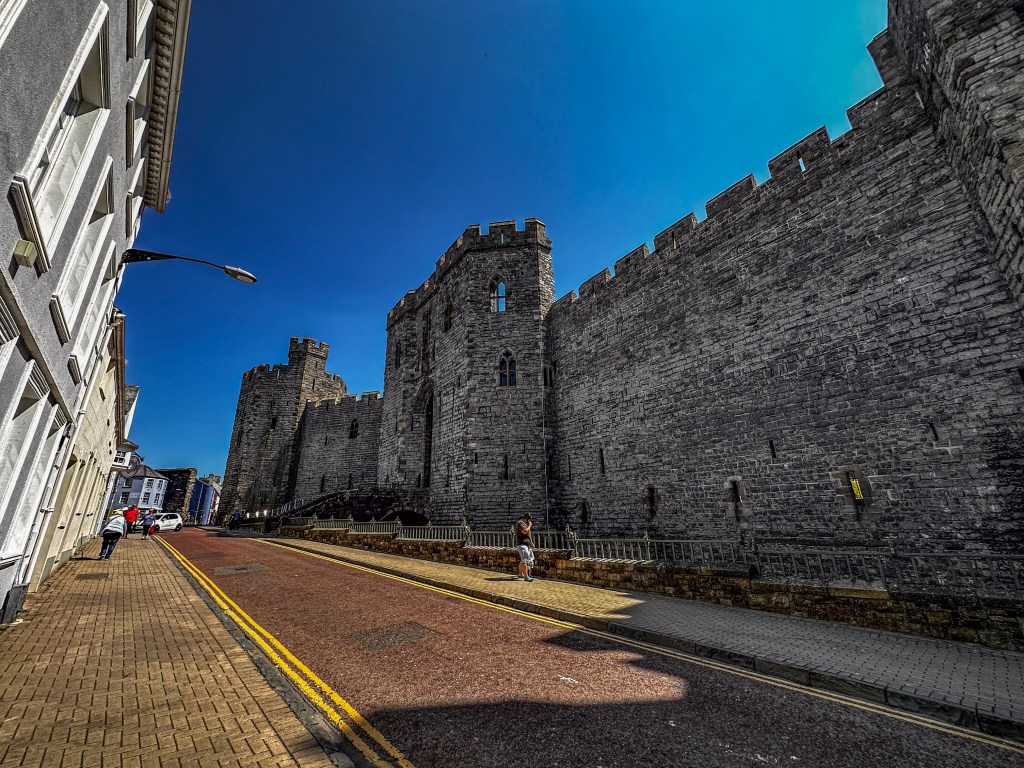
As we bid Ireland farewell, we took an early ferry from Dublin to Holyhead on Angelsey Island in North Wales…67 miles across the St. Charles Channel between the Celtic and Irish Seas. It took about 2.5 hours (on a power catamaran called the Dublin Swift) and was a very easy crossing, with very smooth waters. We then picked up a rental car (much nicer than the first one) and made our way to the small town of Caernarfon (Kuh-NARvon), home of Caernarfon Castle, a fortress palace on the banks of the River Seiont—“one of the greatest buildings of the Middle Ages.” The investiture of Charles, Prince of Wales (now King Charles III) took place here in 1969.


For the first time on this whole trip, the hotel we were booked to stay in for 4 nights was totally unacceptable. After some inquiries, we got the last room available nearby for the first night and, for the following three, at the very nice Celtic Royal Hotel a few blocks away. The town is very old; some parts of it charming; some a bit run down. AND, it was very walkable and a very convenient place to stay for various side trips we took.


The first day we drove up north through more luscious green hills and dales to the town of Conwy and then on to a huge seawall at Colwyn Bay where the waters of the Irish Sea and Liverpool Bay were a deep, dark blue. Had we continued east, we would have ended up in Liverpool! There was an unusual sculpture of a cormorant that I  photographed because I liked the design…and then Gary suggested I go back and look at it more carefully. Its belly was filled with plastic bottles. Quite a poignant message!!!

Both of us were still bothered a bit by our “pet frogs,” so we chose to spend the rest of the day taking it easy (and starting to finally get some of our blogs put together to post). We’d signed up for a boat tour the next day to see the puffins on Puffin Island (atop the northeast corner of Anglesey), but alas the winds were too high and that tour was canceled. So we walked around town a bit and along the walls of the Castle and finally found a café that did NOT serve Irish/English breakfasts. What a delight it was to order and eat Eggs Benedict!!!

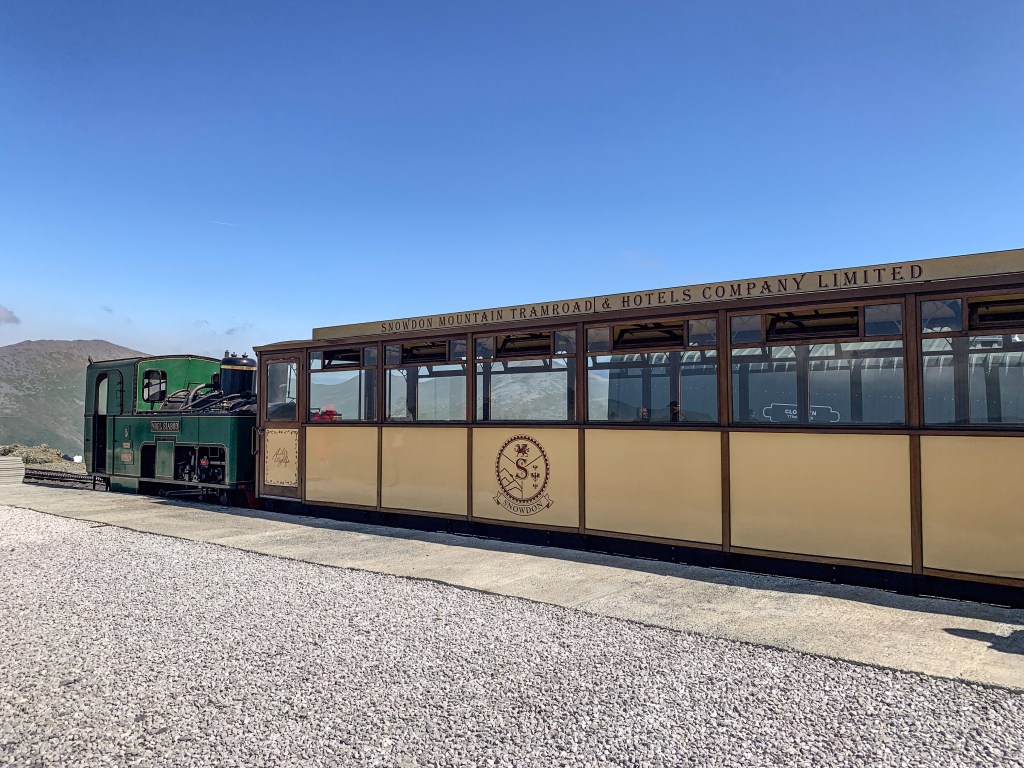
Our last day in the area was a real treat. Many weeks ago we bought tickets for the Snowden Railway 1896 Steam Train up Mt. Snowden in Snowdonia National Park–(the highest mountain in Wales & England at 1085 meters—3559 feet) and ”one of the most beautiful train rides in the world.” We weren’t able to go all the way to the summit (repairs being done to the tracks), but went three-quarters of the way up, to Clogwyn station at 2556 feet. The views were vast and stunning (and very hard to capture in photographs).

As you can see, there were no trees anywhere on the higher mountains, but they were quite green and on the lower half there were hundreds of sheep (and many lambs) grazing over the hillsides. (A baby walked onto the tracks in front of us and her mama quickly nudged her to safety!)

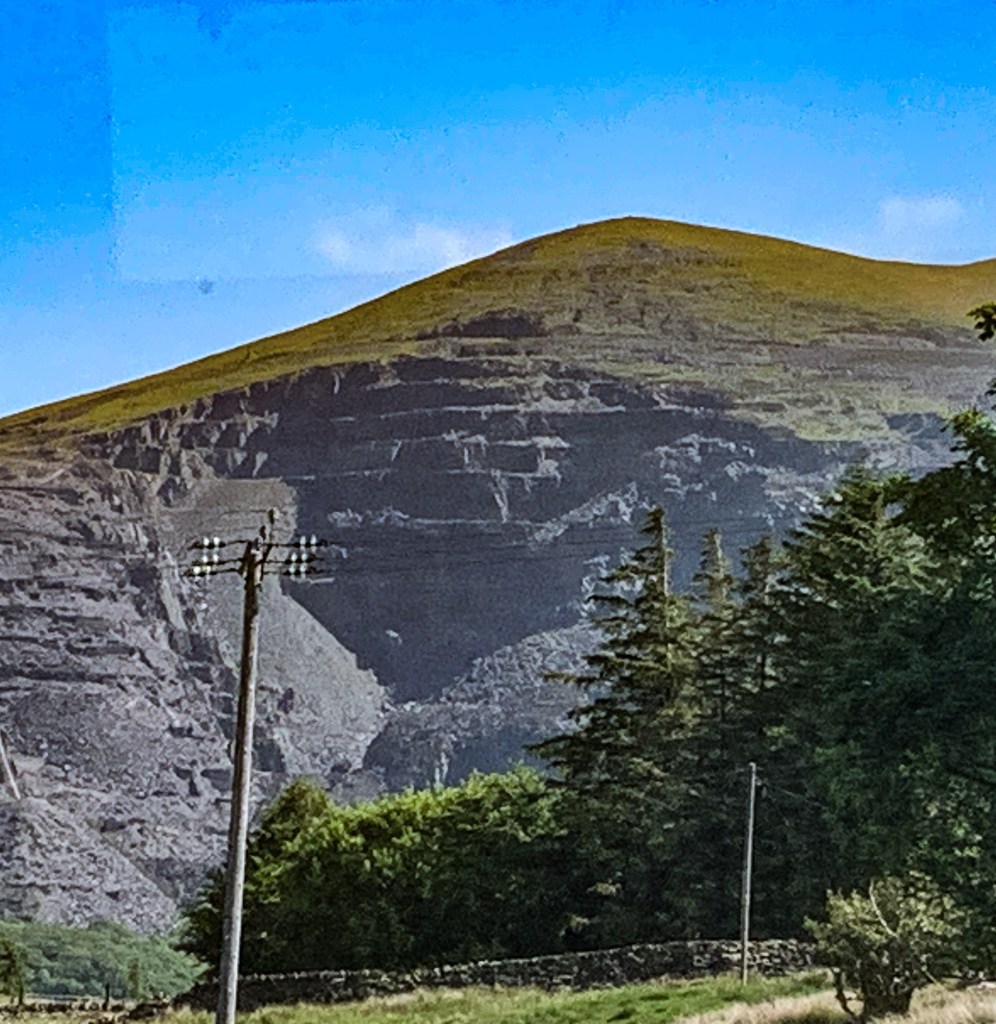
We could also see the huge slate quarry at Dinorwic—“one of the greatest quarries in the world” (lower right, above), so afterwards we took time to visit the nearby National Slate Museum, which was far more interesting than we thought it would be. We learned the history of slate quarrying in Wales, which in its prime employed more than 30,000 people—when factories and houses were built during the Industrial Revolution, all needing slate roofs. We watched a live demonstration of shale being split, from very thick to extremely thin. The craftsman was a 6th generation quarry worker who’d been at it for 39 years! The restored quarry compound also housed “the biggest water wheel in all of the UK”—a 50’ in diameter suspension waterwheel built in 1870 that provided power for all of the quarry operations until 1925. It was huge and also hard to capture, but Gary did a great job. Watch his video below!


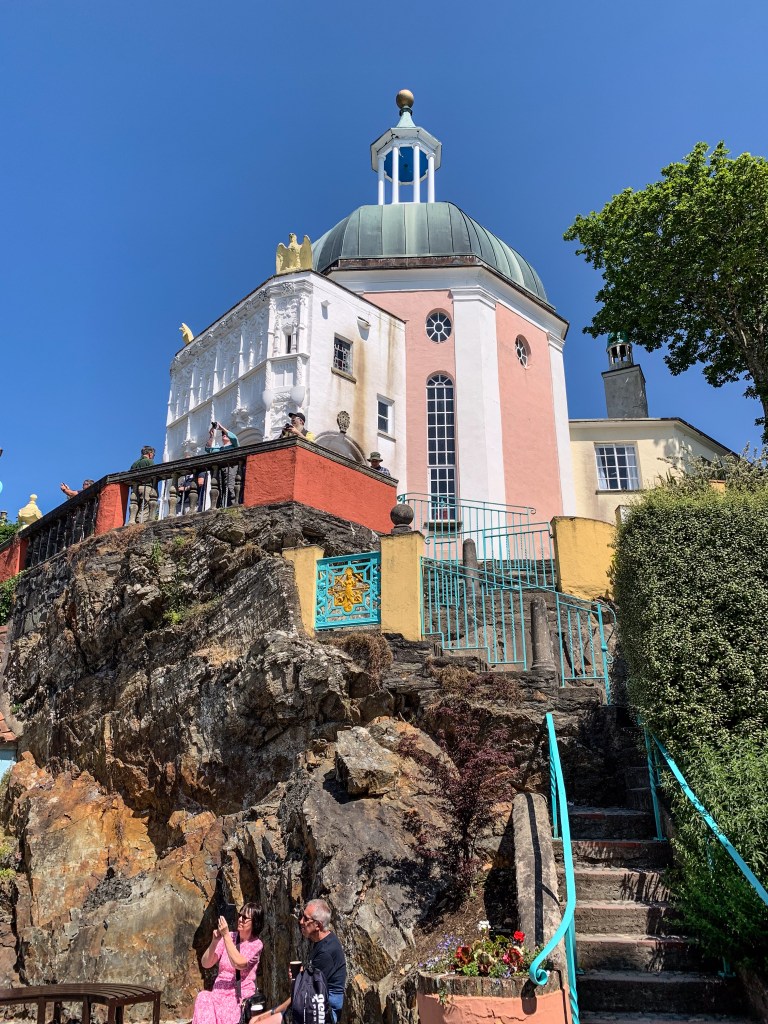
Four days in one location really helped clear up our persistent “frogs,” and gave us just the energy we needed to drive through Mid Wales and discover some very special places. First we stopped in the town of Portmierion, in the Welsh County of Penrhyndeudraeth. (I just had to share that name with you ‘cause every time Gary & I would see one of its signs we would giggle trying to pronounce it…and we never did figure it out!). This charming seaside resort was built by Welsh architect Sir Clough Williams-Ellis (1883-1978) “to show how a beautiful site could be developed without spoiling it.” His motto was: “Cherish the past, adorn the present, construct for the future.” Some of the balconies were shaped by the contour of the rocks they were built on. It was quite enchanting!


Stopping in the small town of Llanbrynmair for bottles of cold water, “Pauline,” the charming host of a small hotel, suggested we take the “scenic mountain shortcut” to our next destination. The “lovely little lake” she mentioned was one of the most beautiful we’ve ever seen, Llyn Clywedon, pictured below. AND, whilst there, we chatted with a sweet little man from Dublin. When we told him how much we loved the people in Ireland, he said with that familiar twinkle in his eye, “Ah, yes, we’ve been through quite a lot over the years, and now we really are quite happy with ourselves!”


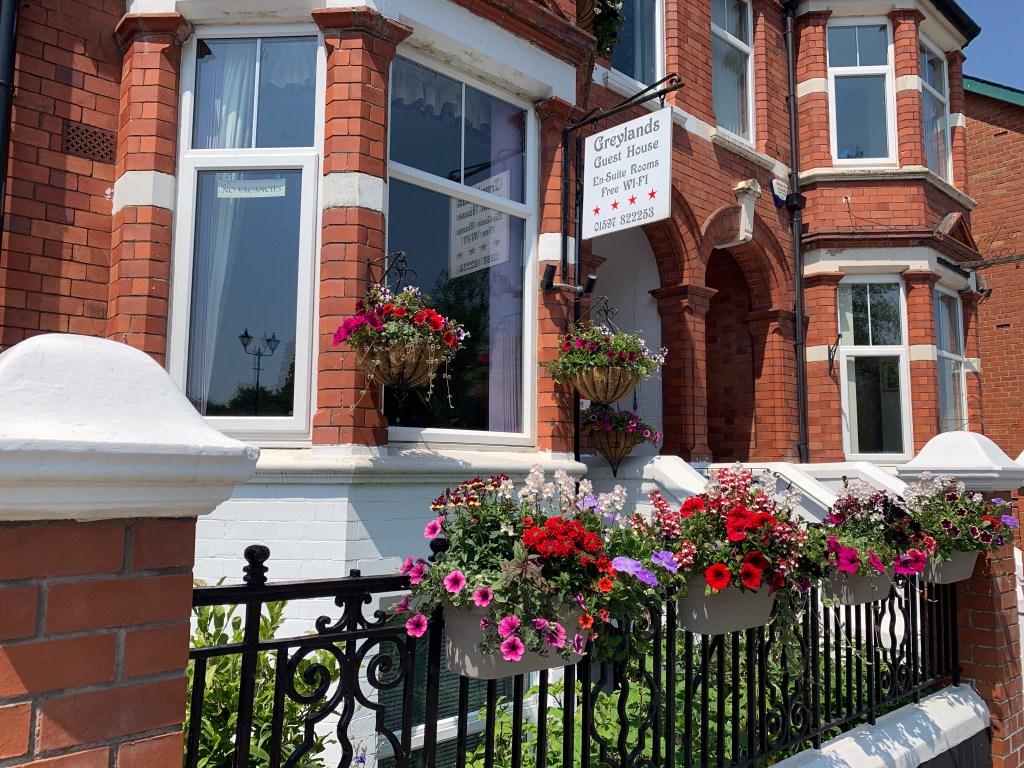
We stayed two nights at a lovely Mid Wales B&B in Llandrindod Wells (Greylands Guest House) so that we could visit the nearby Elan Valley. I had discovered it doing our trip research and “gifted” Gary with an entire day to go wherever he wanted, at his pace (and me tagging along) to explore, photograph and simply enjoy the beauty of this amazing feat of engineering: 70 square miles of dams, reservoirs and rugged Welsh landscapes with an abundance of picturesque scenery. And what made it even more interesting is that most of it was built in the Victorian Age. We also discovered the little “Nantgwyllt Chapel of Ease,” (isn’t that a great name?!?) built close to the uppermost dam, to replace the original that was drowned out to make way for this major water project. We also saw lots more sheep, many of them on the road, so that kept me happy! I even gathered a few tufts of wool from a nearby fence! 


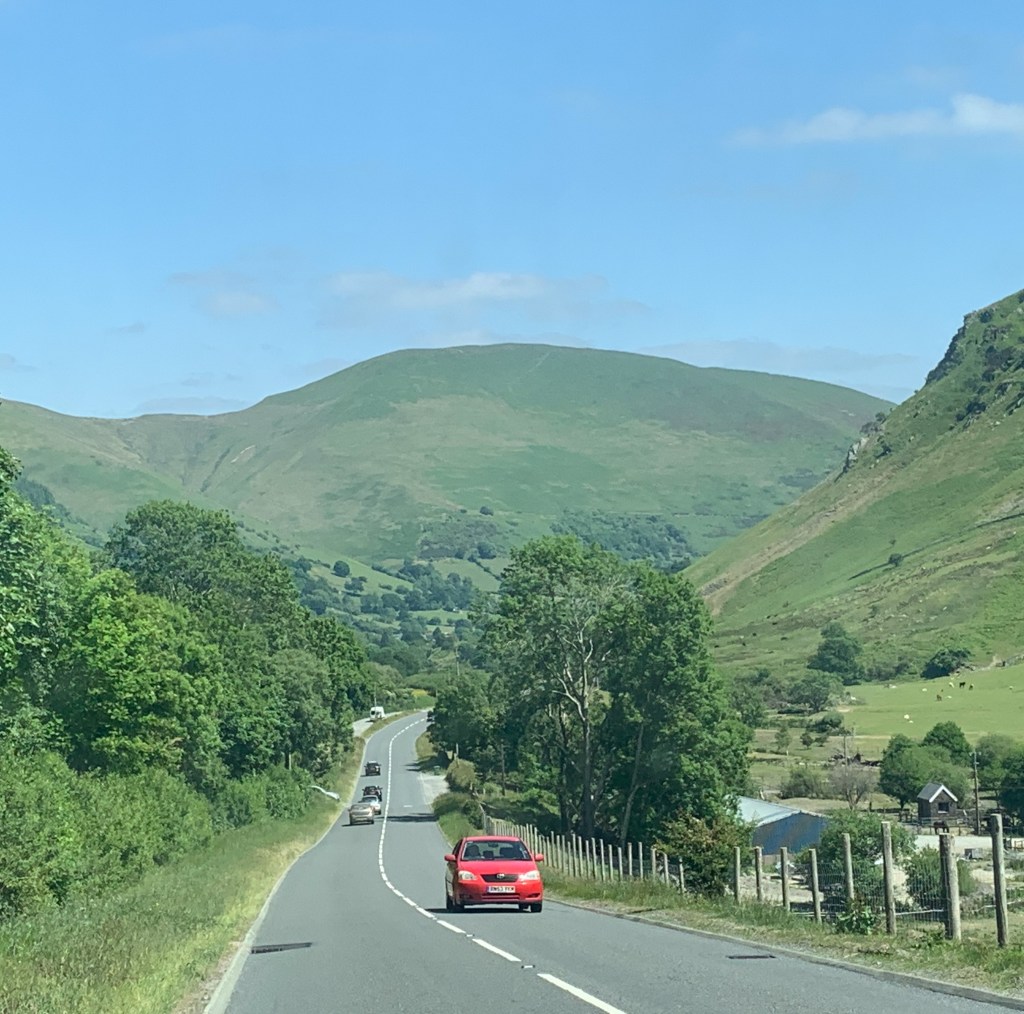
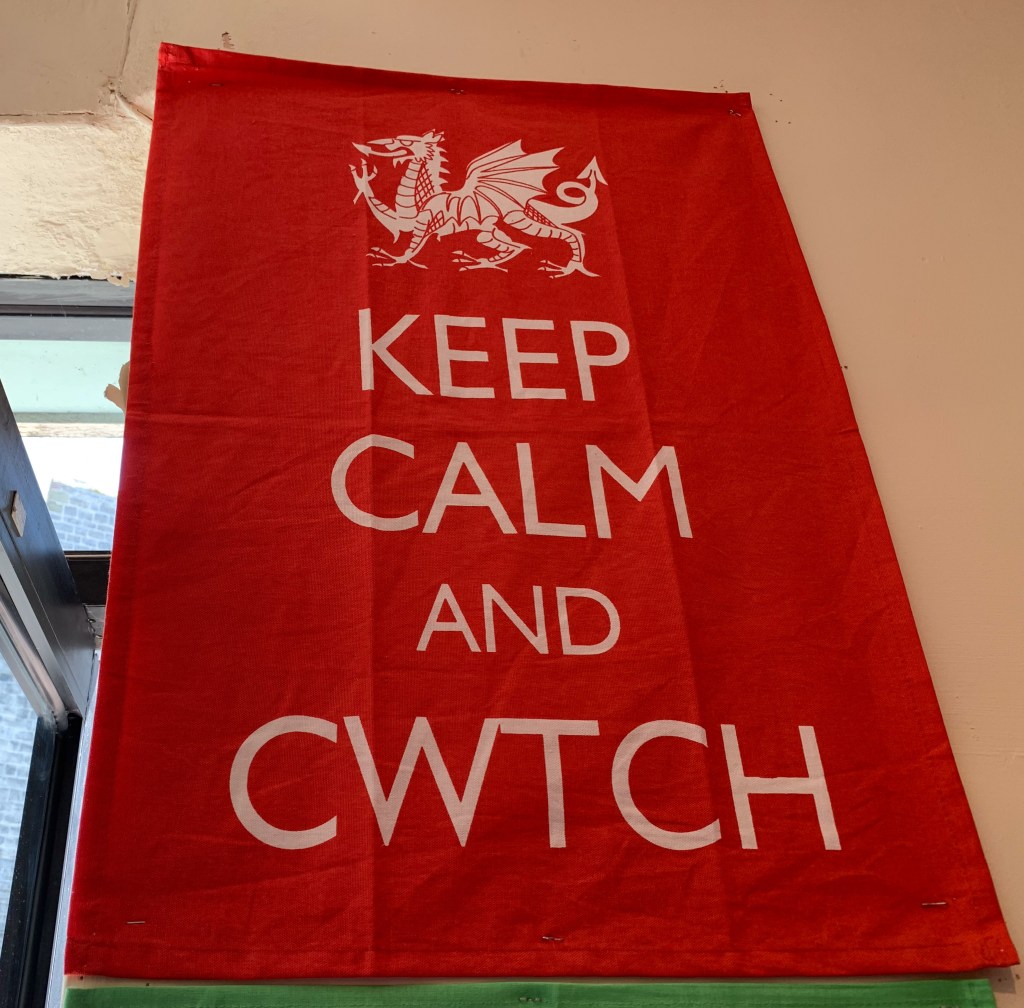
As we made our way out of Mid Wales and headed toward England, we continued to take in the beauty of the rugged, rolling hills and valleys, the green, green fields and the amazing variety of trees that cover the Welsh landscape. We also loved how many houses are adorned with gorgeous pots of bright flowers. To us, Wales also seemed like a very happy place with very friendly, welcoming people. We heard Welsh spoken quite often and never did figure out how to pronounce most words, but it was fun to listen to it. All the street and directional signs were in both Welsh & English. Over almost every doorway was the sign “Croeso—Welcome.” We learned one Welsh word we could really relate to, on a sign in a gift shop that said, “Keep Calm and CWTCH.” CWTCH means cuddle…one of our most favorite things to do!  🙂 🙂


We hope you’ll join us in England! Cheerio!