ICELAND – PART II – West & North

May 22, 2024
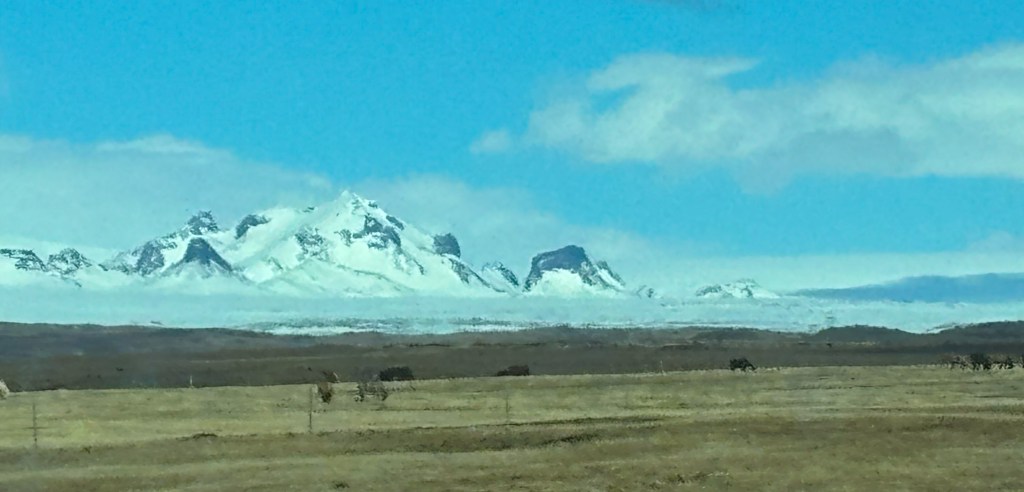
Mid-way through our Ring Road adventure, I found a Visitor’s Guide that helped me find better words to describe all that we saw and experienced beyond Reykjavik. Here’s part of what it says: “ICELAND—LAND OF CONTRASTS. Rural Iceland is a playground of wild beauty and endless space. The Icelandic countryside is made up of contrasts—rivers, mountains, valleys and waterfalls. There are also volcanoes and glaciers as well as hot and cold springs. There are many pearls dotted all over the countryside, each with its own powerful appeal. So, wherever you go in Iceland, no matter the direction, you will always find something to be breathless about.” How true!
Before we left on this vacation I read a novel that Gary’s daughter Joi had thoughtfully given me for Christmas called “The Color of Ice.” The author (Barbara Linn Probst) describes Iceland as “one of the most volatile places on earth. Forged by volcanoes that spewed out molten rock over millions of years, split in half by a massive tectonic place, with more extreme geothermal activity than anywhere else on the planet—it is a country always in formation, largely uninhabitable…. With an impossible language and an equally impossible climate, Iceland has earned its reputation as a country like no other.” Also very true!
Our first stop on Iceland’s 800-mile Ring Road was just an hour away—Borgarnes (BOHR-gahr-NESS), the main hub of West Iceland. We purposely made this a short day, (enjoying all the Icelandic horses, cows, sheep and lambs along the way) so Gary could continue to recover from his exhilarating 3-day photo tour. En route, we went through the longest underwater tunnel we’ve ever been in that went under the Hvalfjardargong Fjord. (I just found out re Google that this tunnel is 5770 meters long (3.5 miles) and reaches a depth of 165 meters (541’). Wow! The last part of this tunnel seemed to slope up for a very long time…no wonder!) One thing we particularly enjoyed in this small town (population 2,000) was an audio tour of The Settlement Museum with interactive exhibits showing where various settlers first arrived and carved out their farmsteads out of the wilderness that at the time was heavily forested along the coast. It was fascinating, and so was the adjacent café built right into the outside wall!


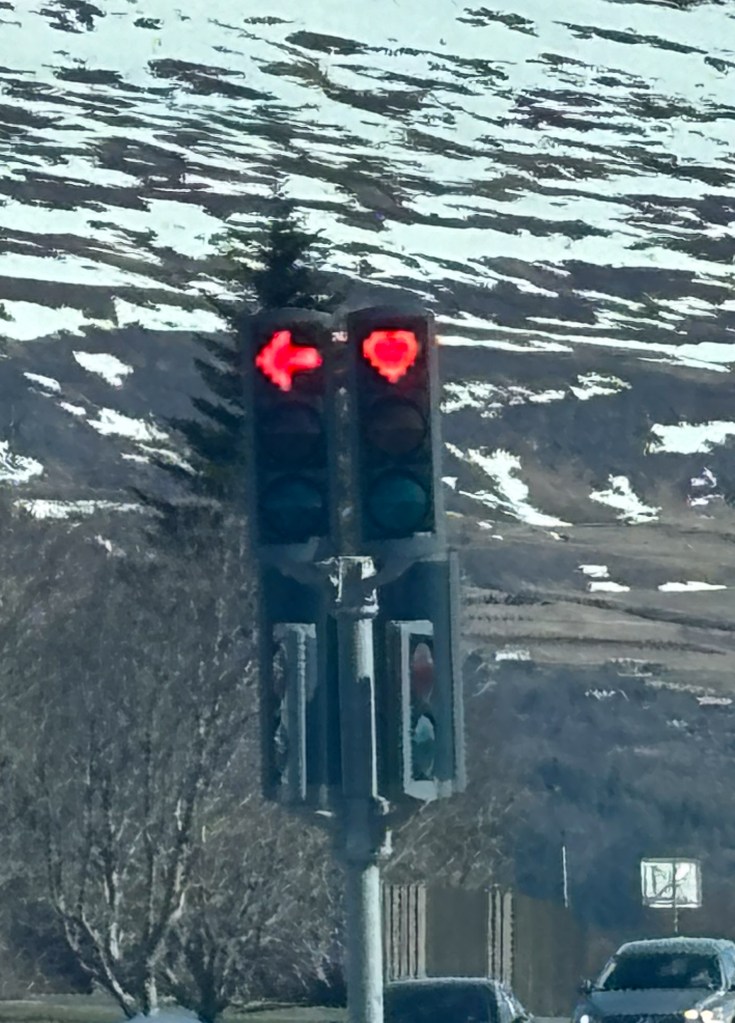
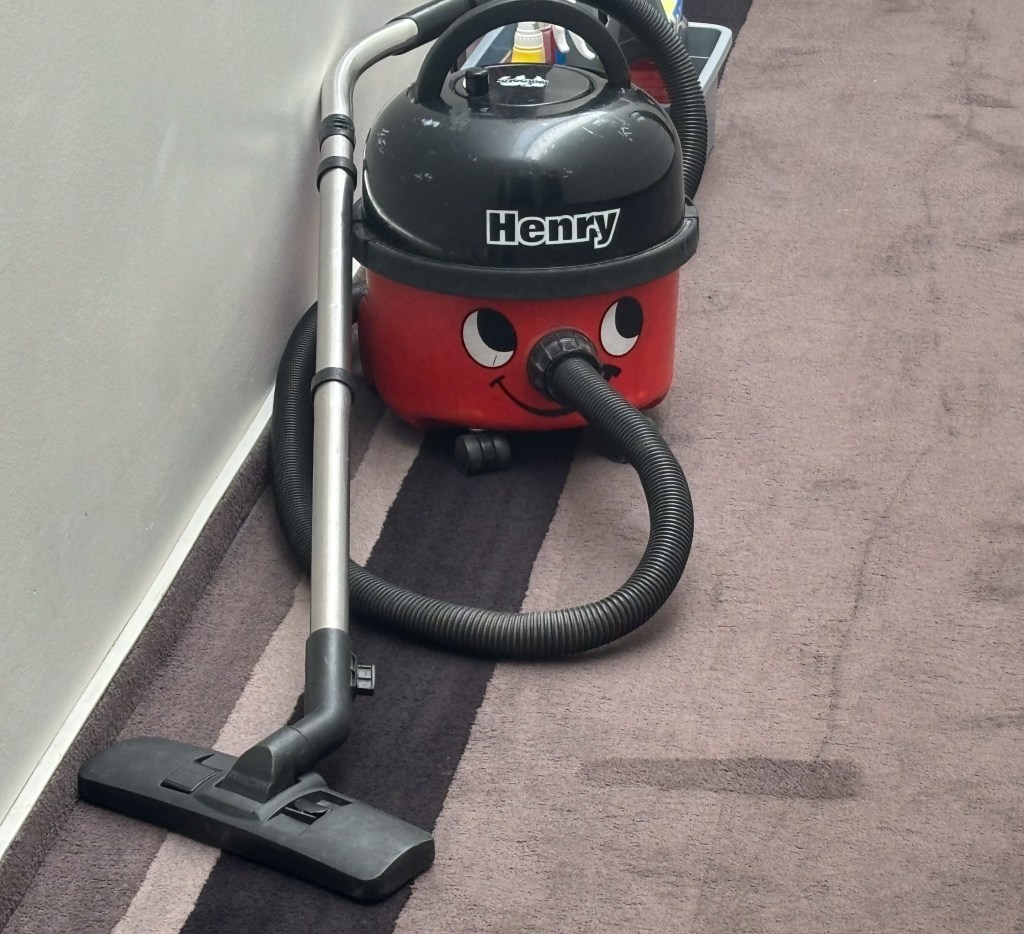
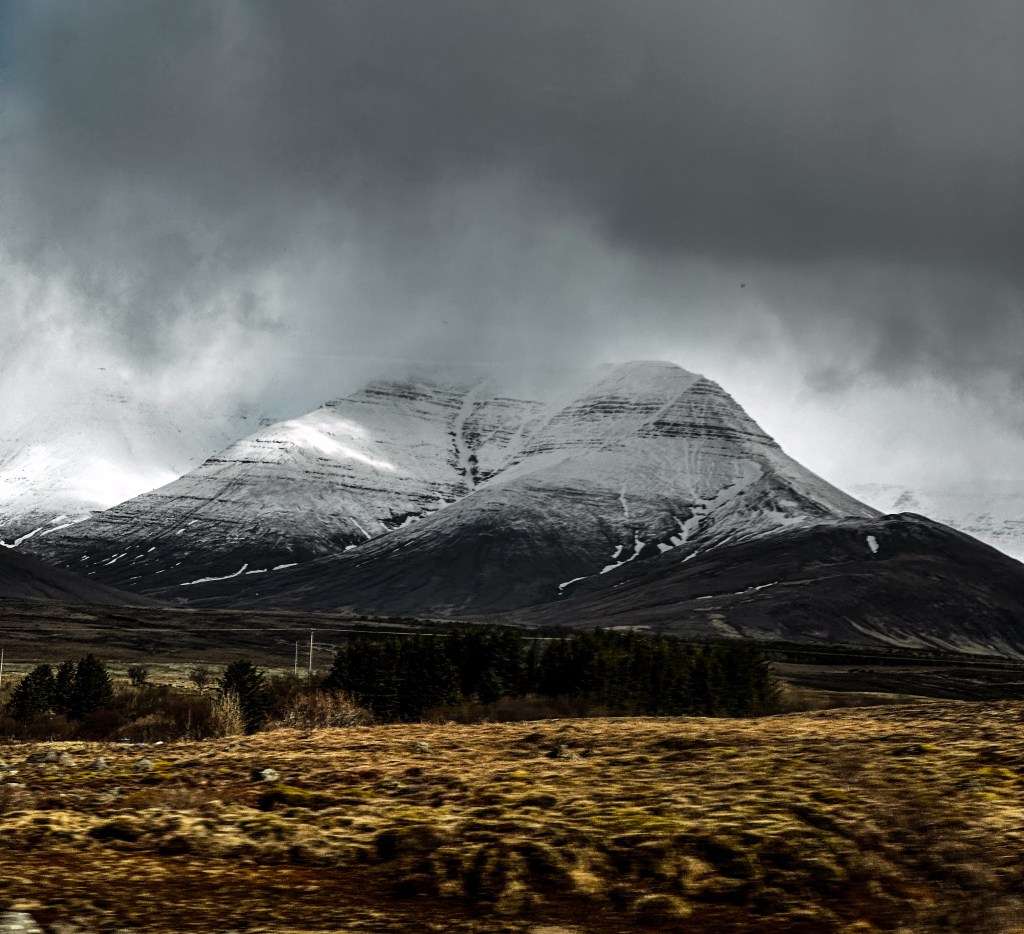
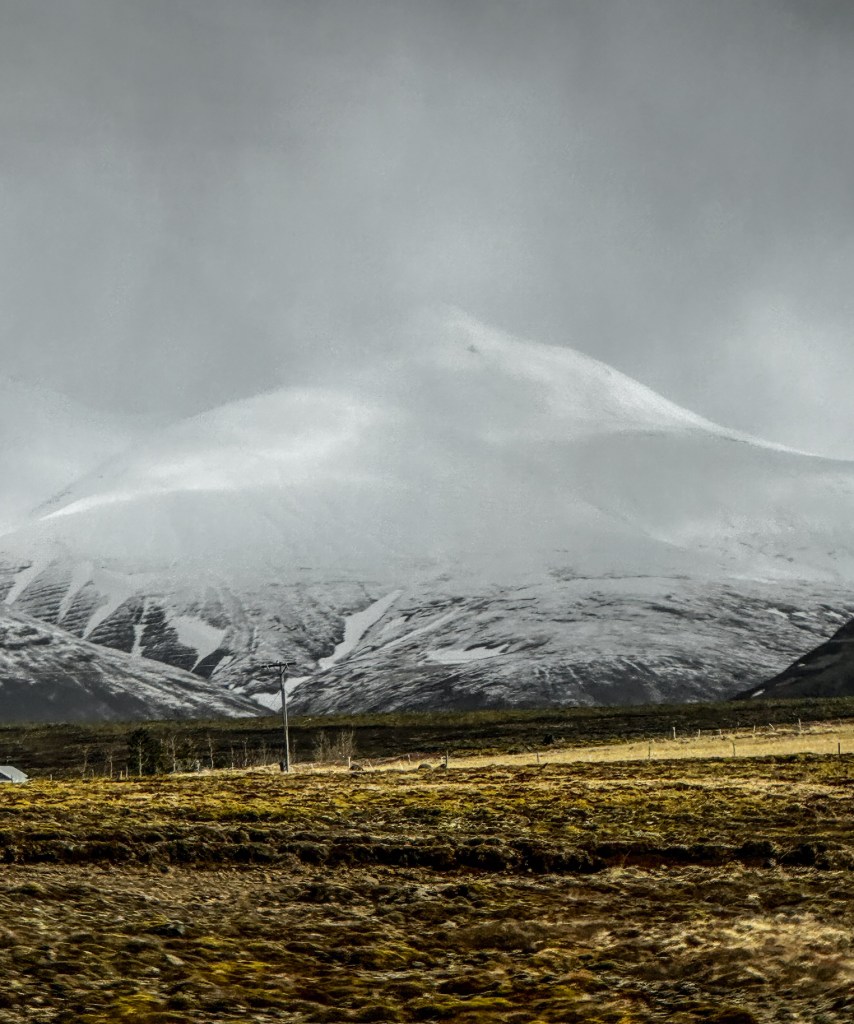
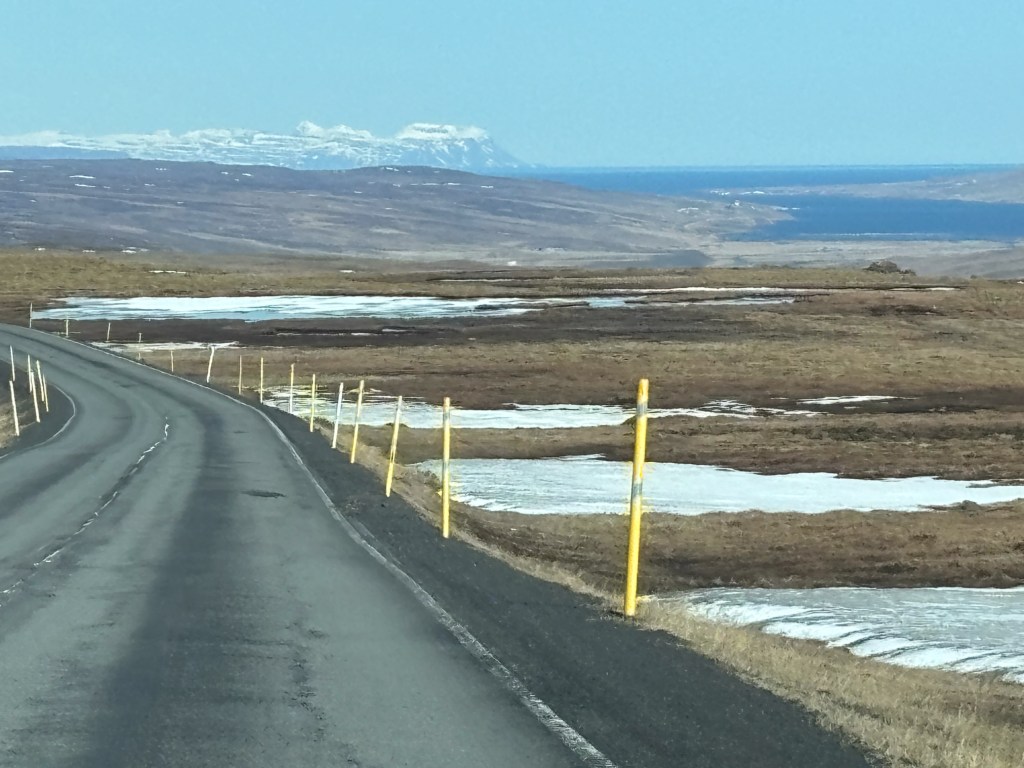
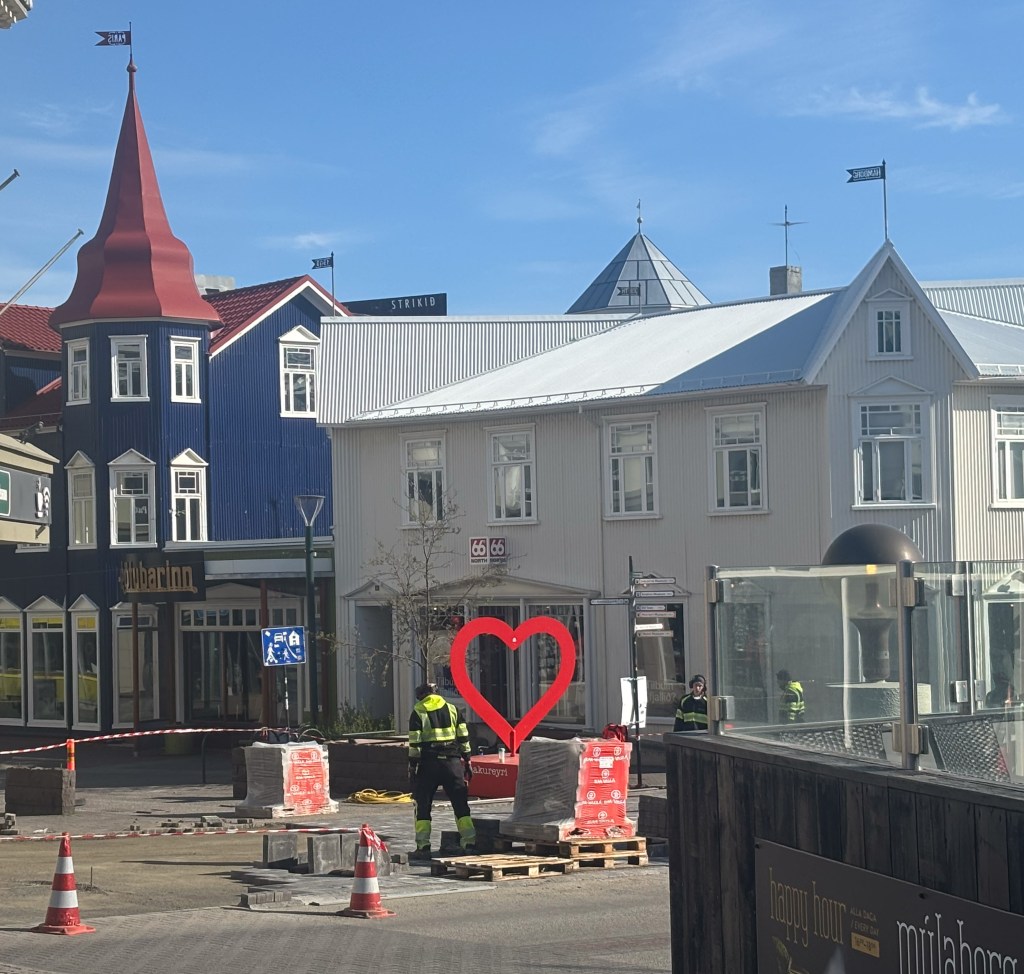
We stayed just one night a bit north of town to give us a head start on a longer travel day (3.5 hours) to Akureyri (AH-kuh-RAY-ree), the unofficial capital of North Ireland. On the way we drove over a pass that had higher snow poles than most places of the Ring Road (pictured below, which also shows what the 2-lane paved roadway looks like) and discovered several jagged peaks. Akureyri is right along the deep fjord called Eyjafjordur where fishing is the mainstay. I found this town of 18,000 people to be very light-hearted. Not only was there a wonderful red heart sculpture right across from our Kea Hotel, but the red in all its stoplights was in the form of a heart! Even the vacuum cleaner used by housekeeping also reflected the town’s joy!

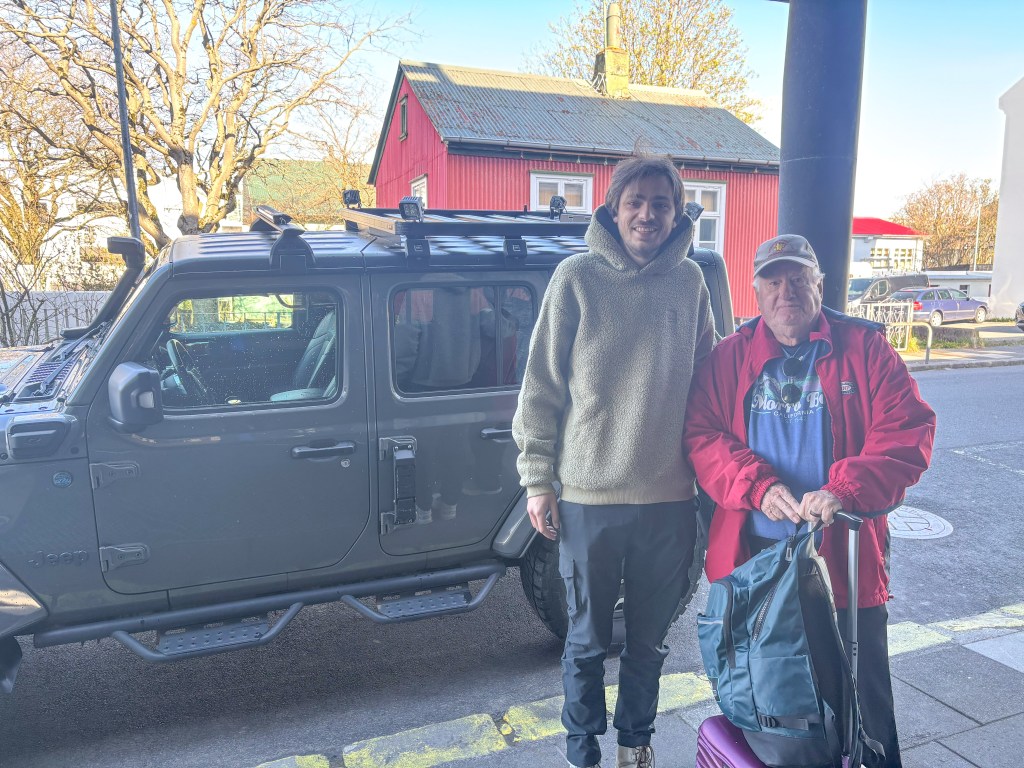
Once again Gary was able to go on another private tour. He thought it was a photo tour (that’s what he signed up for), but the 2 guides who showed up were actually adventure guides. They knew lots of great places to take him for pictures but were not photographers. We didn’t know this when he took off…in this crazy looking jeep with crazy looking tires. In the photo below right, note the tube connecting the tire to the jeep. This allows the driver to adjust the pressure in the tires from the inside for the different terrains he’s traveling over.
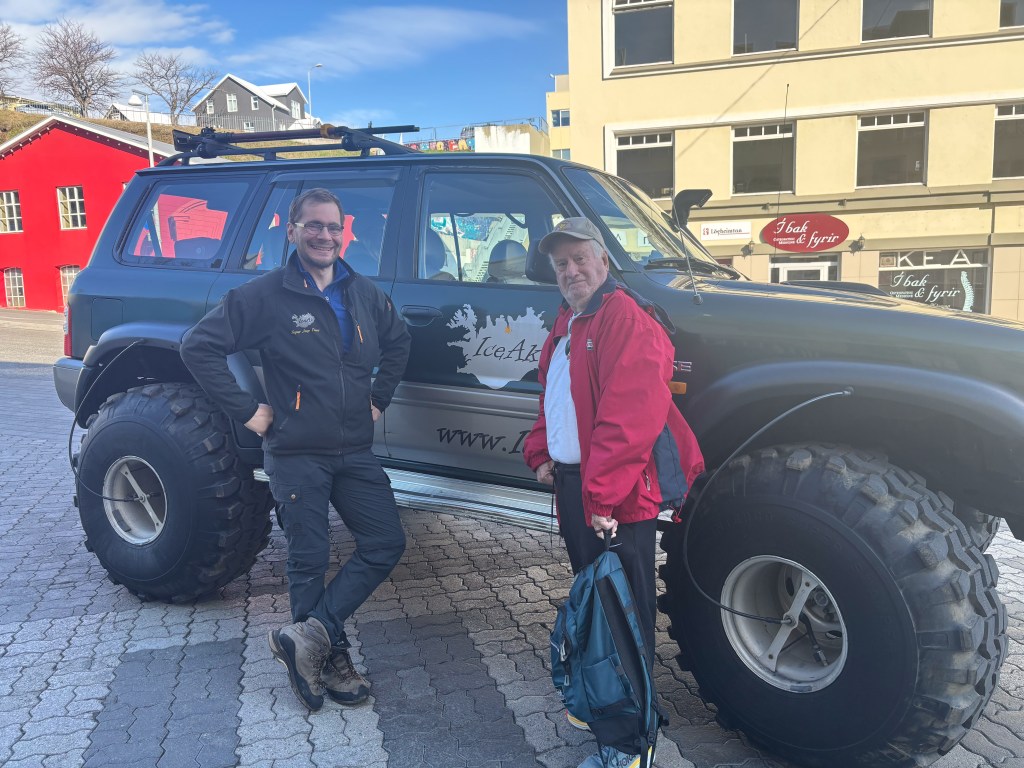
It turned out they really needed this feature because they ended up going into The Highlands, where only off-road vehicles (and no tourists) are allowed. (In fact, deeper into The Highlands and farther south is where NASA astronauts trained for the first moon landing!) Gary quickly adjusted to “adventure mode” and was thrilled to bump and roll through mud, slush, lava and rivers where anyone without experience would never be able to follow the “road.” If you click on each of the top 2 images below, you might enjoy bumping along with him and hearing hin laugh…or not!) It was amazing and, once again, he came back weary but exhilarated! One of the other highlights for him this day was taking photos of Godafoss, one of the most famous of all Iceland’s waterfalls. As you can see below, it is horseshoe-shaped; it is only 40’ high, but over 100 yards across.
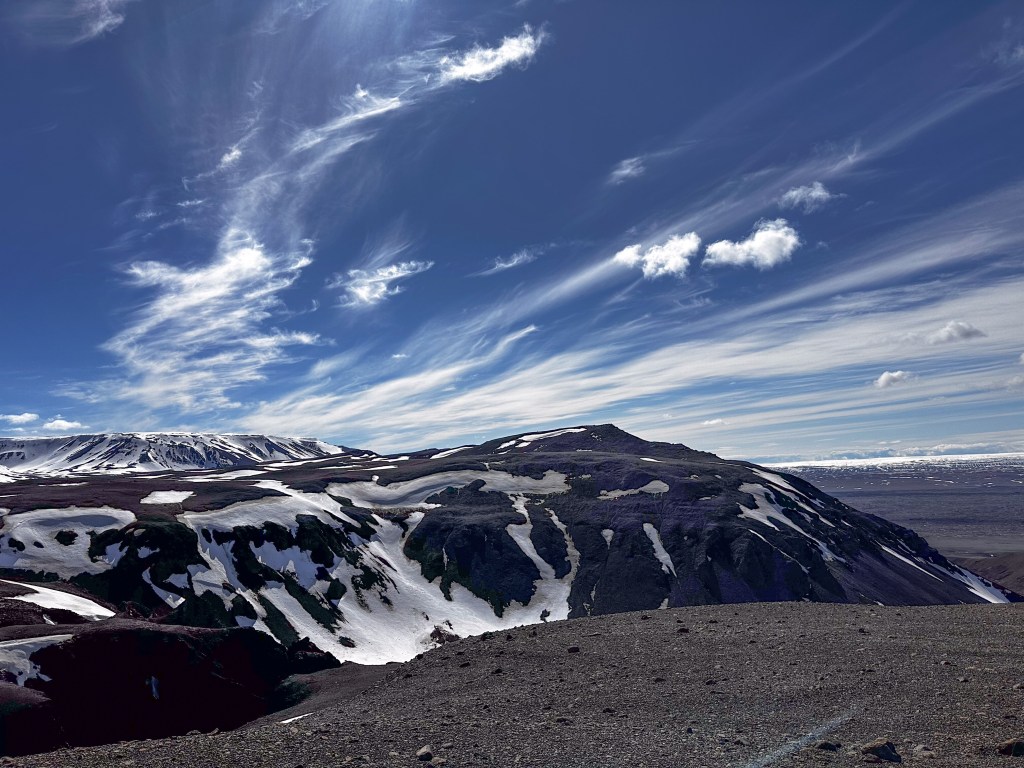
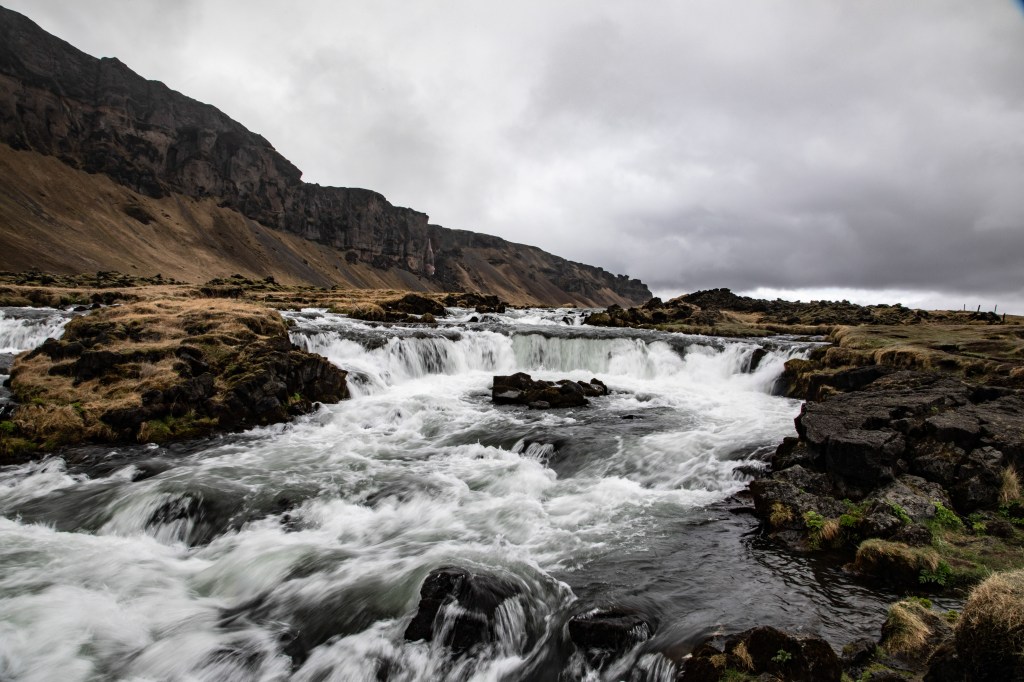
click on these two images above and below


We stayed 2 nights in Akureyri (again, part of our pacing). As we headed northeast the next day, the road took us through the 7.5 kilometer (4.6 mile) Vadlaheidi Tunnel—the only one with a toll, and we had to pay online within 24 hours either before or after traveling through it. Our destination was “The Whale Watching Capital of Iceland,” Husavik (HOOS-ah-VEEK) where we went on a 3-hour whale watching adventure (complete with wind- and waterproof overalls!) in the Skjalfandi Bay, a part of the Greenland Sea, just 35 miles away from the Arctic Circle!! This is the farthest north we’ve ever been. Fortunately, it was a bright and sunny day, but coming back across the Bay late afternoon, it was quite chilly and both of us got drenched from the bow spray. It was definitely worth it though, because the scenery was amazing and we saw several humpback whales, some quite close to our boat—a big, sturdy old wooden boat—and a wonderful North Sailing crew who were marine biologists so we learned a lot about these remarkable mammals.
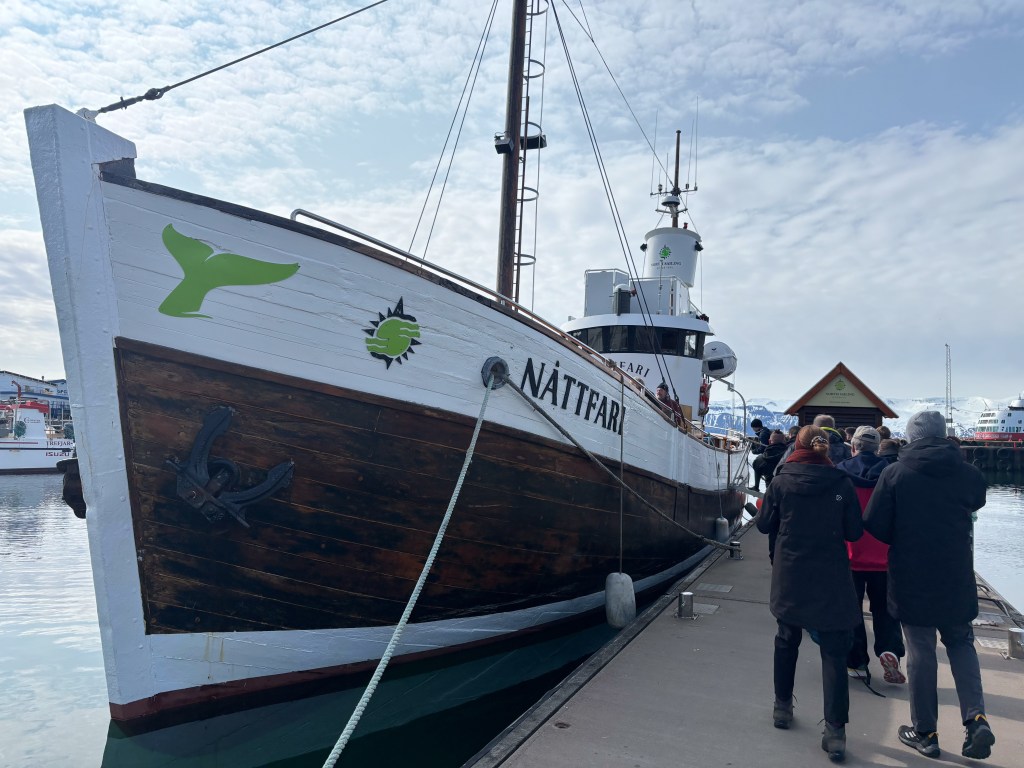

One of the reasons this area has so many whales is because there are far more nutrients in the water here, not only from plants, waterfalls and snowmelt, but also from the many daily earthquakes that release nutrients through the cracks in the ocean floor; when these reach the surface & daylight, the energy creates even richer nutrients for the whales AND the long, long daylight hours of spring & summer help create even more! (By the way, a 4,000-ton whale needs 1 ton of food per day!)


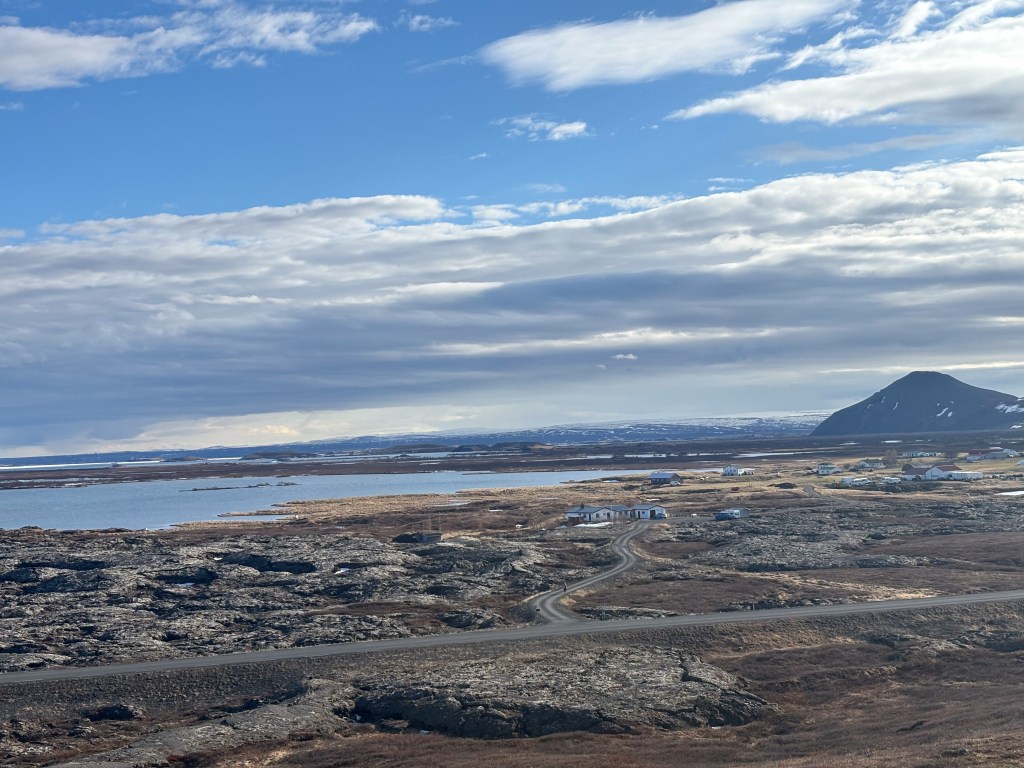
After whale watching, we had an easy drive to our next stop, Myvatn (MEE-vatn, n almost silent). Our wonderful Foss Hotel overlooked the volcanic Lake Myvatn.  I took two pictures from the balcony in our room to show the panorama and sent them to my daughters (views from our room have become a part of our reporting to them as we go along), and Carolyn wrote back: “Kinda makes you miss a good tree.” Only then did we realize it had been several days since we’d seen any trees, and it was another 75 miles east of here before we finally came across a few small forests. After Carolyn’s text message, Gary and I laughed every time we looked out the windows of our hotel. We could see for miles in every direction, and, in the vastness, there were NO TREES!

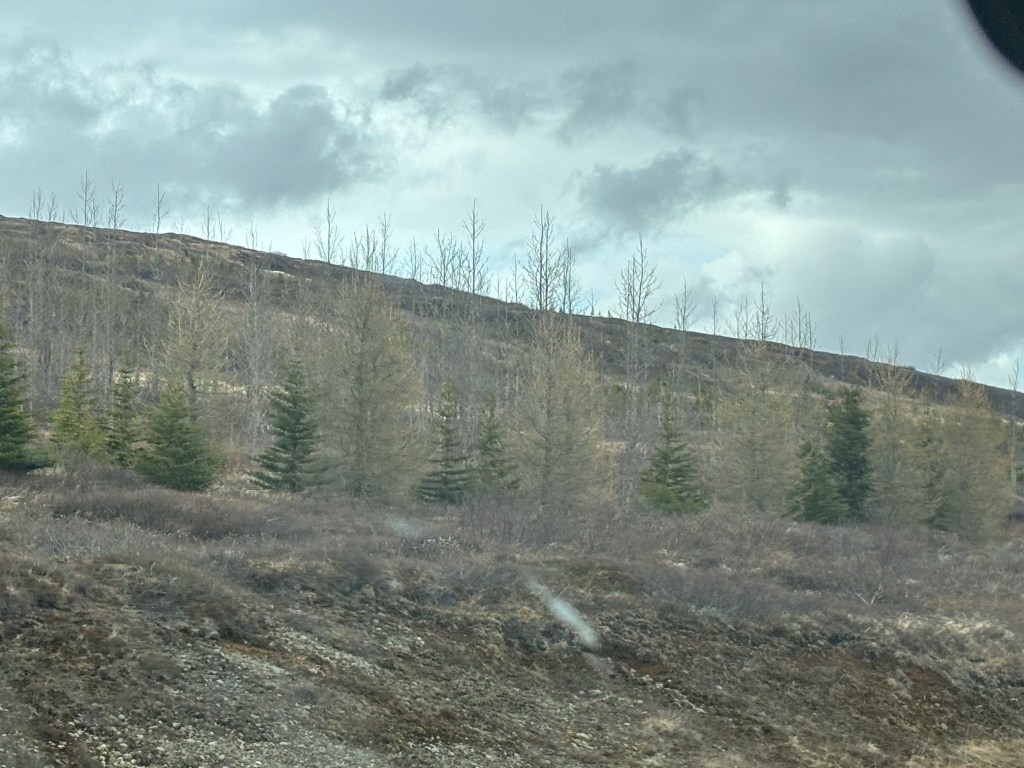
We learned that when the Vikings arrived in the 900’s, there were so many trees along the coast where they settled that they had a hard time navigating through them. Land was cleared to create fields and pastures for the livestock they brought with them and to grow hay. Trees were cut not only to build houses but also for firewood to get residents through the long and bitter-cold winters. AND, volcanic activity through the centuries destroyed most of the rest. Currently, Iceland has relatively few trees, covering only 2% of the land, but there is a huge reforestation program in place whereby over 7 million trees are planted each year. There’s an Icelandic tree saying from pre-reforestation times that is often recited to tourists: “In Iceland if you see three trees together you have a forest.”
As we made our way across to the East, we began to see more and more real forests—primarily birch and spruce, some more mature than others—AND, there are still lots and lots of hugely vast spaces where there are no trees or forests at all—not even three trees together!

We’re still finding it hard to describe what we saw and experienced, but we’ll keep trying!
Away we go to Eastern Iceland (often called the Eastfjords) and beyond. Stay tuned!
ICELAND – PART I – Overview & Reykjavik

May 20, 2024
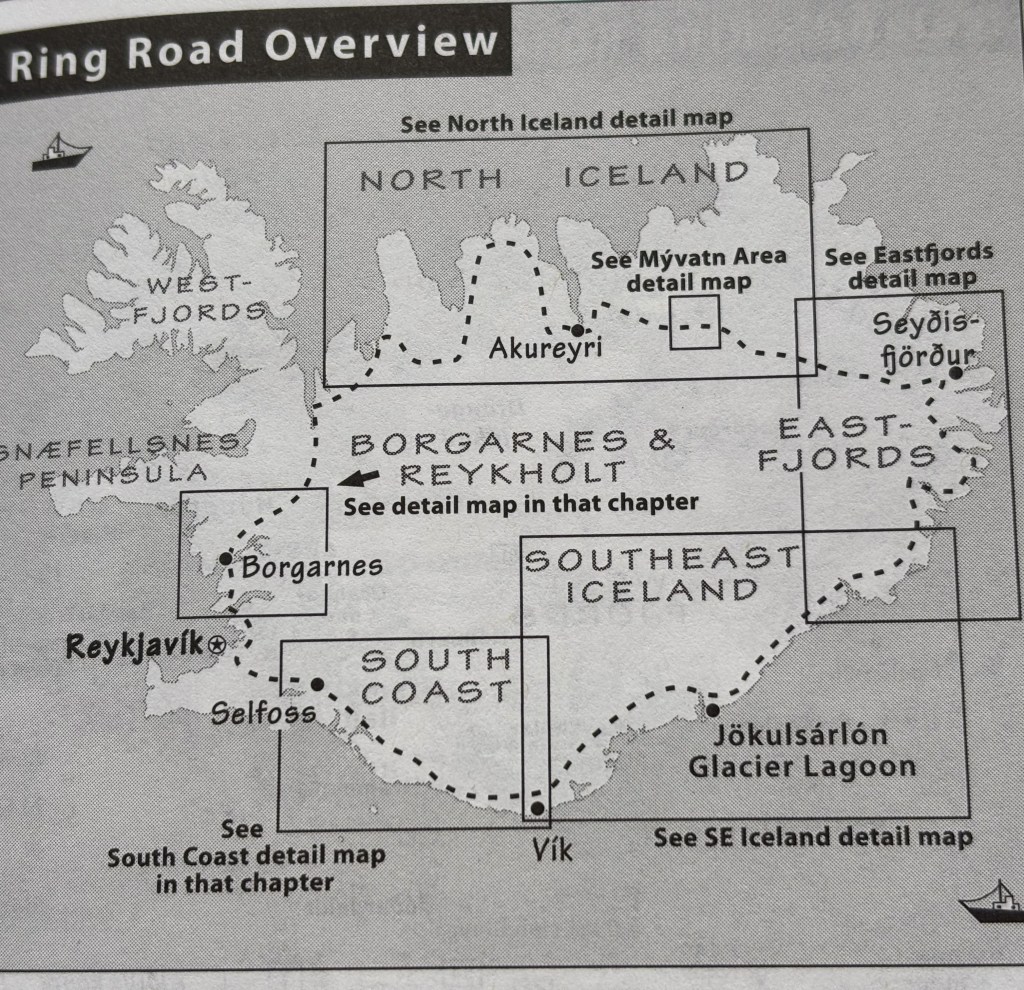
It’s been awhile since I’ve written anything about our continuing adventures. AND, what I’ve realized is that I simply haven’t found the words to even begin to capture all there is to share and describe about Iceland. We’ve been here for almost 2 weeks, having almost completed our drive around the “Ring Road”—all the way around this amazing country –and I haven’t known where or how to begin! Geographically, Iceland is divided into several sections, as shown on the map below (from Rick Steves). Perhaps this will help as we attempt to paint pictures of what we’ve experienced, one geographical area at a time.


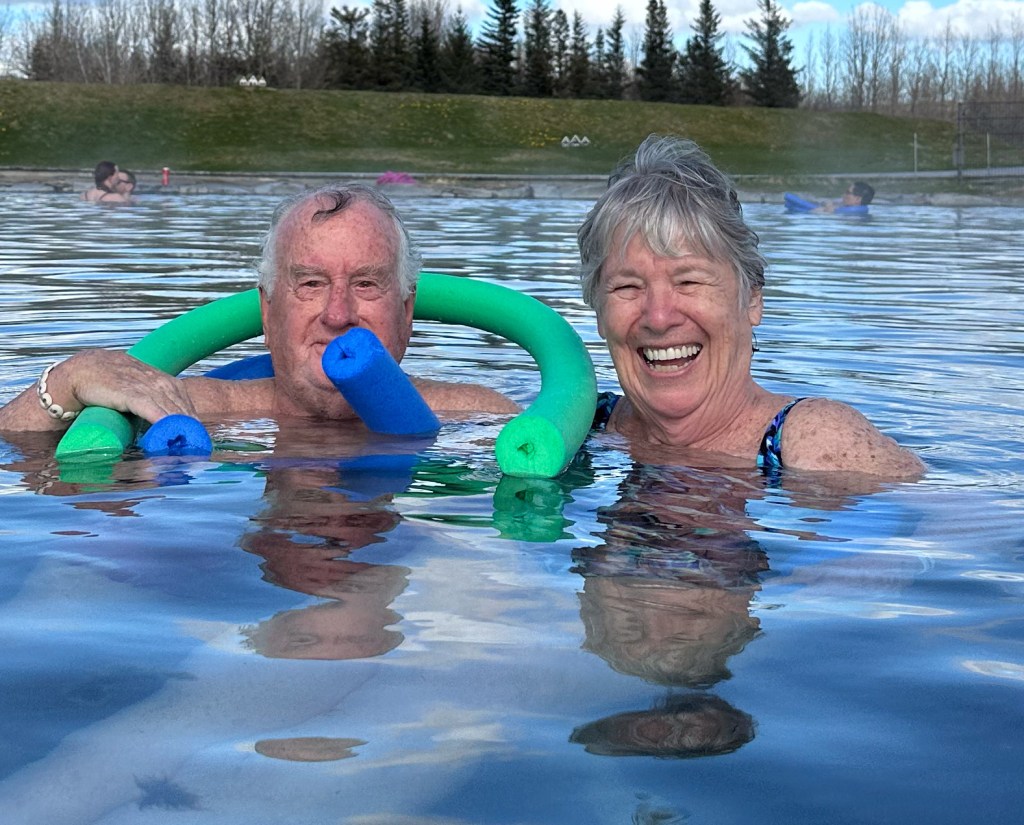
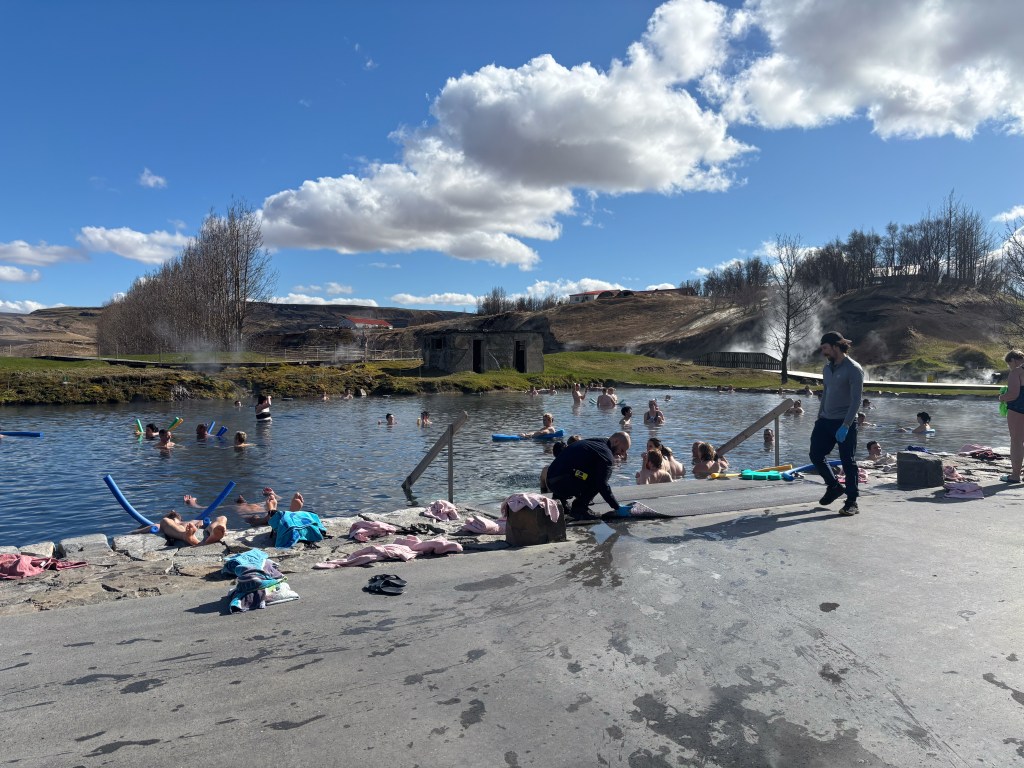
Iceland was first populated in the 9th century by Norse settlers, some of whom took Celtic slaves and wives from Ireland and Scotland along the way. There is evidence to suggest the island’s existence had been known for centuries and Irish monks may have come here to meditate and worship in solitude. Once the Vikings and their pagan ways arrived, the monks left. During the Viking Age, the Icelandic language developed from the Old Norse of Scandinavia. It is one of the hardest languages for outsiders to learn but is still spoken by most Islanders (even though most also speak English very well). Icelanders are quite proud of their Viking heritage and the many customs that come along with it. Iceland is also quite proud to be a “land of renewable energy” because energy generation comes from 100% renewable resources—mostly hydro, but also from wind and geothermal. In fact, geothermal energy provides heating and hot water for the majority of buildings in Iceland, plays an essential role in growing vegetables all year round in geothermal greenhouses and provides enjoyment in the form of geothermal pools all around the country. The Blue Lagoon near the country’s capitol is the most famous pool. We chose our first experience in a smaller, less known “Secret Lagoon” that was quite refreshing, delightful and much less crowded.


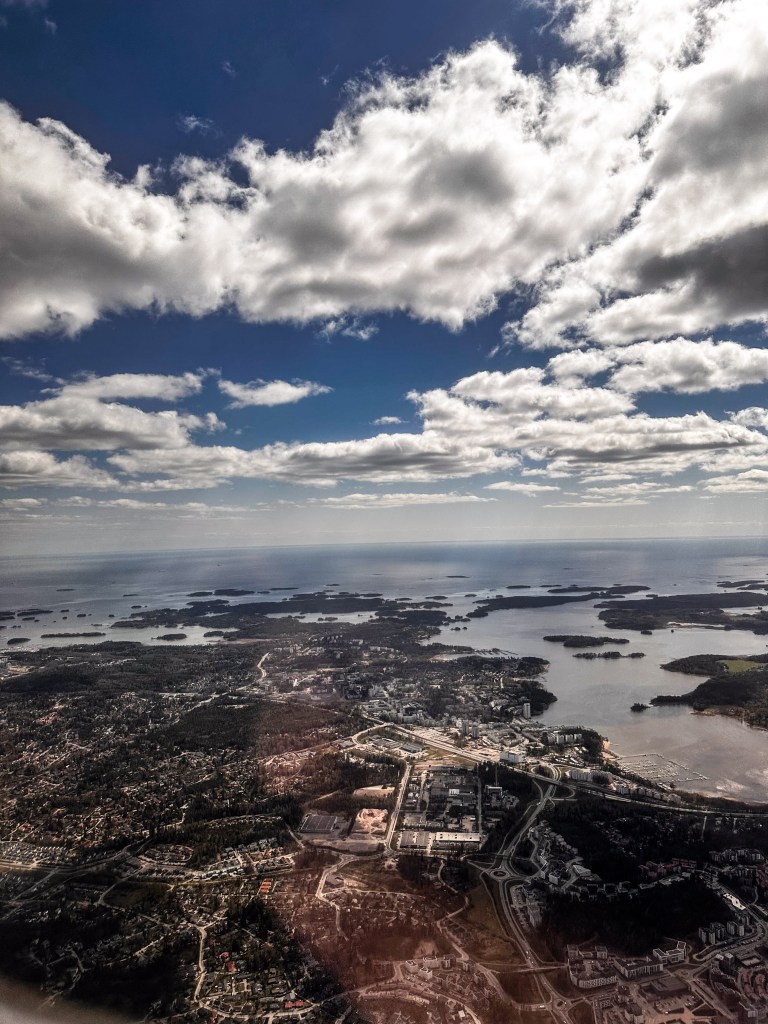
Gary and I flew from Venice, Italy through Helsinki, Finland (above right) to Reykjavik (RAYK-yah-veek), the northernmost and smallest capital in the world, where about 60% of Iceland’s population resides—70,000 in the city itself and another 70,000 in its 6 surrounding suburbs. It sits on the west coast of Ireland about 40 miles north of Grindavik, where the volcano has been erupting in recent months. (It stopped soon after our arrival and started up again the day after we left!)
Some of you might recall that it was in Reykjavik that American chess grand master Bobby Fischer defeated Russian grand master Boris Spassky for the world championship in 1972. In fact, Bobby Fischer is buried just south of Reykjavik. But it wasn’t until after the 2010 eruption of the Eyjafjallajokull volcano (“E-15” for the 15 letters after E, since no one could pronounce this) that Iceland caught the attention of the world and the tourist industry began to boom. You may also recall that the ash from this particular eruption polluted the air all over Europe and disrupted flights there for fear it would damage jet engines.

We rented a car at Keflavik International Airport and it was an easy drive to our elegant “Holt Hotel—The Art Hotel” near the center of Reykjavik. The owner’s father created this hotel to house his extensive art collection, which can be found throughout every room and hallway. There are over 50 original paintings by one of the most famous Icelandic artists, Johannes Kjarval (sample below) and a huge variety of elegant furnishings and other art. We loved it!


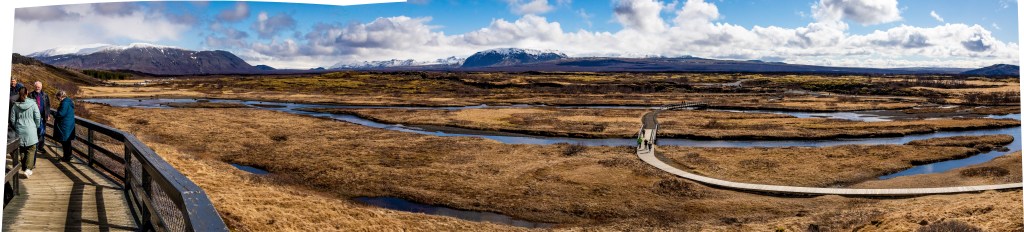
The second day we took the very popular 8-hour guided “Golden Circle Tour,” and this was the perfect way to begin to get acquainted with the Iceland we came to love and appreciate, with all its natural contrasts and splendor, fascinating history and stark beauty. Often there would be flat, brown grasses for miles (and sometimes a lake) and then an amazing mountain, volcano or glacier beyond.


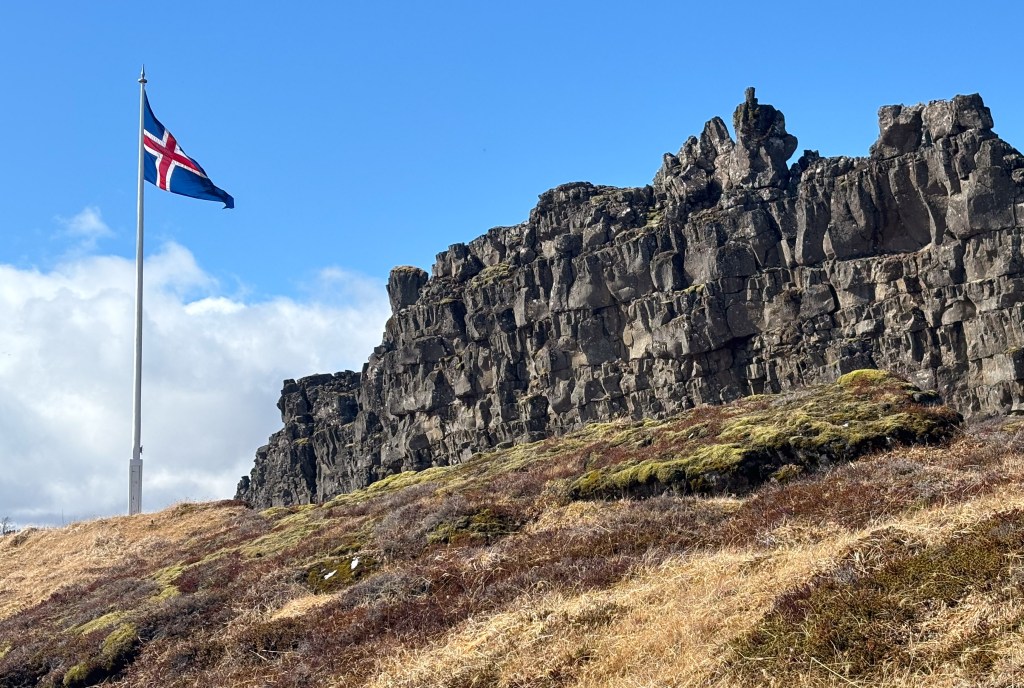
We were especially intrigued with a visit to Thingvellir, a dramatic gorge marking the pulling apart of the Eurasian and North American Techtronic plates. This creates great tension and causes most of the 185+ earthquakes that take place each day (and rarely felt). This is also the site of the country’s annual assemblies in the Middle Ages (and the first Parliament) and where many gatherings and festivals take place today (note the Icelandic flag: red for fire, blue for water, white for ice).


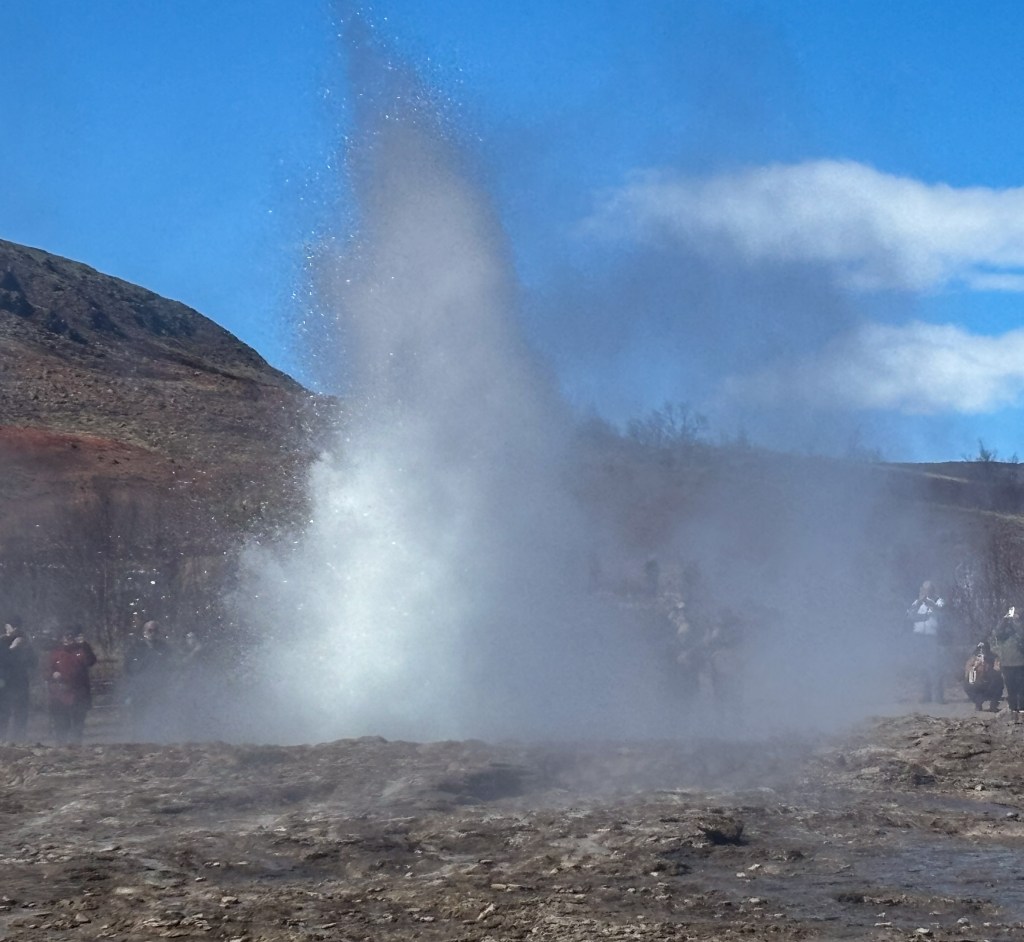
We visited a bubbling geothermal hillside and also got to see where locals use the geothermal heat to bake bread! They bury it in the hot soil, forming a cone (above, right), and in 24 hours, it’s done! On this tour, we also saw Strokkur, Iceland’s most active geyser (shoots steam 260’) as well as the amazing Gullfoss, one of Iceland’s many impressive waterfalls (105’). One of my favorite parts was stopping to meet and pet a few Icelandic horses that I’ve heard and read so much about recently (more about these later). It was also on this day trip that we enjoyed a favorite Icelandic ritual of the thermal bath at the Secret Lagoon (first photos above).


For the next three days Gary the Photographer went on a Photo Tour of Iceland’s South Coast. He thought he was going to be in a group, but it turned out he was the only one and he was thrilled to have a private tour! His guide was a very talented photographer named Kevin who took him to glaciers, lagoons, and the amazing black Diamond Beach, where icebergs end up tossed there by the waves when the tide comes in. He also photographed waterfalls and volcanic fields covered with lava and often with moss. We’ll share lots more about this when we both visit the amazing Southeast Coast on the Ring Road (Part III).


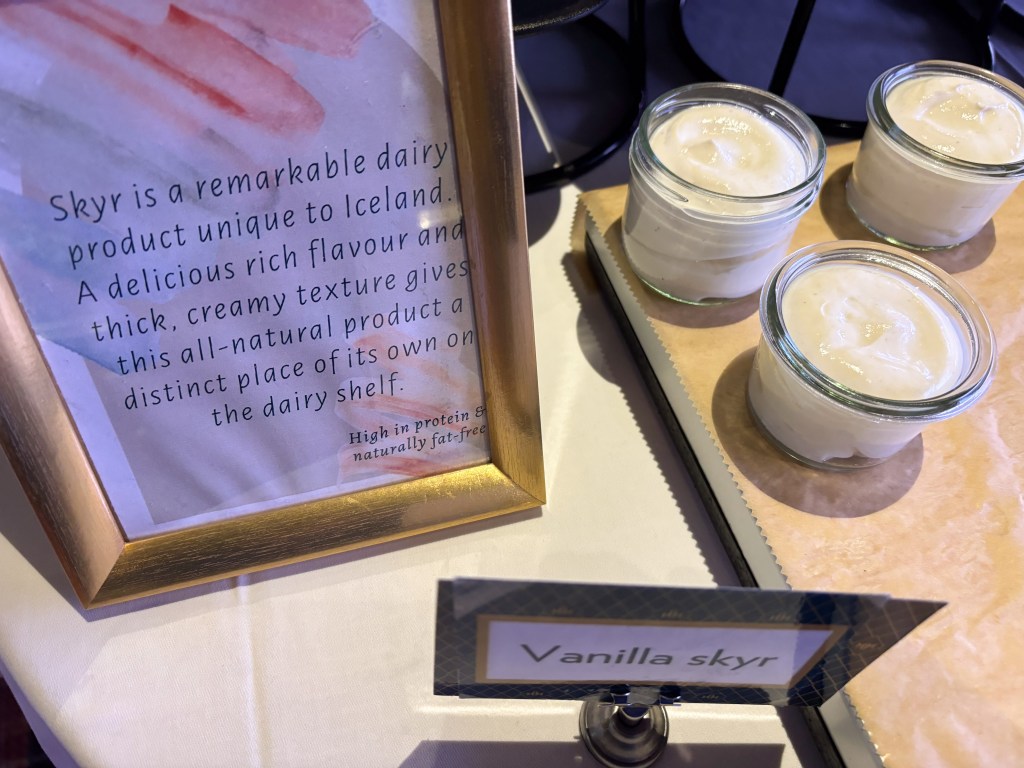
While Gary was gone, I took quite a bit of time to simply “be” after so many weeks of traveling at a fairly steady pace. It was supposed to rain the last two days so the first day I took a taxi to the Reykjavik Park & Zoo. I wanted to see an arctic fox and reindeer! I just Googled this to make sure I had the name of the zoo right and discovered a pretty perfect description: it was “quite underwhelming”—very small with just a few animals compared to most zoos I’ve been to. However, it was very fun to walk around and see 3 reindeer, several herds of goats, some more Icelandic horses, cows, pigs, rabbits, a falcon, some frogs and a very cool iguana. I think I was the only one there who didn’t have a stroller, but it was fun to watch and hear the children’s joy and awe at animals they were seeing for the first time. (Unfortunately I didn’t get to see the arctic fox who was holed up in his den, but I heard there’s one at the Santa Barbara Zoo—about 2 hours south of where we live—so maybe I’ll get to see that one day.) I love animals and it was a fun way to get some walking in. Another day, I walked to a nearby restaurant to have some Icelandic lamb soup. This has turned out to be one of our favorite meals all the way around the country. Another discovery was a delicious breakfast treat called Skyr (“skeer”), like a very thick and creamy yogurt—plain, vanilla, strawberry & blueberry. Yum!!


One of the most fun parts of these three days was Gary’s return from his private photo tour. He was the “happiest tired” I’ve ever seen. So full of awe and wonder, photographing many things he’d never seen before for 3 full days (without his usual naps or stretch-outs) with an amazing young guide. He was both exhausted and exhilarated, with child-like glee, and we look forward to sharing a gallery of his/our photos from this amazing experience in our next blogs. (We’ve decided to organize these Iceland blogs geographically, starting in Reykjavik and traveling all the way around the island clockwise, so these amazing photos will appear after we’ve traveled on the Ring Road through the North and East because they were mostly taken on the Southeast Coast, which is on our way back around to Reykjavik. Hope this makes sense!)

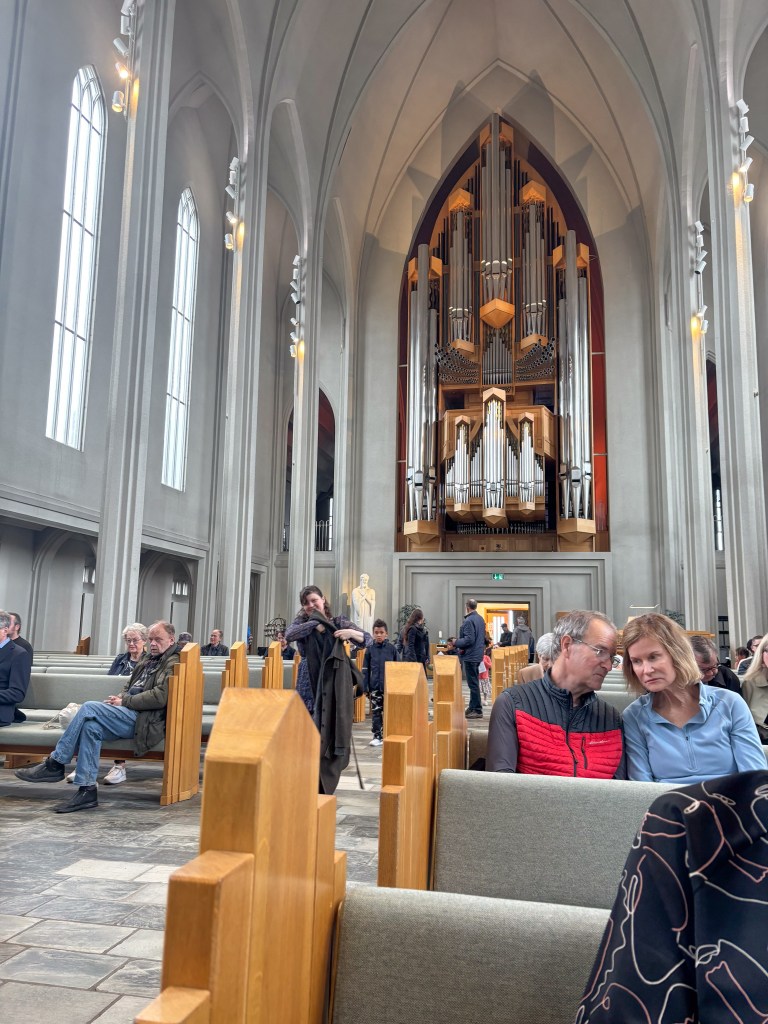
Our final full day in Reykjavik had always been planned as a well-deserved day of rest. However, not too far from our hotel was the iconic Hallgrimskirkja Lutheran Church (HAHTL-greems-KEER-kyah)—a remarkable 250’ high concrete structure completed in the 1980’s and named for a 17th century Icelandic poet Hallgrimur Petursson who wrote a series of 50 hymns called The Passion Stories.


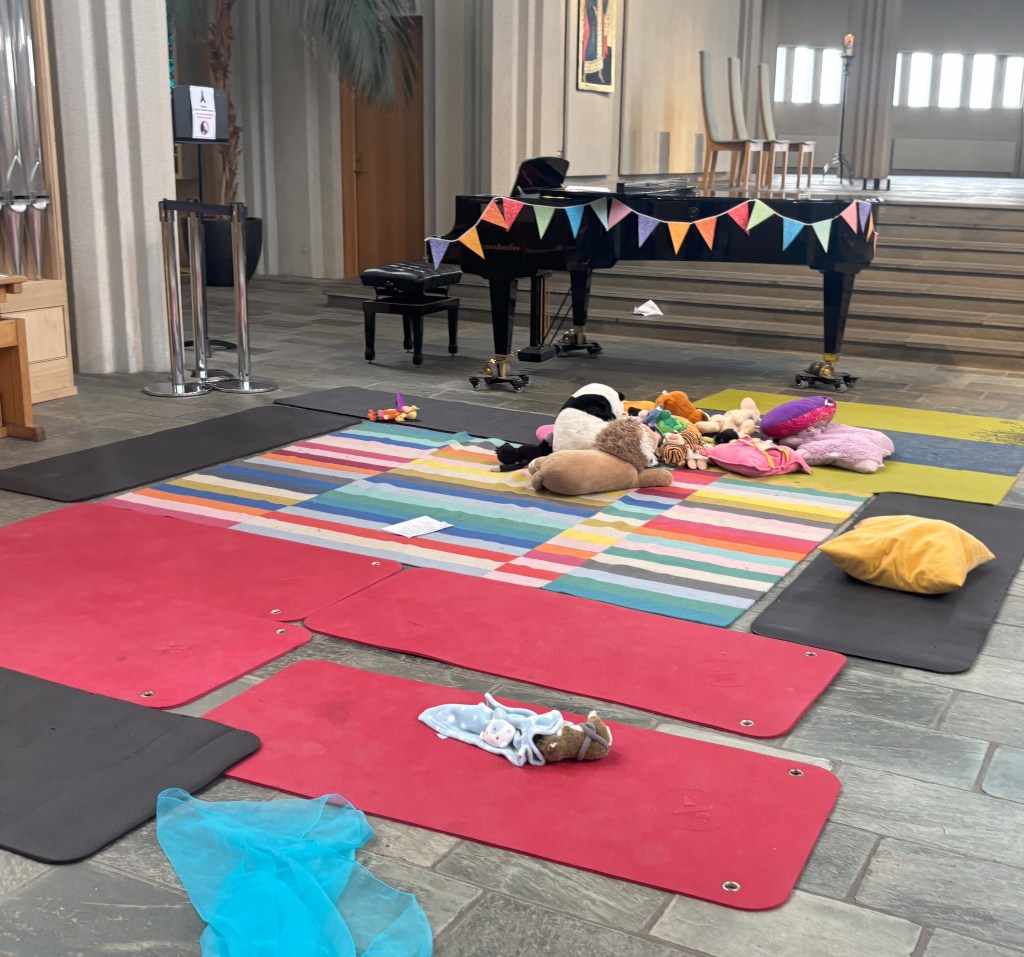
The outside of this cement building is a basalt-column motif soaring skyward recalling Iceland’s volcanic origins. We had heard about its massive concert organ with its 4 keyboards and 5275 pipes. I’d hoped we could hear an organ concert but none were scheduled until summer. So I got the idea we could go to a church service on Sunday morning to hear this amazing instrument. AND, it turned out it was their monthly “family service” where everything was geared toward the children. There were blankets and stuffed animals laid out on the floor at the front of the church, trays of dirt to play in with plastic toys.  There was a choir of tweens leading all the singing. The minister spoke to the children in between songs and encouraged them to sing and play. At one point, each child was given a large scarf and encouraged to toss it up in the air. Such joy!

The church itself was surprisingly austere—all cement, no art to speak of (except two small posters of angels or saints beyond the pulpit)—and the whole service was in Icelandic. We couldn’t understand a single word that was said, but we  really didn’t have to. The whole experience was one of pure love and pure joy…it was so easy to feel the presence of the Divine. A smaller organ near the front was used to accompany all the singing, so it was only at the beginning and at the end of the service that we heard the large organ. However, after the service several tweens took their turn at the keyboard, each playing a song on the big concert organ, which is at the rear of the church. Because the organ is so important, all the seats in the church are designed so that the back flips over and congregants can face the organ. It was all pretty amazing and VERY uplifting. Thinking about this Sunday service experience still warms our hearts and souls.


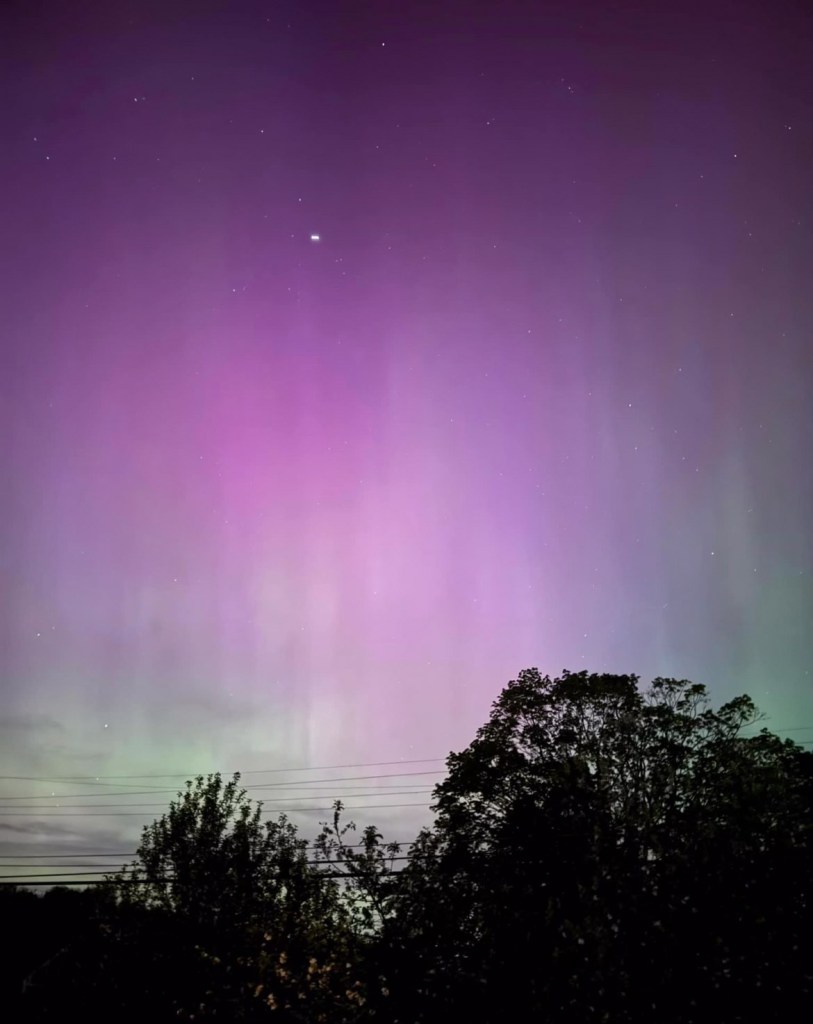
Gary got a good nap in all afternoon, recovering nicely from his 3-day photo tour, so we then went one more place that turned out to be a “must.” Many of you know that Iceland is most famous for its prolific show of the Northern Lights (Aurora Borealis) usually from October to April. (In spring and summer months the sun sets after 10pm and rises before 4am, so there aren’t any dark skies.) Younger daughter Laurie Alice (which, in our family, we’ve always rhymed with Aurora Borealis!) has always wanted to see the Northern Lights—definitely at the top of her bucket list. She was so hopeful we might get to see them and take some photographs to send her. AND, early Saturday morning, May 11, there just happened to be a huge solar storm (first in 20+ years) that allowed people in many parts of the world (even California) to see the Northern Lights where they are rarely viewed. Laurie and family knew this was a possibility, AND, here are some photos she and her daughter Emmy took that night from their driveway in Tolland, Connecticut (about an hour west of Boston, 15 min. north of U.Conn)! They even captured the International Space Station flying over (below, right). What an experience they had!


Since we couldn’t see the Northern Lights in person, we went to a show about them at Reykjavik’s Aurora Northern Lights Center, where we not only saw spectacular videos and photographs of this phenomenon but also learned about some of the legends and superstitions that attempted to explain these once-mysterious dancing lights. We also learned more about what causes them. I like the explanation on Google: They are created when energized particles from the sun slam into and interact with the gases in the Earth’s upper atmosphere—the ionosphere—(at speeds of up to 45 million mph!). Our planet’s magnetic field protects us from this violent onslaught, redirecting the particles toward the poles (there are Southern Lights too). That’s what creates these amazing visual displays of colorful light waves. The recent displays beyond the far North were caused by an unusually powerful solar storm.


On our way to this show, we drove along the sea wall of the North Atlantic Ocean to see the iconic metal sculpture of a Viking ship called “Sun Voyager.” Beautiful!  Everything we did this day was a perfect ending to our 6-night stay in Reykjavik. And now we’re ready to start our 800-mile journey around Iceland’s Ring Road. Here we go!

SLOVENIA & ITALY

May 7, 2024
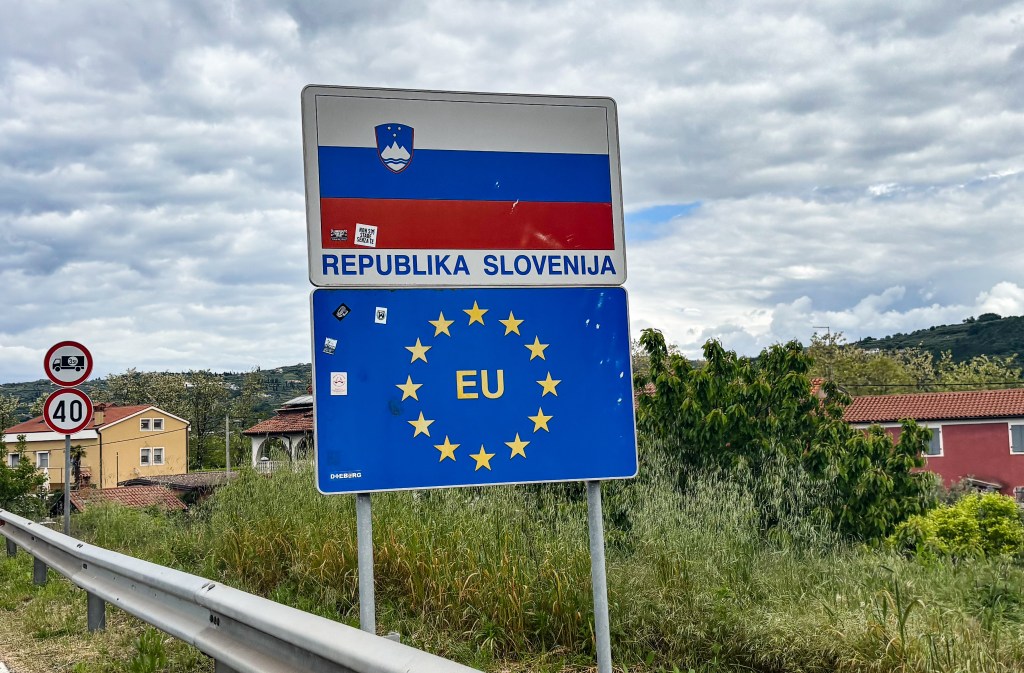
Leaving Croatia was a wee bit difficult—we liked it so much. AND, we very quickly got immersed in the change of scenery as we made the relatively short drive from Rovinj, Croatia to Trieste, Italy. There were still lots of tunnels (mostly shorter) and the divided highway made driving easy the first half of the trip. We saw miles and miles of rolling hills, sweet little villages, vineyards large and small and many home gardens that sometimes included a few grape vines. AND, to get to Trieste, we had to drive through a small bit of Slovenia!

What we found most interesting is that the entire landscape changed immediately and everywhere we looked there were terraced hillsides filled with olive groves (above), often with houses tucked in among the terraces. As soon as we left Slovenia and entered Italy, the landscape changed again and we found ourselves back to the Adriatic Sea, passing through many small towns and overlooking several small harbors.

Trieste, Italy was very easy to navigate and we found our small hotel quite easily—Albergo Alla Posta (its entry pictured below, left). We selected it because it was very close to the train station as well as the return for our rental car. We found ourselves just off a beautiful square with an amazing building right outside our window. As you can see from the photo below right, the building had all sorts of fancy carved stonework and statues…very Italian! We walked around its main square to find a spot for dinner and found several beautiful statues and buildings, but alas both our iPhones died so no photos. Sigh!


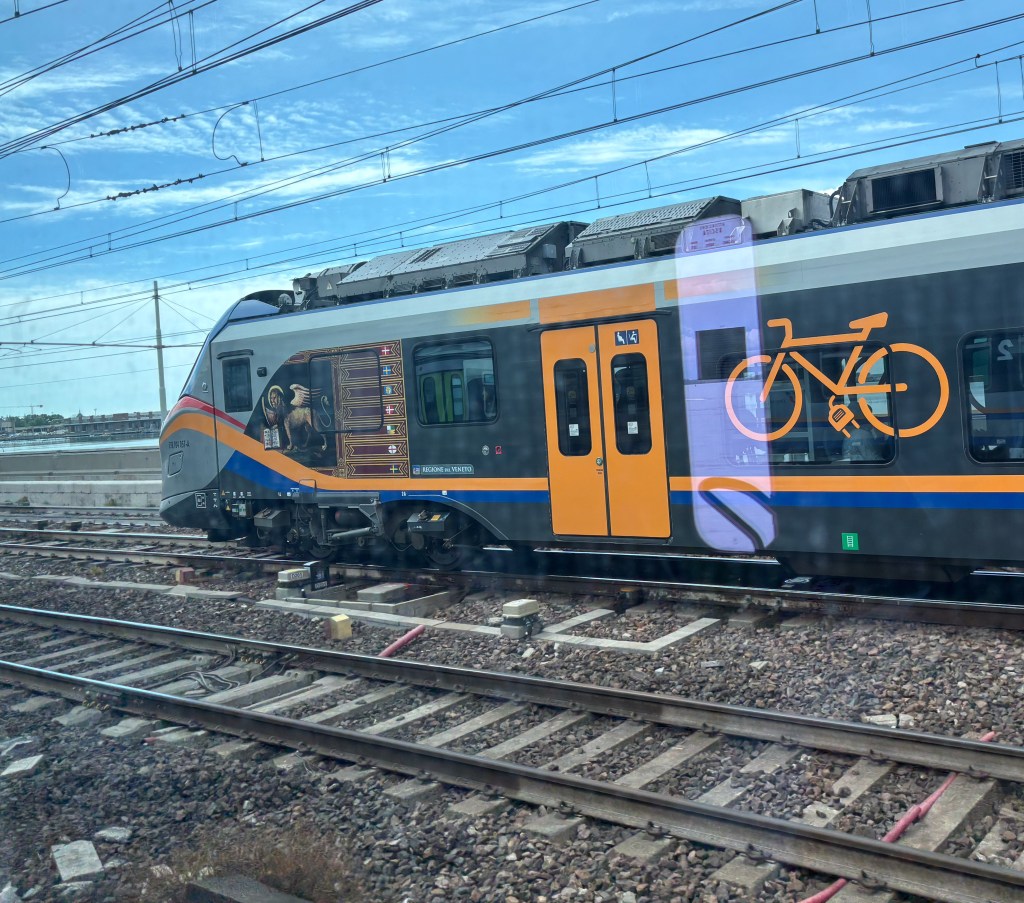
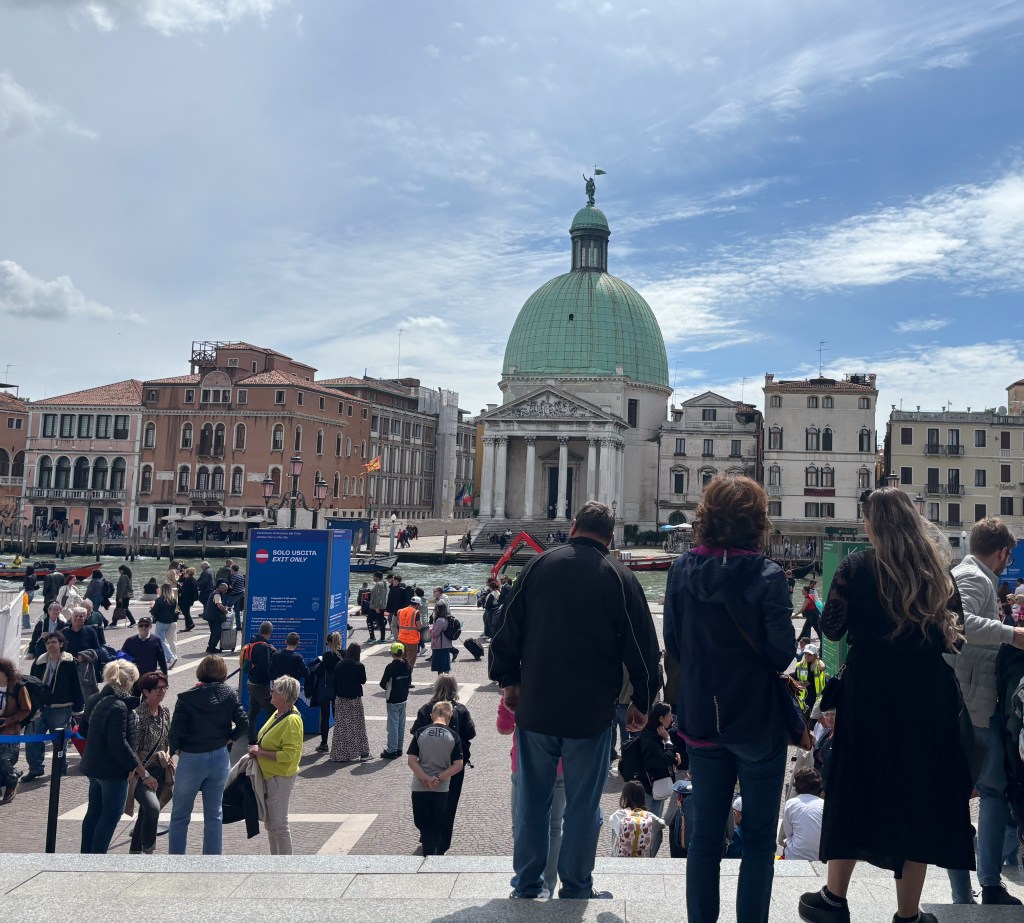
The next morning, we took a short taxi ride to the train station and had an easy journey by train to Venice with several stops along the way. It took a little over two hours. The train station in Venice was very close to the Grand Canal and so was our hotel. However, it was quite a long walk and there were many stairs so the hotel instructed us to hire a porter (“look for the orange jackets”) to transport our luggage to the hotel. That was the perfect solution! I wish I’d thought to take a picture of our porter, but I got very distracted by the huge crowds of people everywhere, unlike anything we’d experienced on this whole trip. The good news is, we also took delight in seeing the “real Venice,” with its beautiful Grand Canal and small motorboats of all kinds cruising quite quickly along its main waterway.


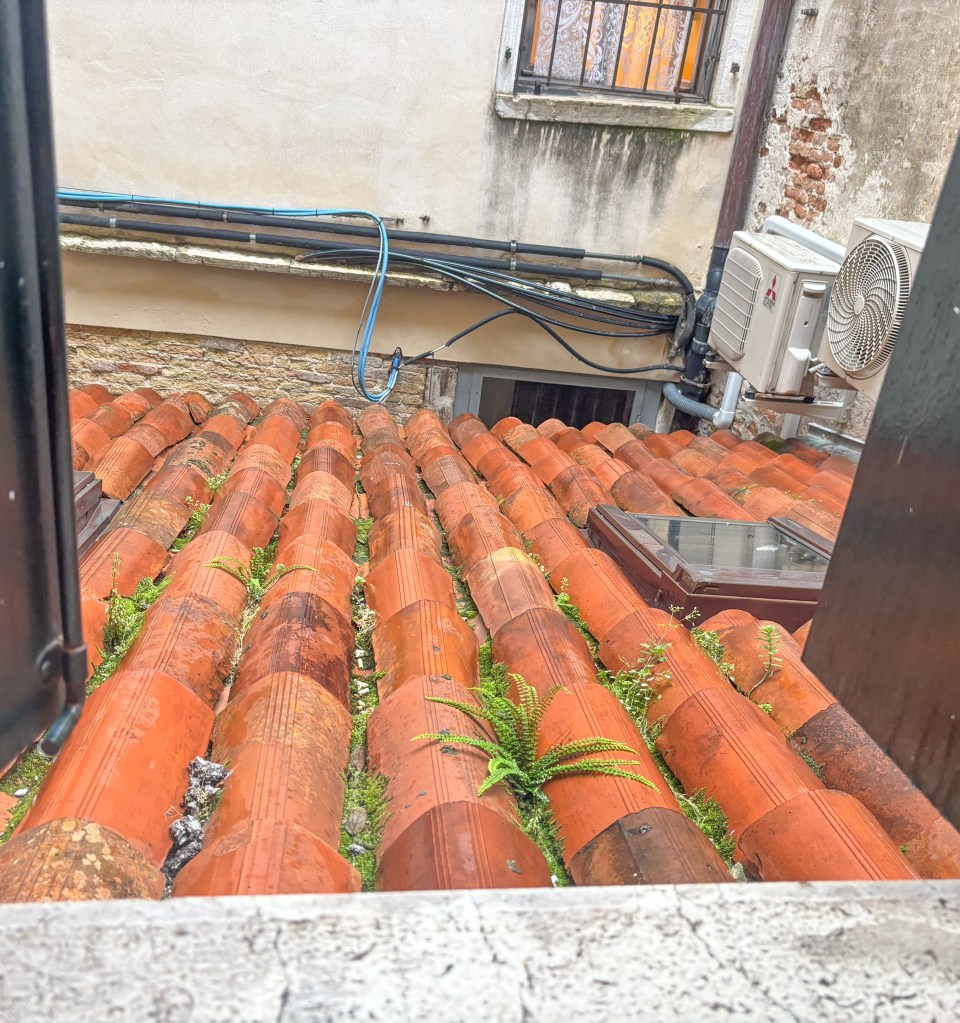
It took awhile to get to our hotel…and we weren’t very impressed with its outside…and frankly, we weren’t very impressed with the inside either—the most disappointing choice of this whole trip. Small, few services, less caring, tiny room & bathroom with little space for suitcases, etc. and not as well maintained (that’s stating it as nicely as possible). AND, as I’m usually inclined to do, on the bright side, it was clean, VERY well located and convenient to many transportation options including the bus we needed to take to the airport after a 4-night stay. So we did the best we could with it. There was a gorgeous hotel not too far away that would have been lovely—at $598/night. No thank you. As I told Gary, this entire trip we have stayed in some exceptionally nice hotels with exceptional views (unlike the “garden view” from our Venice hotel below), so 4 nights in something “less than” was fine. Besides, as we like to remind ourselves, it’s APOTA—All Part Of The Adventure!!!  


Venice is a fascinating place—built on more than 100 small islands on a large lagoon in the Adriatic Sea. It has few roads, mostly canals, walkways and bridges (with lots of steps up, over, and lots of steps down!). Venice was first occupied around 450 A.D. and became a major maritime power in the 10th century. Most of the city is an extraordinary architectural masterpiece where even the smallest buildings are said to contain works by many famous artists. There were some magnificent structures and, frankly, a surprising number of smaller buildings that looked very run down (including our hotel)

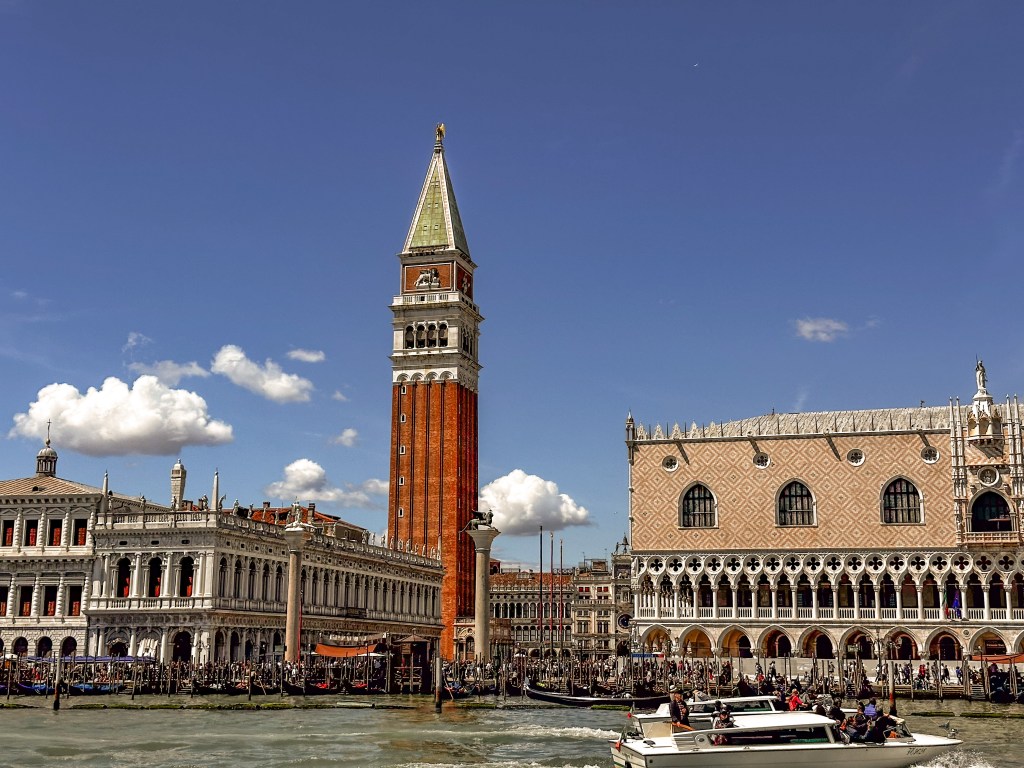
We planned three days of seeing the sights of Venice and its surroundings and were able to buy a 3-day pass that allowed us to use all the water transportation and get into most of the popular buildings. Day 1 we chose to take the “water bus” (aka “vaporetto”) all the way around the Grand Canal, stopping midway at the famed St. Mark’s Square. Even though we knew it was Saturday, neither one of us was prepared for the monstrous crowds that seemed to be everywhere. Once we got to the Square, there was a little more room to breathe and the line wasn’t very long to visit the Basilica—the most important religious temple in the city of Venice. [When Gary was here 40+ years ago, this Square had 3’ of water in it due to an “Aqua Alto,” (flood) which happens several times a year because it is the lowest point in Venice. As a result, nothing was open, so he was glad we could see more this time.] The Basilica is a stunning blend of Byzantine, Gothic & Renaissance architecture that reflects Venice’s rich cultural heritage.

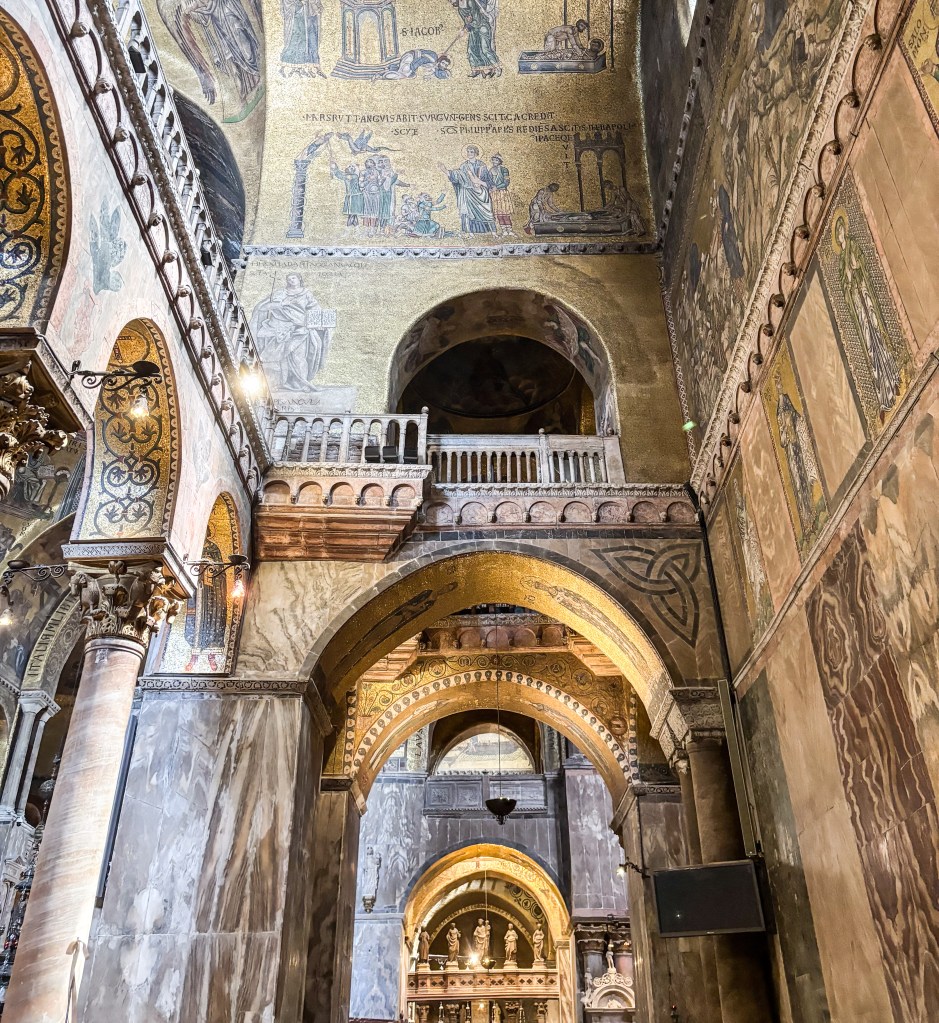
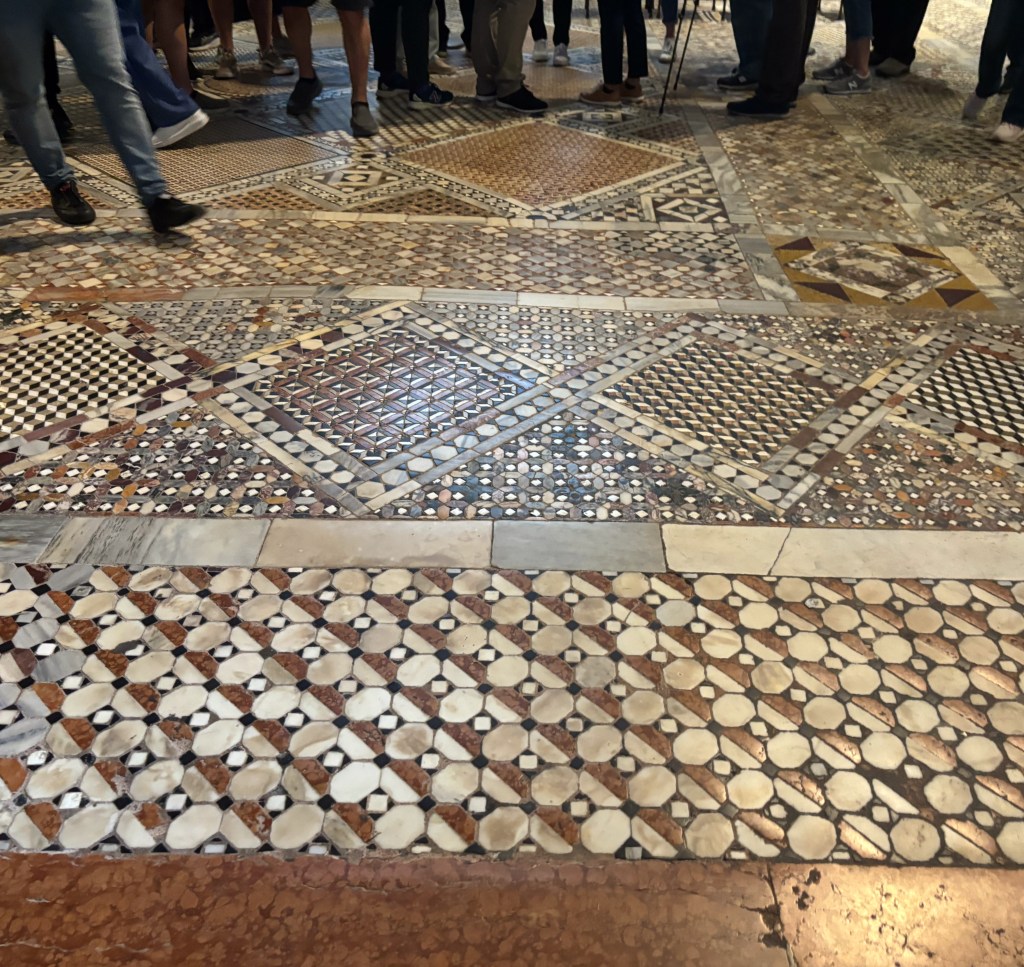
There was more beauty inside this magnificent cathedral as you can see from the photos below. I was especially drawn to the gold accents and the exquisite mosaic floor tiles. In doing some research (as I’m writing this), I discovered there are more than 4000 square meters of mosaics (that’s 43,055.642 square feet!!), many of them belonging to the 13th century!


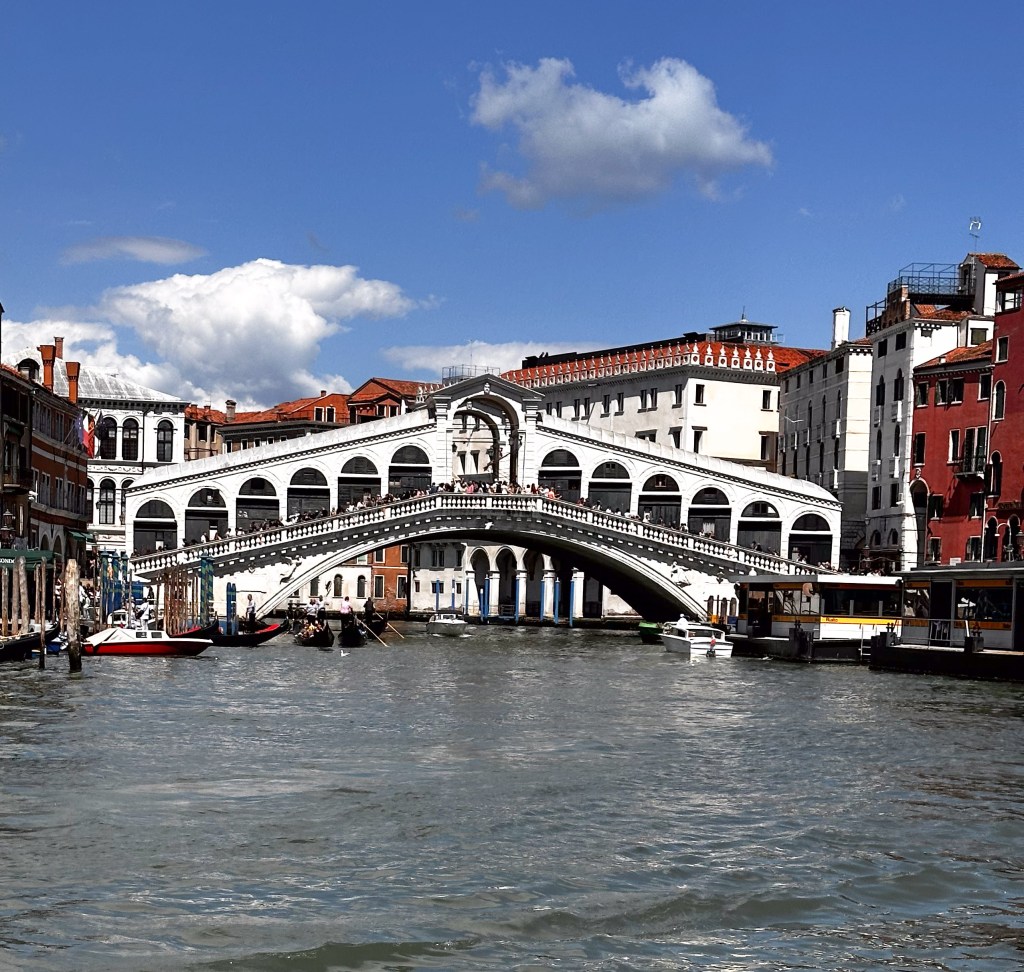
We finally began to relax at a beautiful outdoor restaurant on the Square where we had a leisurely lunch and spent most of the time people-watching and listening to beautiful music from a quartet playing there for our enjoyment. We made our way back to the vaporetto (left, below) to take us back to the hotel. Nearby we watched several people riding in the famed gondolas. We’d watched them pass by the sidewalk bistro by our hotel and noticed how bumpy the ride was…the wakes were constant from the steady stream of motor boats going every direction (with no apparent right of way rules in place that we could figure out) so we decided to pass on a gondola ride. But it was fun to ride the larger, sturdier vaporetti and a real treat to go under and see the varied designs of all the bridges, including the famous Rialto Bridge (below).

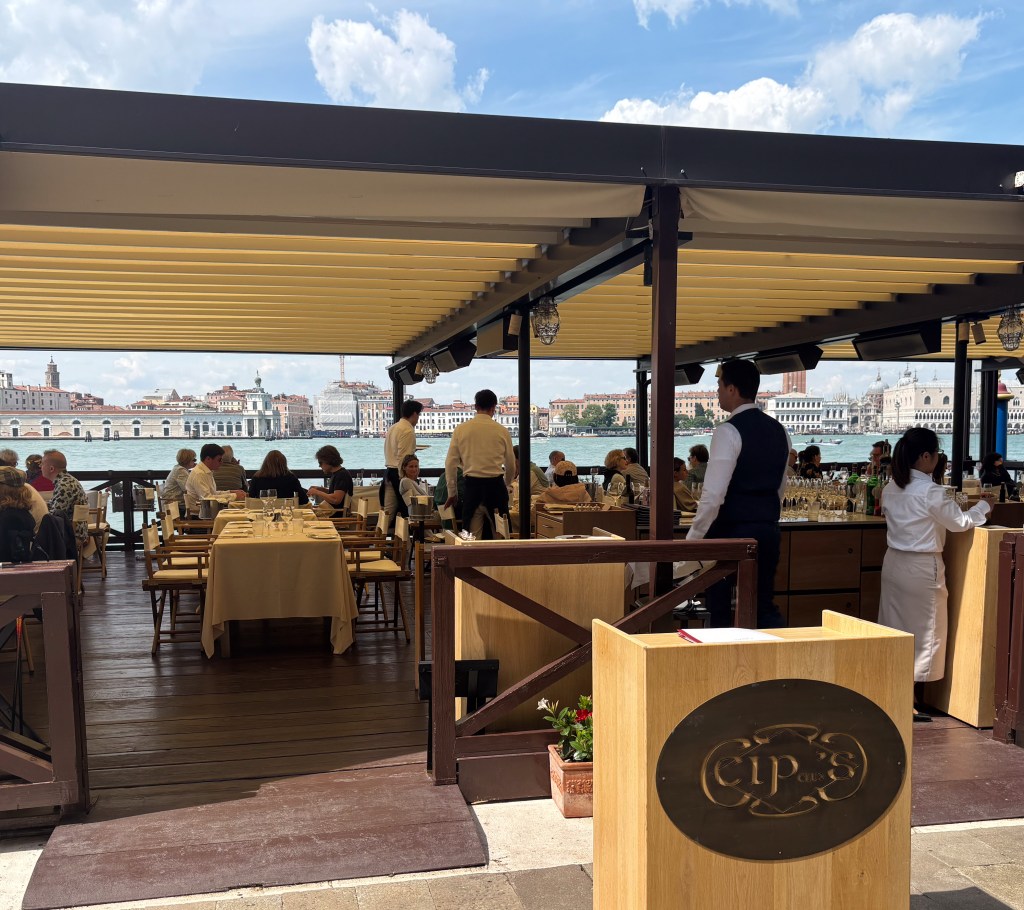
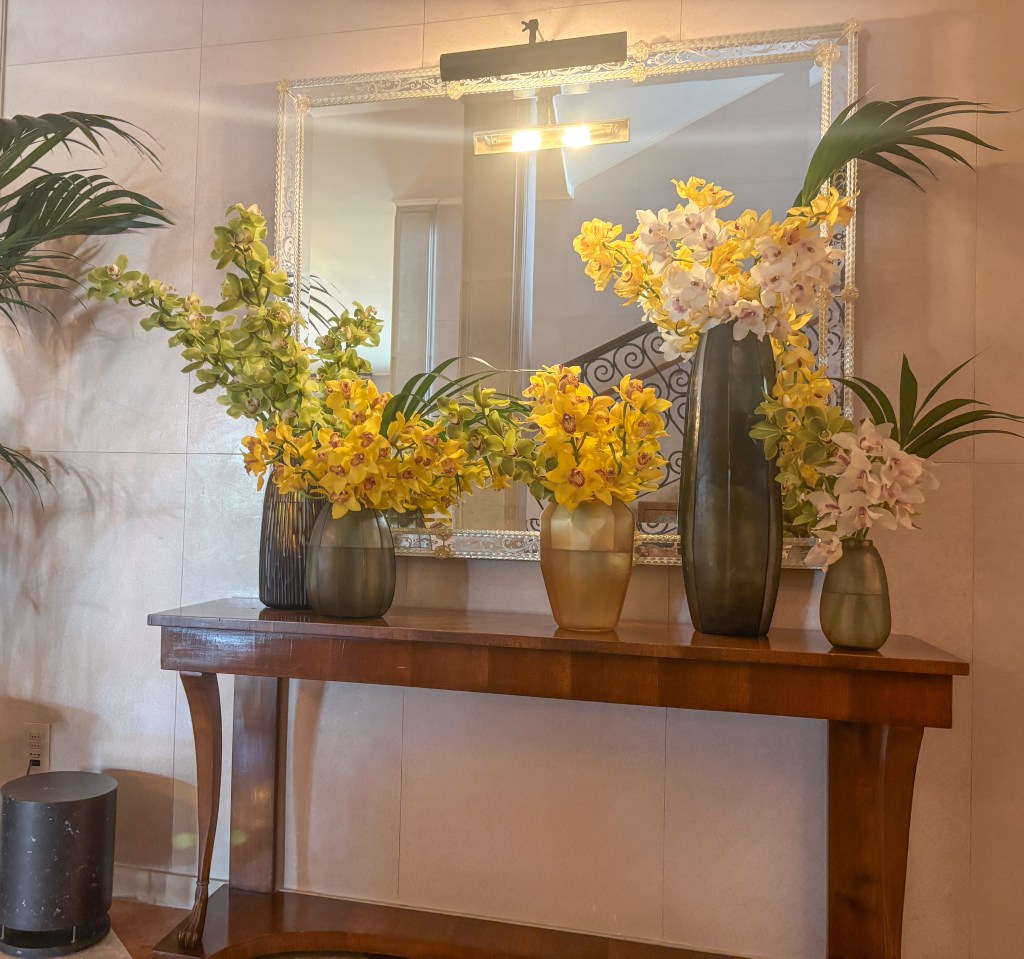
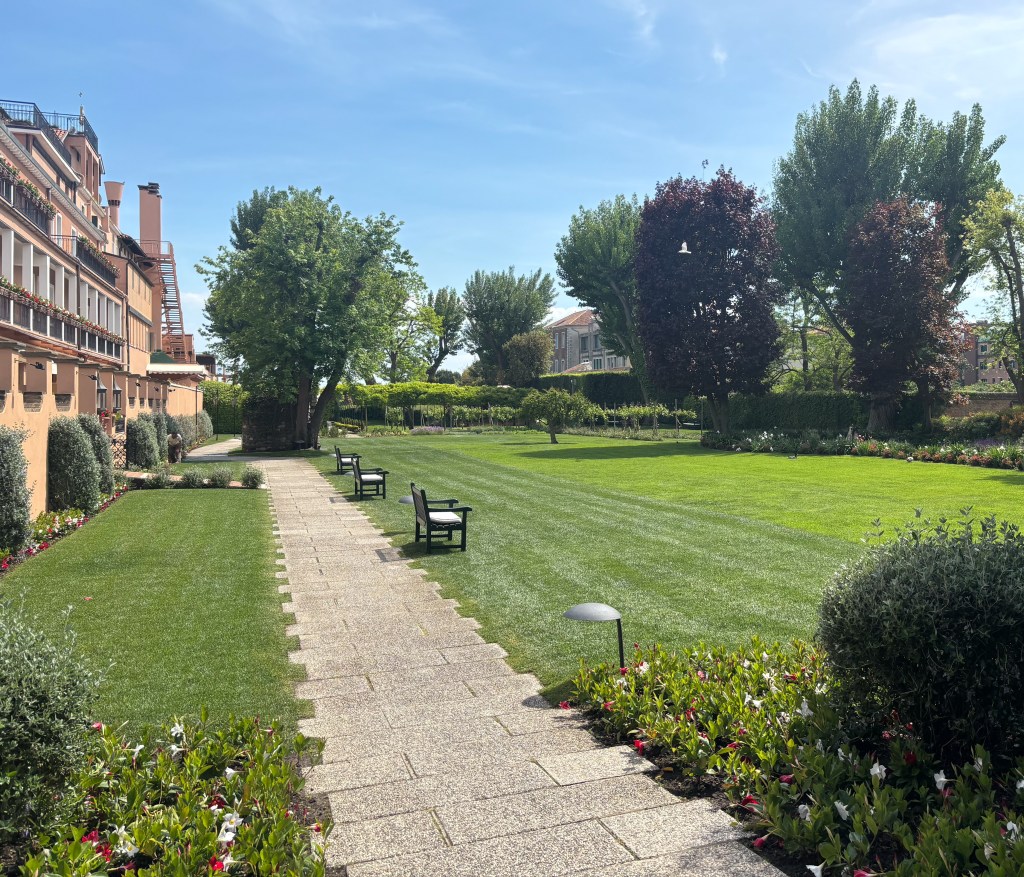
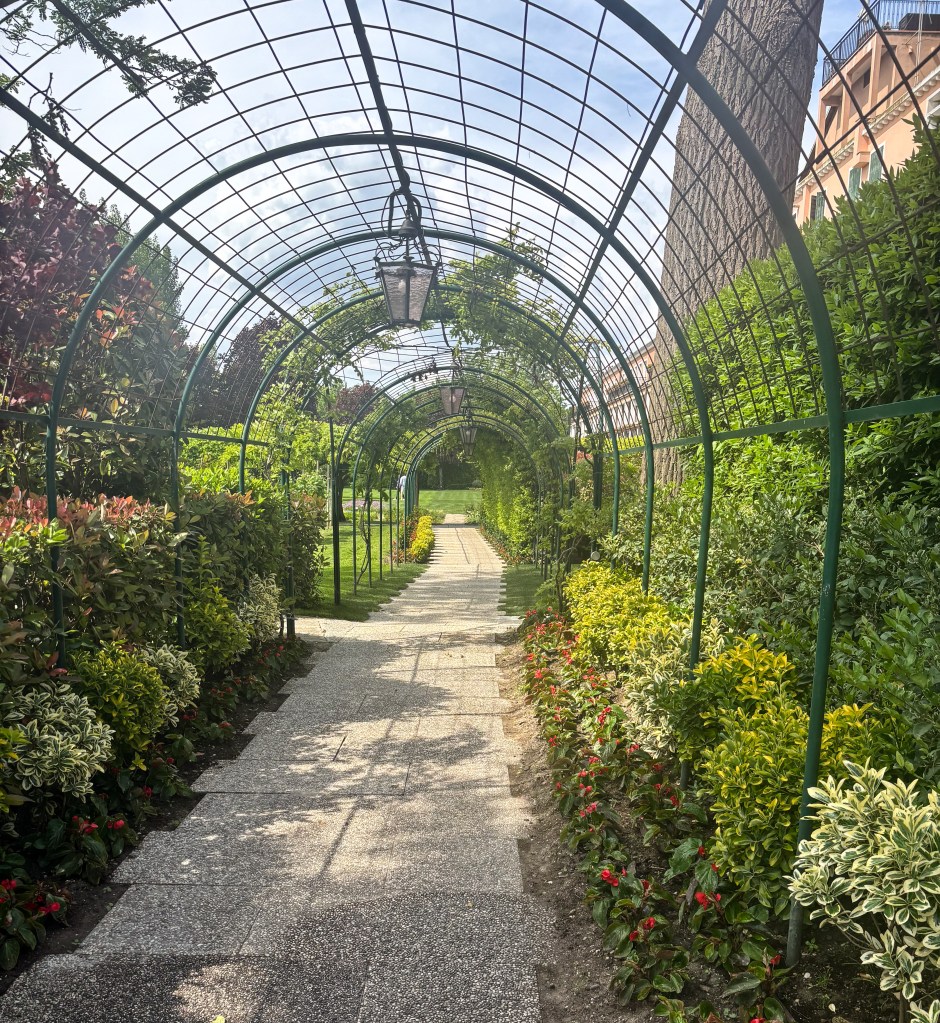
Day 2 we treated ourselves to the most elegant, delicious, relaxing and enjoyable lunch of our whole trip. Once again, taking the vaporetto, we went over to the nearby island of Giudecca. A very dear friend had stayed at this high end Cipriani Hotel over 40 years ago and highly recommended we dine there. It was a sunny day and we ate at the Cip’s Club overlooking the beautiful lagoon, St. Mark’s and its surroundings. We could have sat there for hours simply soaking it all in. We started with mimosas, had delicious pasta dishes (famous for its Taglioni Gratin—a favorite of opera singer Maria Callas—and absolutely delicious), their own “Cipramusu” for dessert, some port and coffee…and the bill was $249!!! How’s that for a treat?!? AND, the experience was worth every penny/euro! Afterwards, we explored the grounds of the Hotel and marveled at the large lawns and gardens as well as the elegant inside, with. large orchid displays. We still grin when we think about how we spent this glorious afternoon!


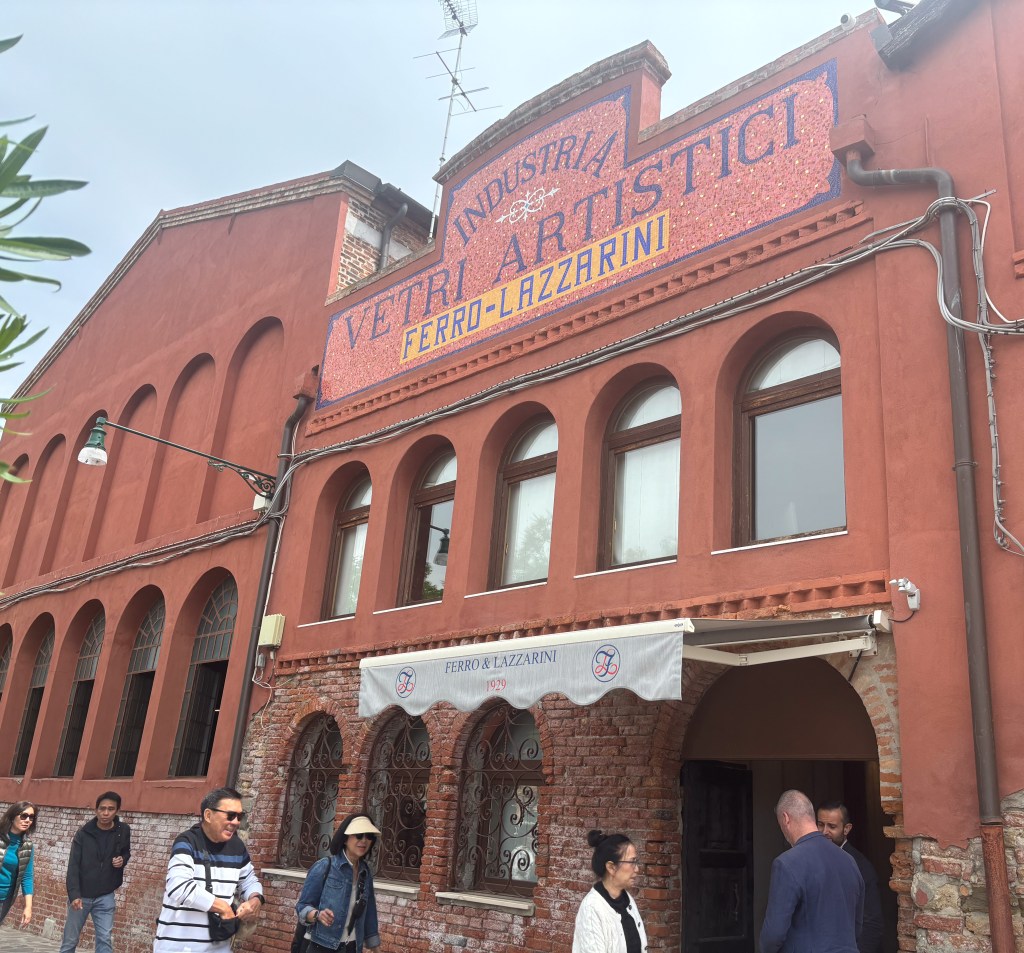
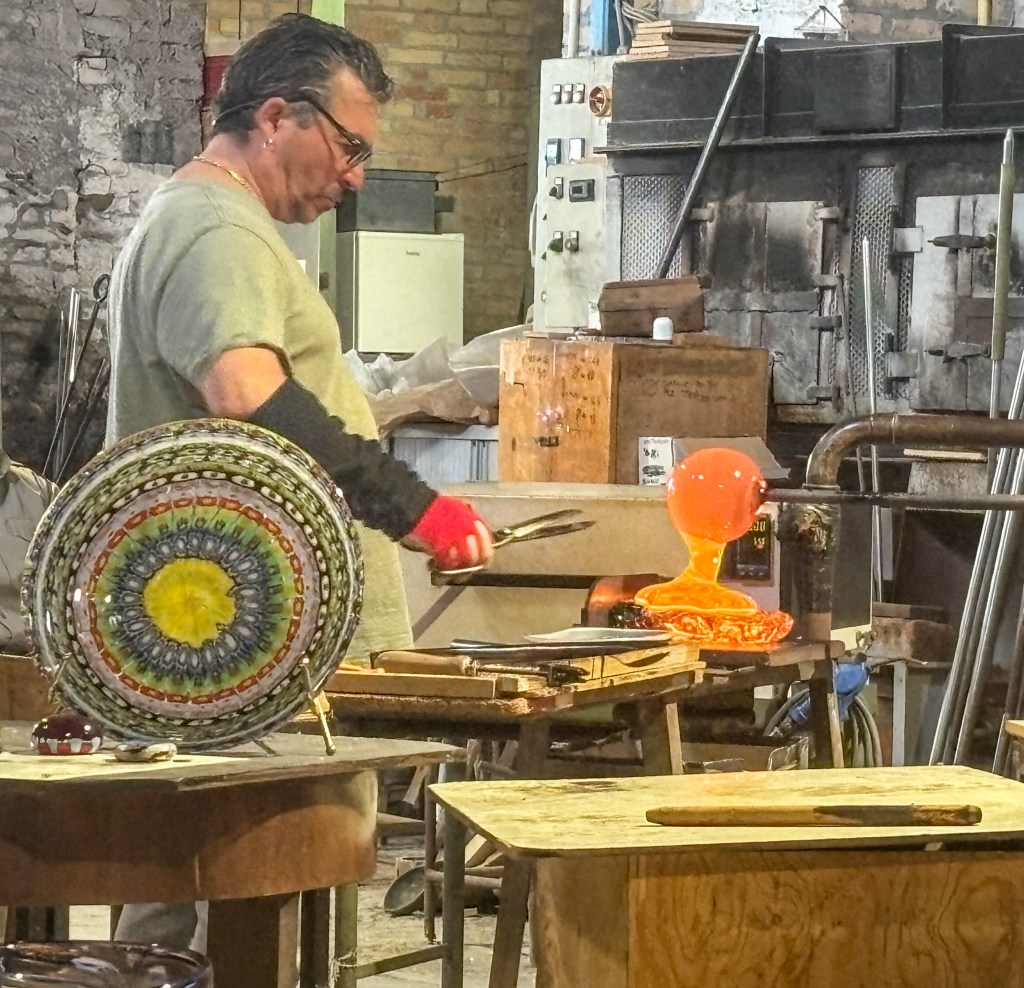
Day 3 was also delightful. We went on a guided tour to three more islands, Murano, Torcello and Burano. Gary has a gorgeous Murano plate that he had custom made during his first trip to Venice 40+ years ago, and we both very much enjoyed going to the Ferro-Lazzarini Glass Factory, watching two glass-blowing demonstrations and shopping in their gift store. Gary bought me two beautiful Murano glass necklaces and a pair of earrings.


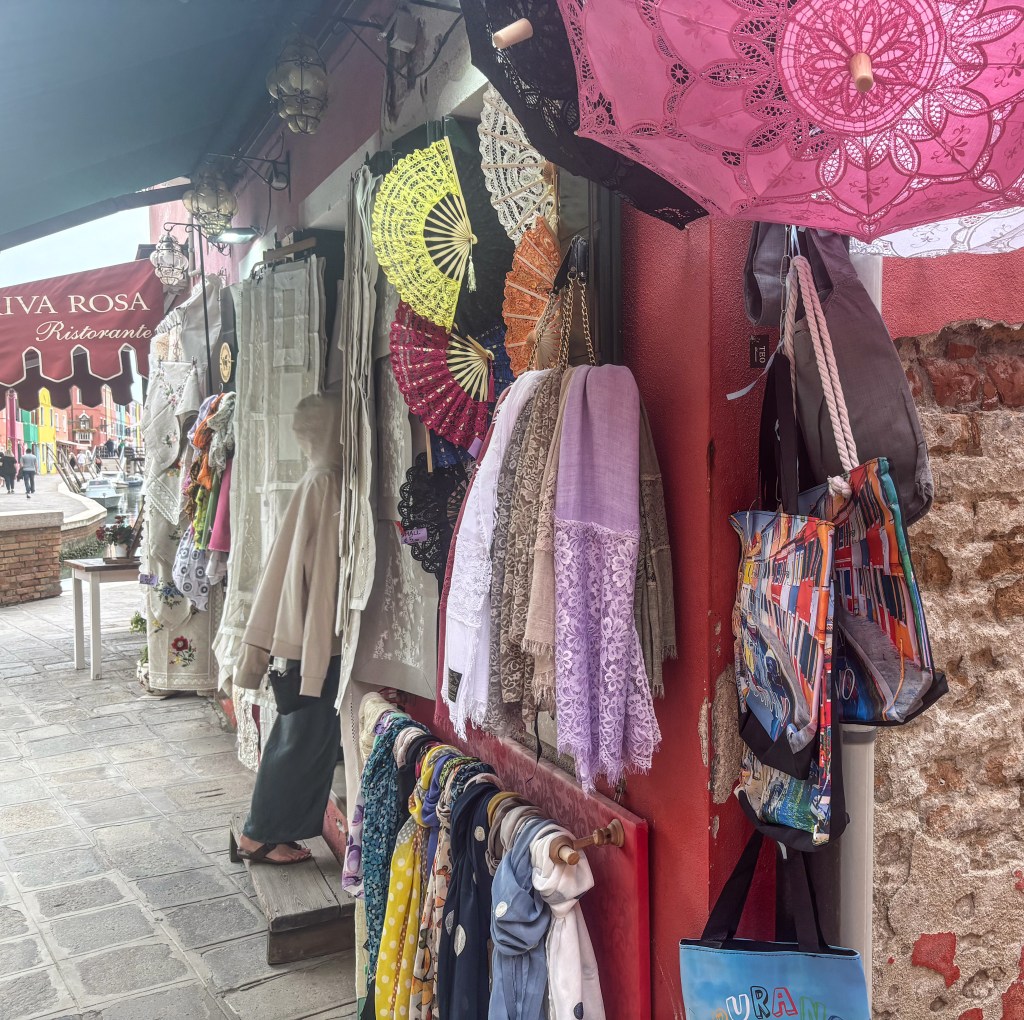
We stopped briefly on Torcello. It was a long walk to town and I opted to sit on a bench near the boat and watch other boats go by (always a joy!). That worked out well, because we walked quite a bit on the next island of Burano and that was very fun. What a colorful place—a fishing village, also known for its lace-making, with beautiful little shops, stunning laces and linens, little bistros and small canals. And it wasn’t crowded at all!

We’re really glad we spent a few days in Venice. There was lots we didn’t see, but finding the less chaotic, less crowded places made it far more enjoyable. Highlights would be the Hotel Cipriani, Murano and Burano. Gary did a little more walking than I did (my knee didn’t like going up and down so many stairs & bridges) and captured some of the sweeter scenes of Venice. Here are a few of them, including a little park not too far from our hotel:


Meanwhile, I started doing some more research during our rest/stretch-out times and we are getting more and more excited about the next chapter of our trip: ICELAND!  

Thanks again for traveling along with us. We’re carrying each of you in our hearts as we travel to so many amazing and beautiful places.

CROATIA – PART III – Zadar, Plitvice National Park & Rovinj

May 3, 2024
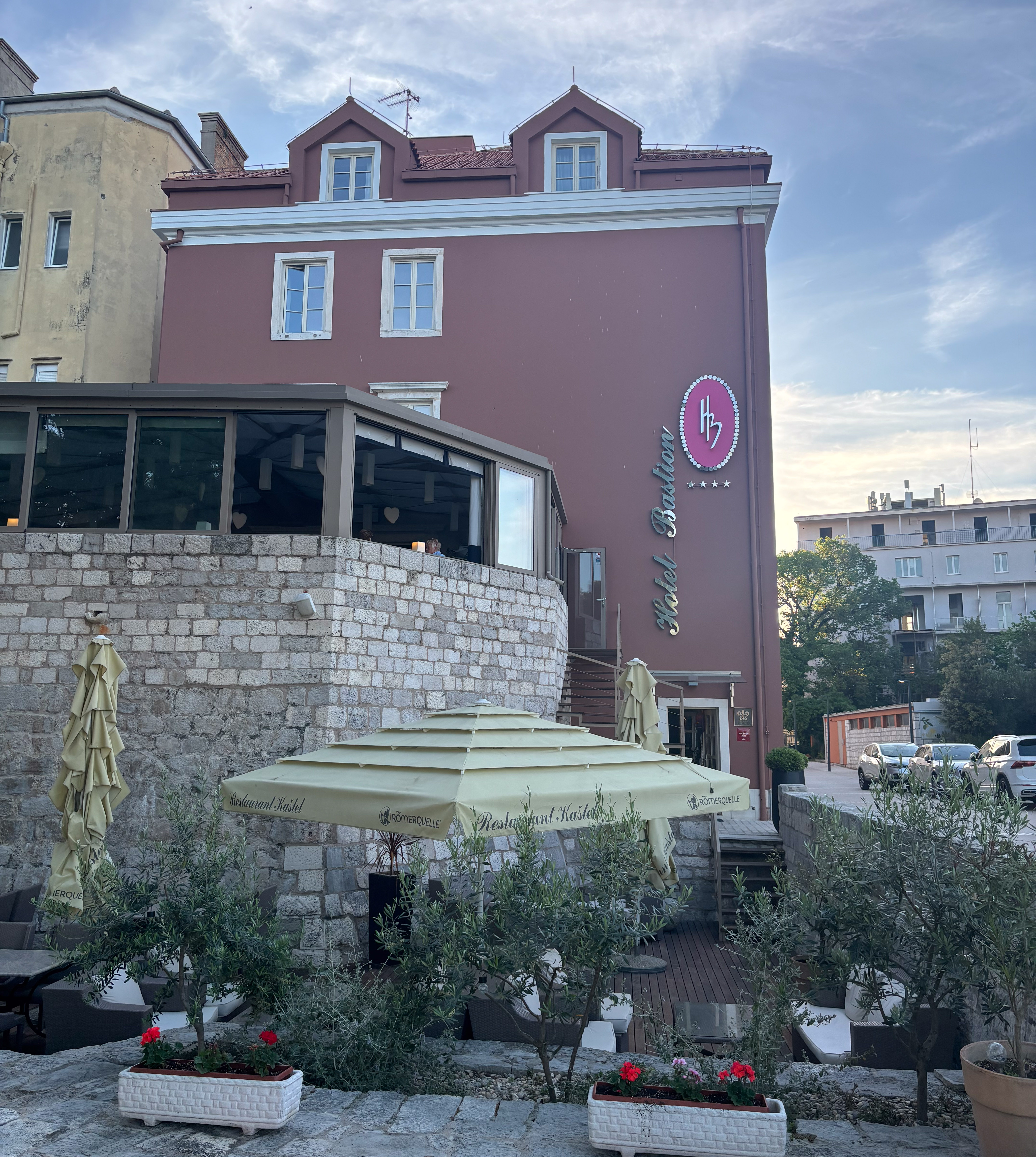
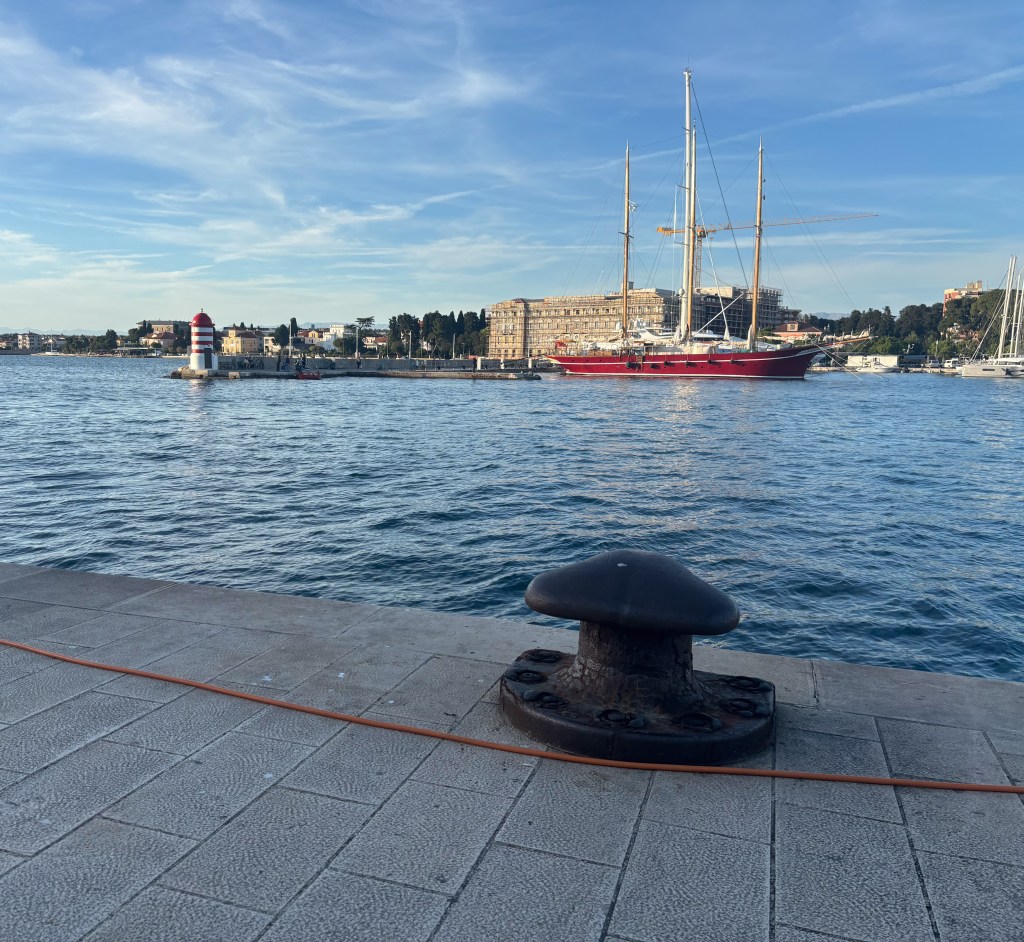
As amazing as all the places we’ve been in Croatia, I think my favorite is the small seaside town of Zadar. We stayed at an elegant boutique hotel—Heritage Hotel Bastion—built at the tip of the peninsula, overlooking the harbor, on the remains of a former 13th century Venetian mediaeval fortress. Here’s a photo of our hotel and the view from our room:


The town’s main monuments were very close by as were two very unique art installations created by Croatian artist Nikola Basic. The first is The Sea Organ, a musical “instrument” that emits sounds generated by sea waves. It consists of 35 organ pipes of different lengths and sizes built beneath a set of marble steps. When water from the sea flows in and out of the pipes, it creates a myriad of tuned sounds. The more wave action there is, the louder the sounds, which come out of small holes in the concrete walkway. There were lots of people, speaking many languages, walking along this one-of-a-kind Sea Organ, so it was very hard to capture the sounds on video, but you might try looking it up on Google. It was pretty phenomenal!
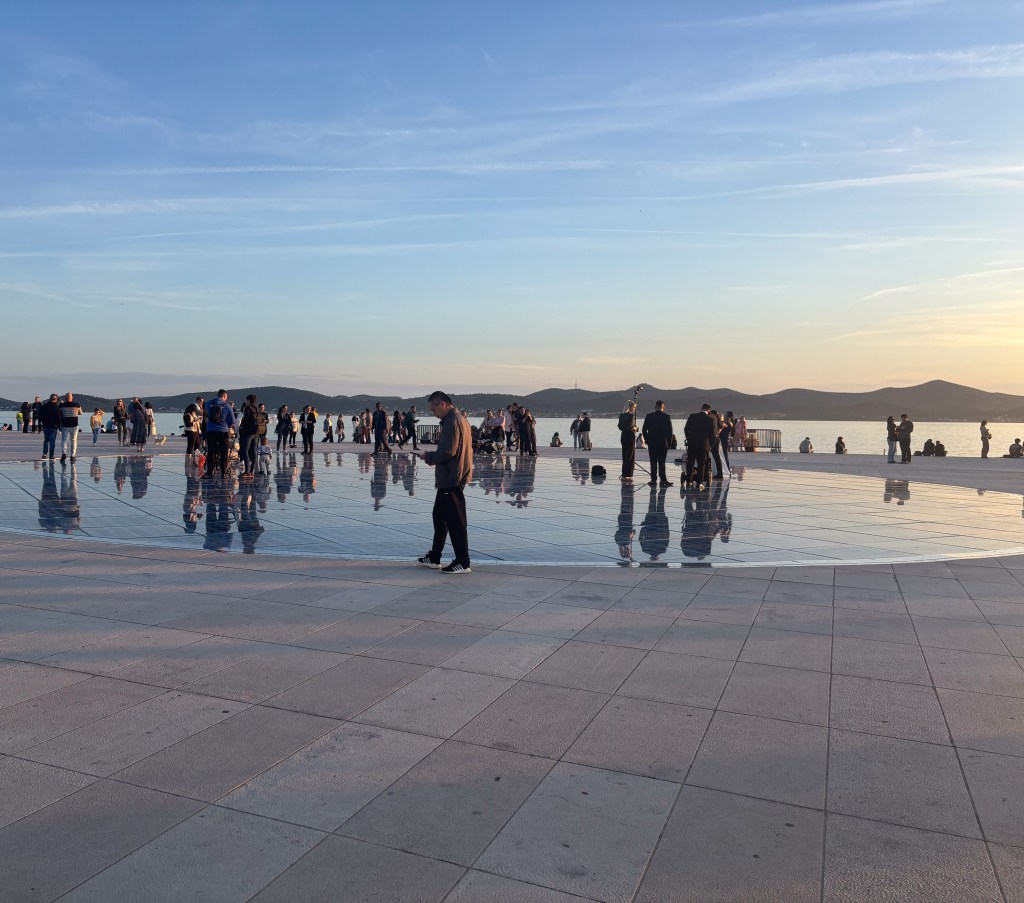
Adjacent to this piece was the Sun Salutation (aka Greeting to the Sun), a 22-meter (72’) round solar panel made from 300 layered glass panels. During the day, the panels absorb energy from the sun and convert that energy into light at night. In addition to creating its own beautiful spectacle (see video below), the Sun Salutation produces enough energy to light Zadar’s entire waterfront once the sun sets. (Thanks again to Rick Steves for calling our attention to these remarkable creations.)

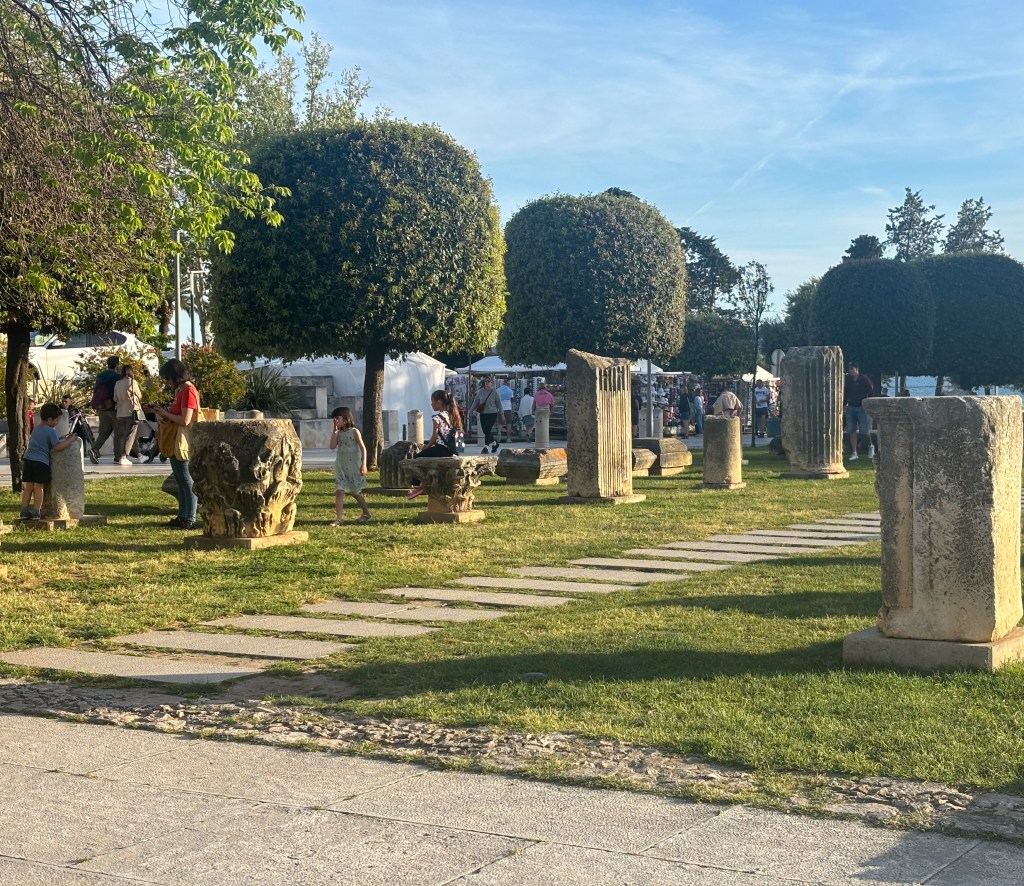
One of the reasons Zadar has become a favorite is because it’s very small, very peaceful and it’s also mostly flat, so it was easy to walk around its wider walkways. Every other place we’ve been was pretty crowded, with very hilly, uneven cobblestoned walkways, often very narrow, that felt somewhat “confining.” Zadar was an important trading port in Roman times that was heavily damaged during World War II, but part of its charm is the many Roman and Byzantine pieces retrieved from the rubble that are on display near its very large square called the Forum (below). This is also where its centerpiece Cathedral of St. Anastasius is located. Zadar’s Old Town felt spacious, freeing and soothing. It’s hard to come up with the right words, but needless to say we really liked it there and could have stayed several more days, if only to stroll along its waterfront, sit on one of many benches, watch the boats go by and feel the sea breeze on our faces. It was very nourishing!!!  


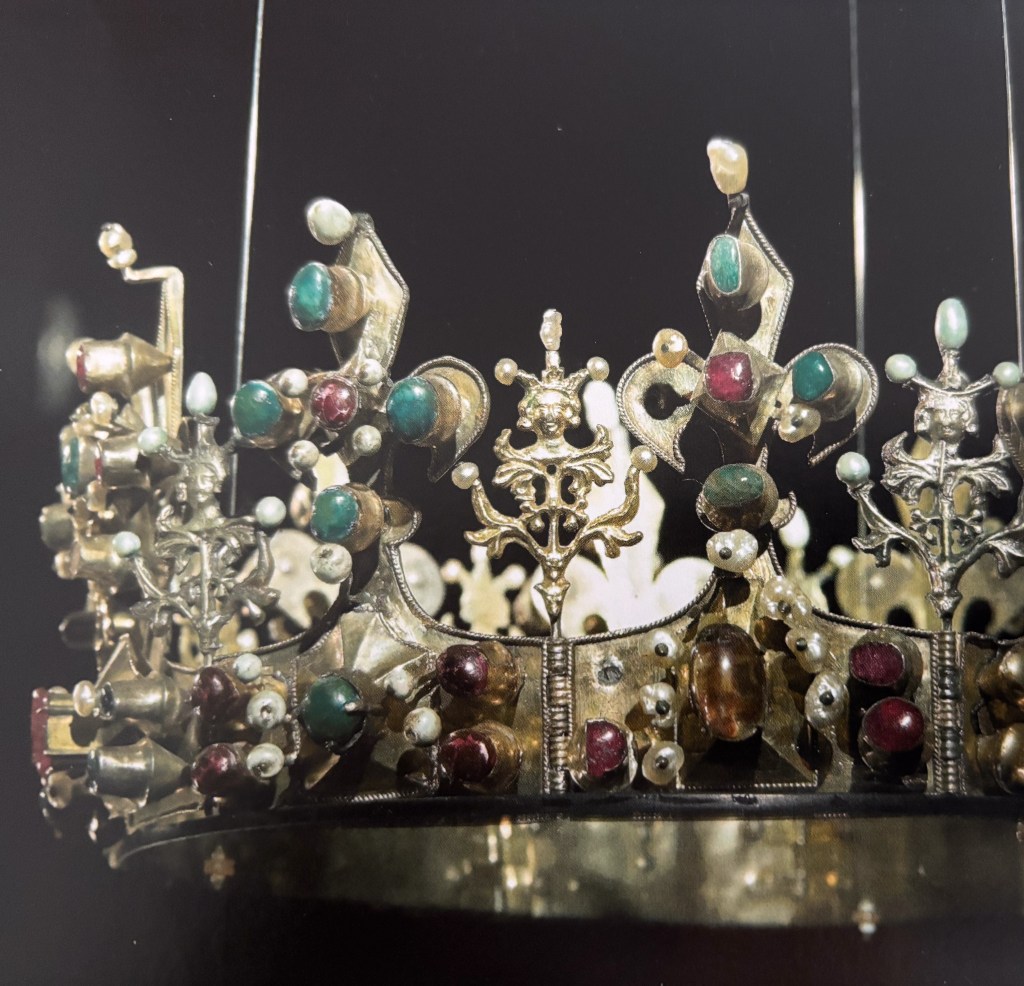
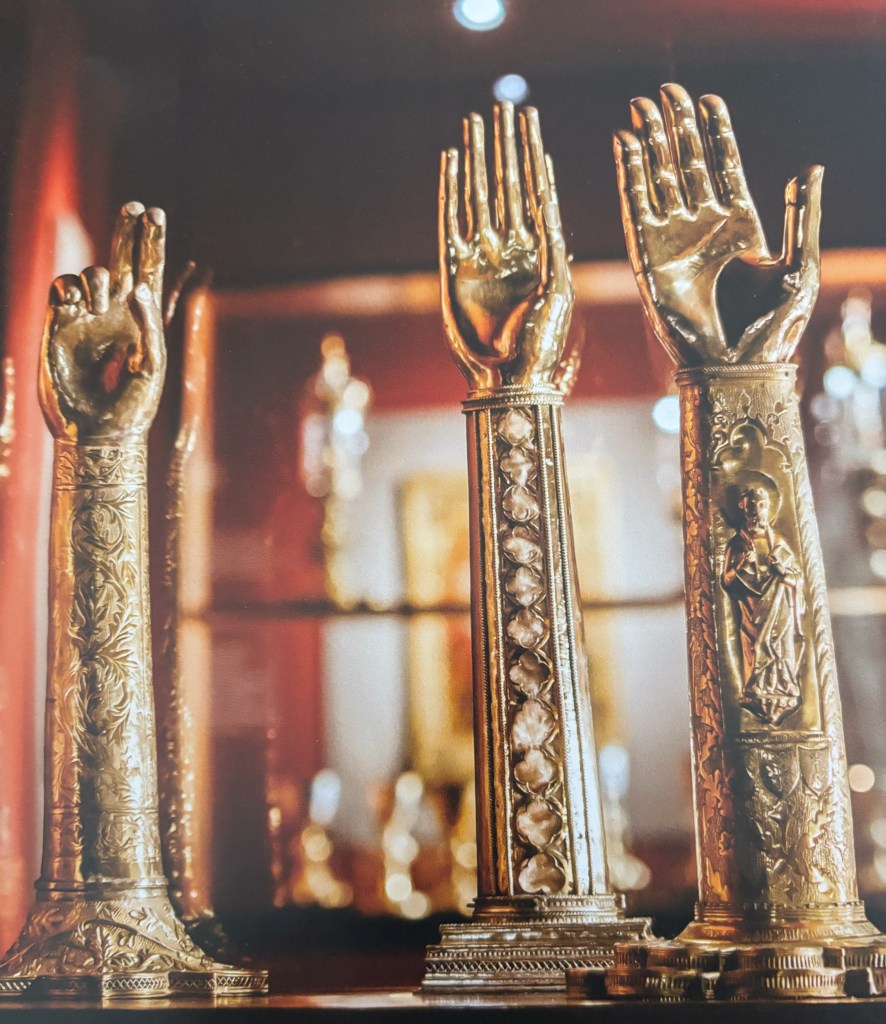
After another leisurely morning, we strolled through parts of Old Town again to visit “The Permanent Exhibition of Religious Art” housed in and taken care of by the Benedictine nuns at St. Mary Convent & Monastery, founded in 1066 and rebuilt after WWII. No photos were allowed, but we were astonished at the number of sacred processional crosses, an amazing bejeweled crown and a very large collection of silver and gold “reliquaries”—containers for bone relics. Many were shaped like arms with hands, but there were also shoes, boxes, busts and other shapes, often identified as belonging to various saints (photos below taken from a tourist brochure). We also saw remnants of sacred robes and cloths embroidered in gold and dozens of Renaissance-style paintings. The nuns were very friendly and had a very special sparkle to them. It was a wonderful way to complete our visit to Zadar.

                     
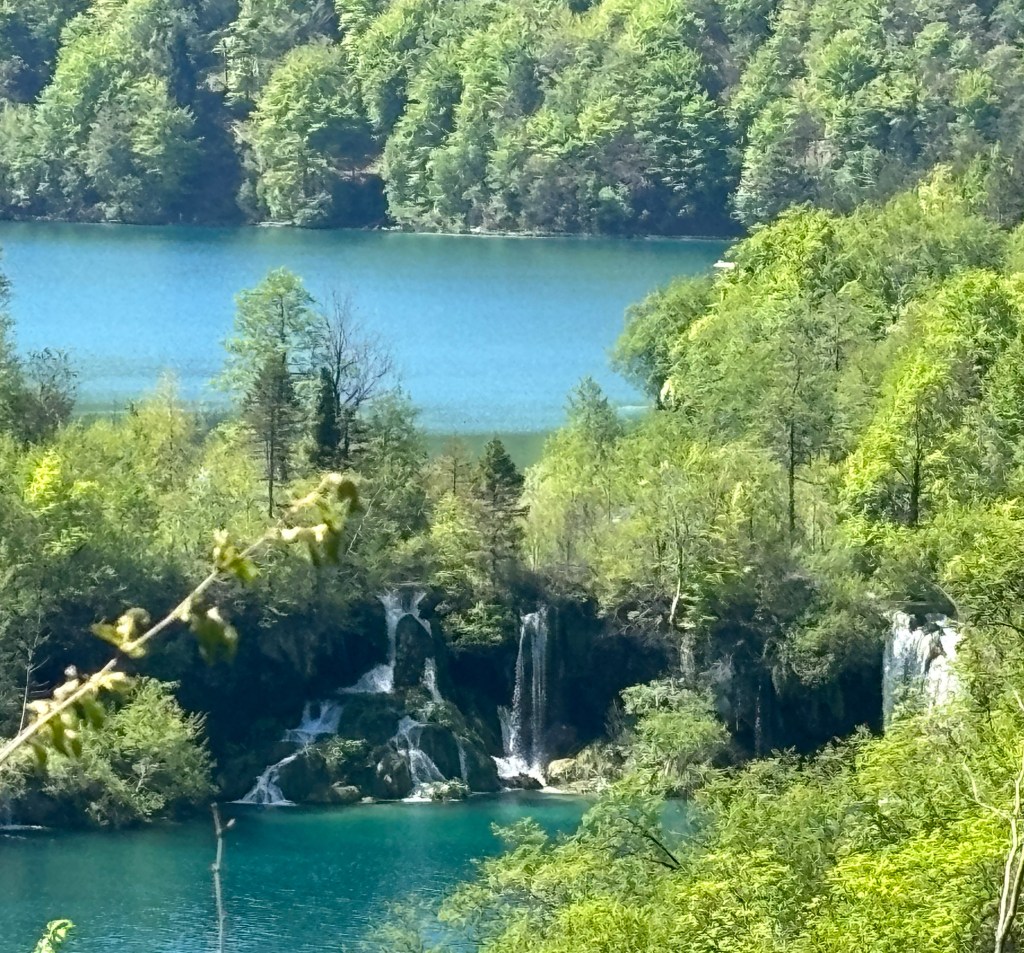
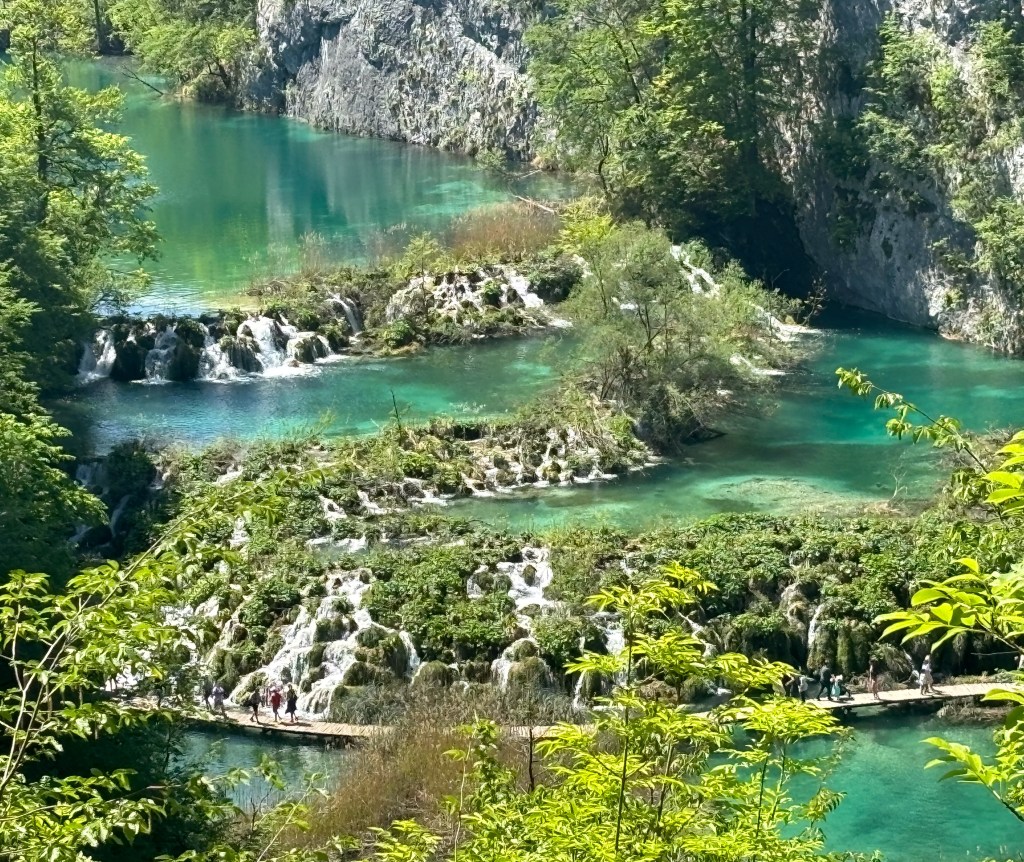
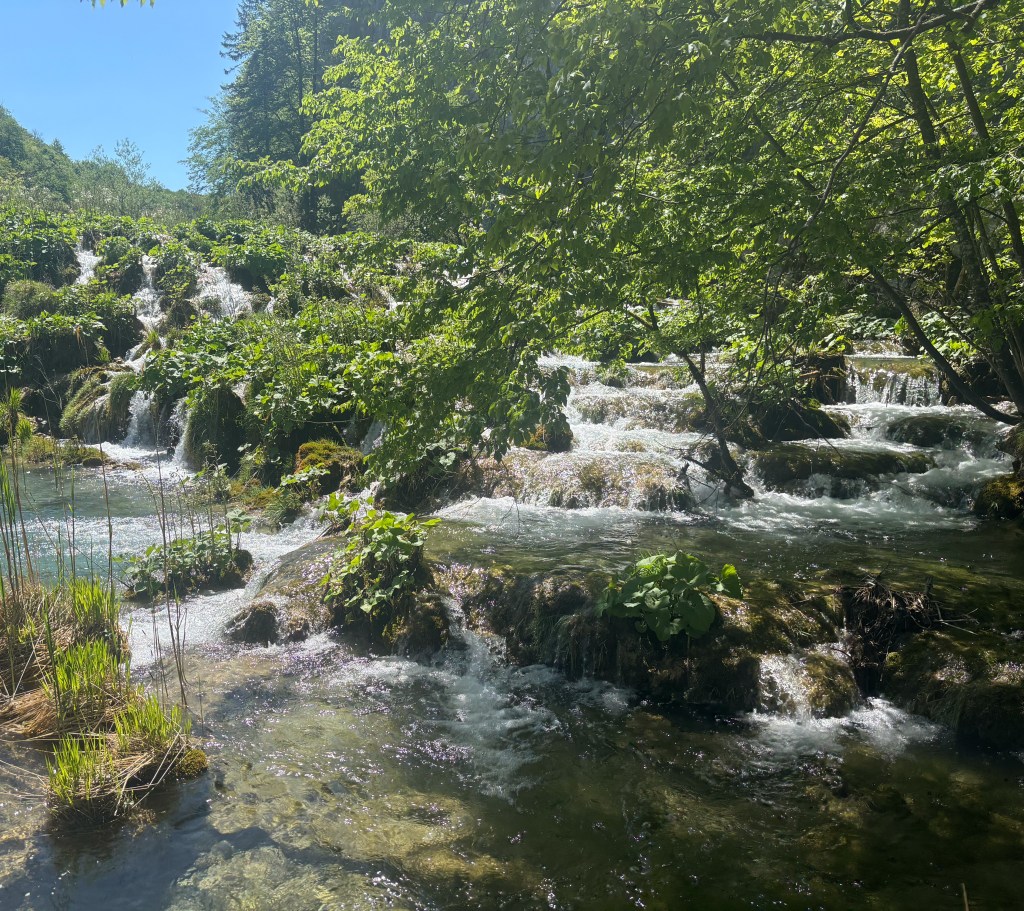
We then had an easy 2-hour drive to Croatia’s first National Park called Plitvitce Lakes (PLEET-veet-seh) which opened in 1047. I did some of the driving including going through the VERY long Svet Rek tunnel—over 3.5 miles—through the Velebit mountains. (It was very nice to finally see the light at the end!) Plitvice Lakes National Park “is one of Europe’s most spectacular natural wonders.” There are dozens of waterfalls, large and small, sprinkled over a heavily forested canyon and between 16 terraced, turquoise blue lakes. There was a bit more walking than we expected, up and down wooden planked stairs and along the water’s edge, with mostly smooth trails in between. Plitvitce is popular for its amazing scenery and also because of its network of hiking trails around both the upper and lower lakes. A shuttle train and boat ride made it a bit easier for us and we’re really glad we chose to come here, but we were pretty weary after 5 hours.


Our last stop in Croatia was the beautiful little seaside town of Rovinj (Ro-VEEN). On the way there we went through miles and miles of dense forests, several little villages and several more tunnels—some 1-2 miles long. We stopped for lunch in Rijeka (ree-YAY-kah), which was the primary industrial port of the Hungarian half of the Astro-Hungarian Empire. Most of the buildings and antiquated cargo cranes were way past their prime. However, when we walked along the water we discovered it is a primary transportation hub (lots of ferries) and several very large private yachts like to dock here. One in particular was colossal—423’ (that would be more than 10 times longer than the 40’ cabin cruiser we used to do America’s Great Loop a couple of years ago!!). We looked up its name (Al Mirgab) and found it is owned by Qatar’s former Prime Minister and is registered in the Grand Cayman Islands. No photo can really capture its magnificence, but here’s what a $300 million impeccably-maintained yacht looks like:


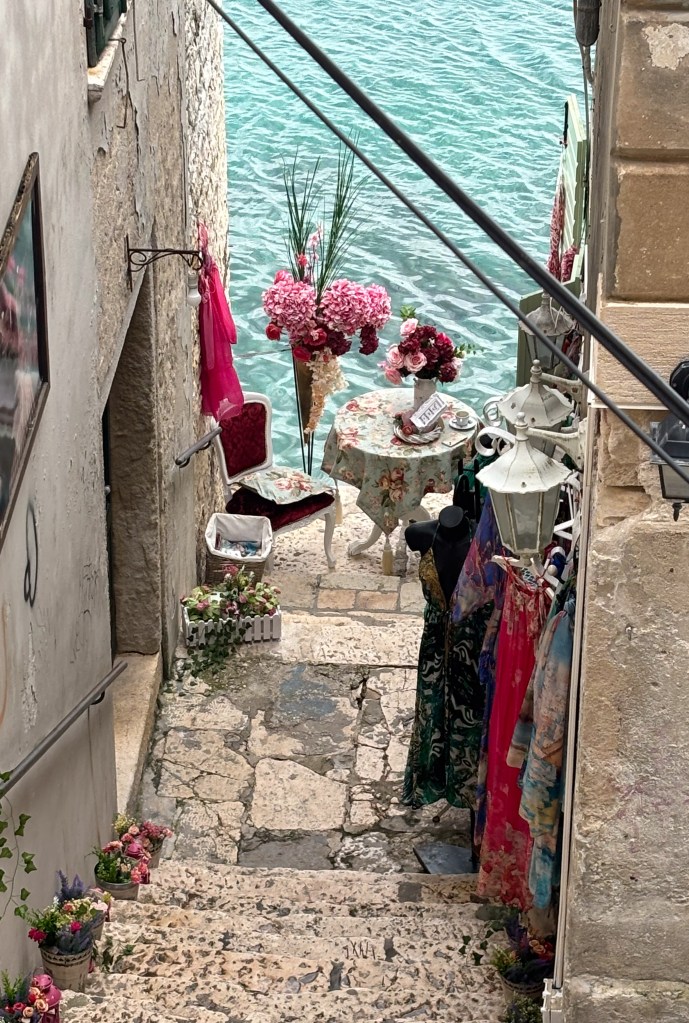
Rovinj is a sweet little fishing village on the heart-shaped Istrian Peninsula in the northwest corner of Croatia. What makes it especially charming is that it’s a real town where local residents still live and shop in its narrow streets with skinny houses that have sheltered humble families for generations. It is the most Italian town in Croatia’s most Italian region (very close to Trieste and directly east of Italy). We stayed in another small but elegant boutique hotel (Angelo d’Oro) on the edge of Old Town with somewhat of a “sea view,” down a very narrow, very short street that the next morning was filled with flowing dresses for sale and an enchanting little table with huge floral bouquets. We started to walk around the one evening we were there, but it started raining and the stones along the walkways became quite slick, so we headed back to the hotel.


As we look back over the last two weeks in the relatively young country of Croatia, we will always remember the friendly people, spectacular scenery and the joy of cruising on and overlooking the deep-blue, crystal-clear waters of the Adriatic Sea. It really is a wonderful place to vacation. There are also a few other little things we want to share with you:
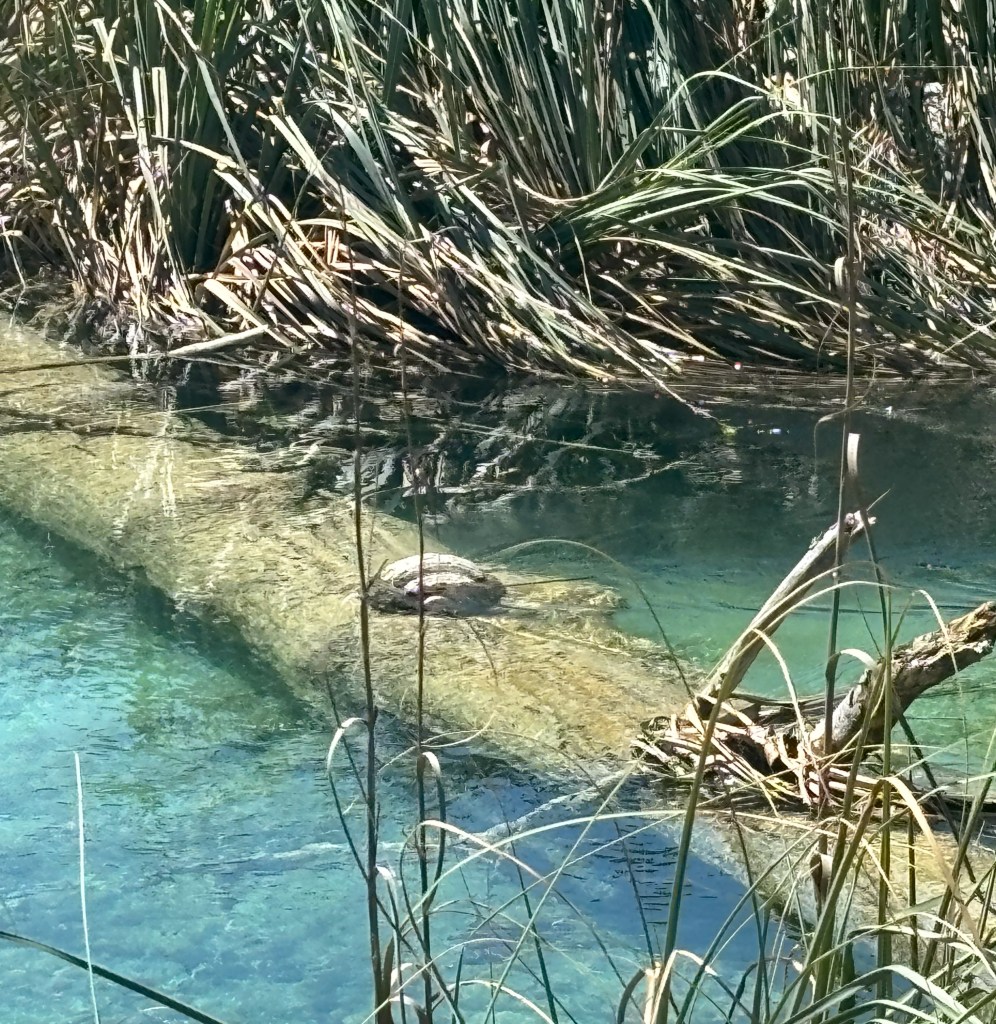
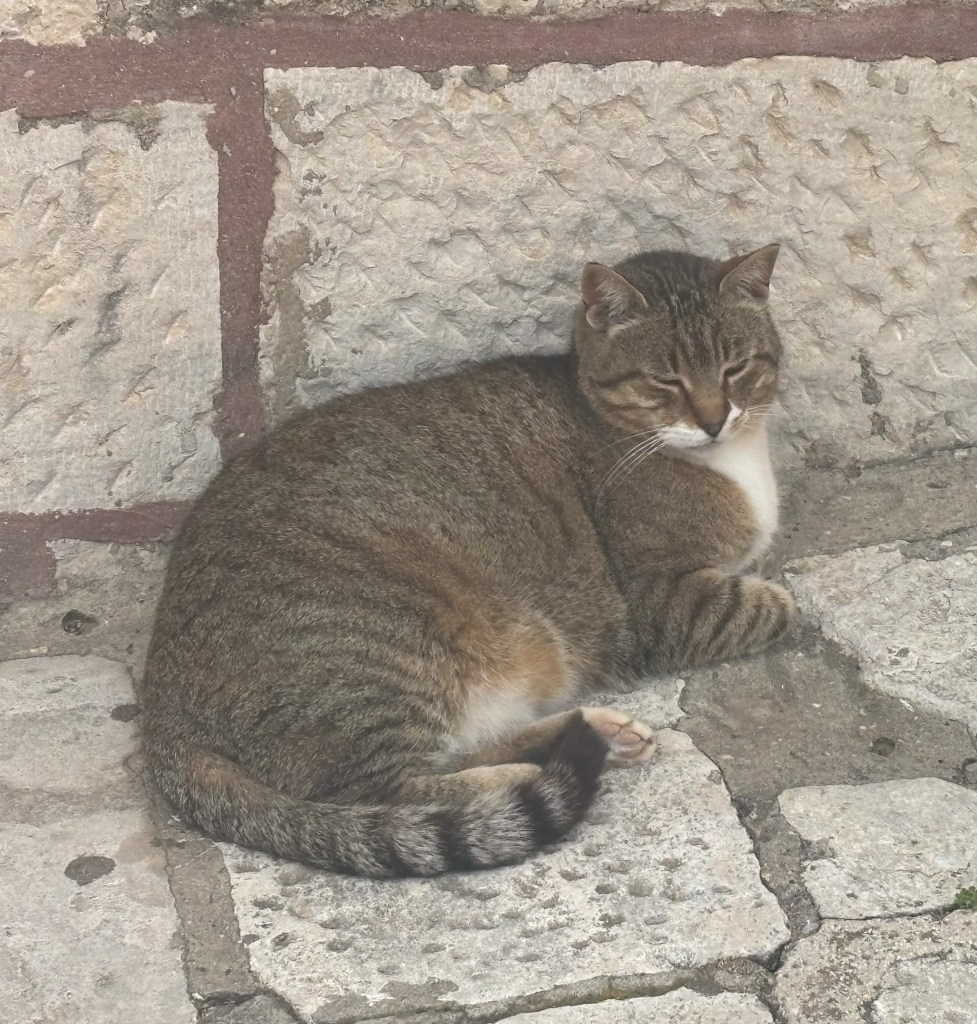
1. We saw a variety of birds, including several very vocal peacocks in Split, but very little “wildlife”…a few herds of cattle & sheep, a small herd of goats (running free in Rovinj), some horses grazing and a teeny-tiny “vole,” and that’s it. There were also lots of cats perched or wandering around in every Old Town we visited. We’d hoped to see some wildlife in Plitvice. There are deer, wolves, bears, wildcats, lynx, wild boar, otters and snakes, but all we saw was a turtle sunning on a log. (See last photo above, from Plitvice.) Oh well! And, by the way, we found out that Dalmatians come from Croatia–the spots representing all the islands, according to a guide–but we never saw one of these either!


2. Driving north from Split, we saw dozens of large windsocks along the highway as well as many wind turbines. We learned from a waiter in Zadar that about four times a year, mighty gusts of wind reach over 90 mph and everything shuts down. However, the salt air that blows across the land during these times affects the grazing and, as a result, creates a very desirable flavor in the lamb and the cheeses produced in the area. This is particularly true on the relatively barren island of Pag where the Adriatic sea salt dusts the herb-filled pastures and gives the sheep’s milk a unique flavor. Perhaps you have heard of Pag cheese—“Paski sir” in Croatian. (We find these little tidbits of info fascinating. Hope you do too!)
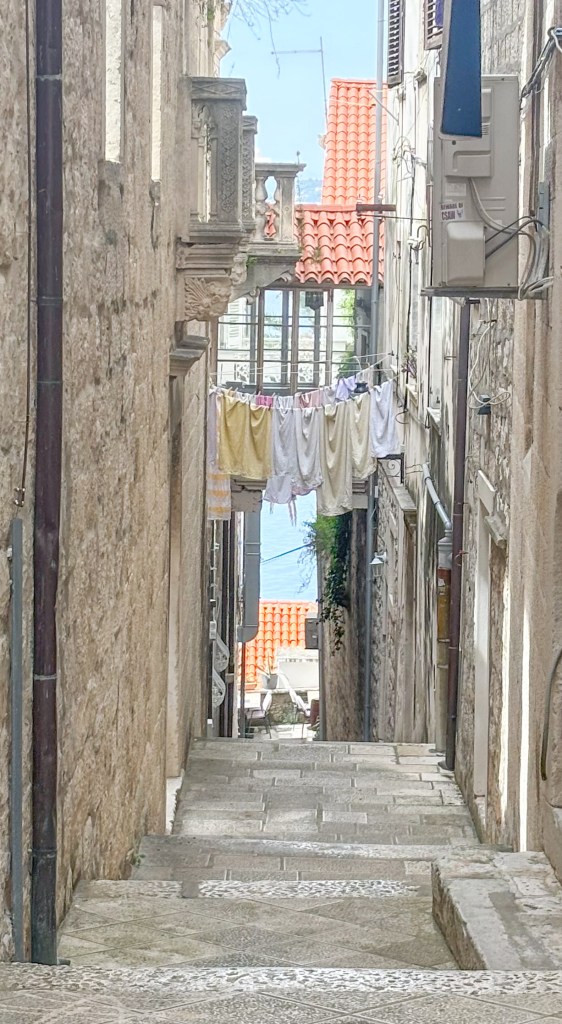
3. We were also intrigued with how many people hang their laundry out their windows in every Croatian town we’ve been to (even more so in Montenegro).


4. Tuk Tuk tours are the best! In Budapest, Dubrovnik and Split, the amazing tour guides helped each city “come alive “ for us as they drove and/or walked us along the various Old Towns, magnificent buildings and harbors, sharing the unique history and interesting facts, answering questions and helping us experience everything in a very enjoyable and informative way. Because my knee is not quite healed, these tours allowed us to see way more than if we’d been on foot. We will always be grateful for Tuk Tuks!

On we go to Italy! Thanks for continuing to travel along with us!

CROATIA – PART II – Ston, Korcula & Split

April 27, 2024
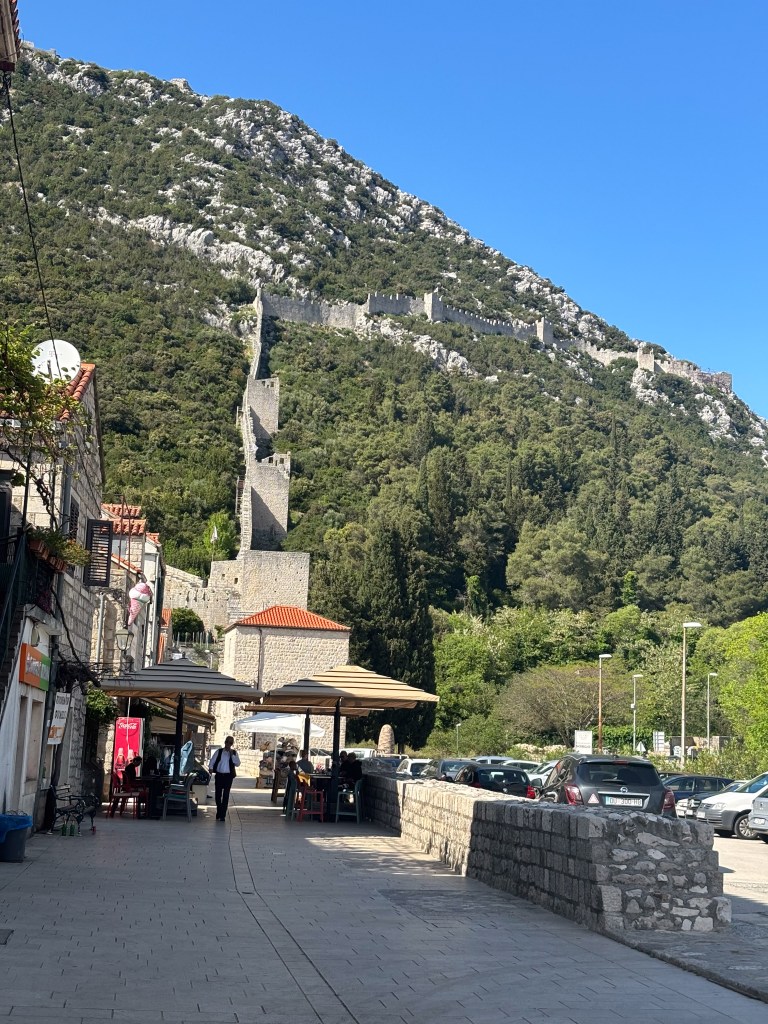
Getting back across the border from Montenegro into Croatia was much easier than we expected…it took less than 5 minutes (compared with over 1.5 hours two days ago). It was a beautiful, sunny day and we got to see way more scenery this time. It took about 2.5 hours to drive from Kotor beyond Debrovnik to the small town of Ston for lunch. The roads are really nice and I actually did some of the driving. (Gary was grateful to have a break.)  Ston had the longest wall outside of China, zigzagging up the steep mountains. It was originally built in the 14th & 15th centuries and was 5 kilometers long (3.1 miles). The wall, its fortresses and bastions were built to protect the saltworks, the shellfish farm and the city itself and to keep enemies from coming onto the Petjasek Peninsula. Earthquakes destroyed much of the wall, but the 1200 meters (.74 miles) remaining and restored are pretty amazing. It was hard to photograph, but at least you can see parts of it going straight up the hill and then over to the right. Some people come here to walk the wall…we chose to admire it from a distance!


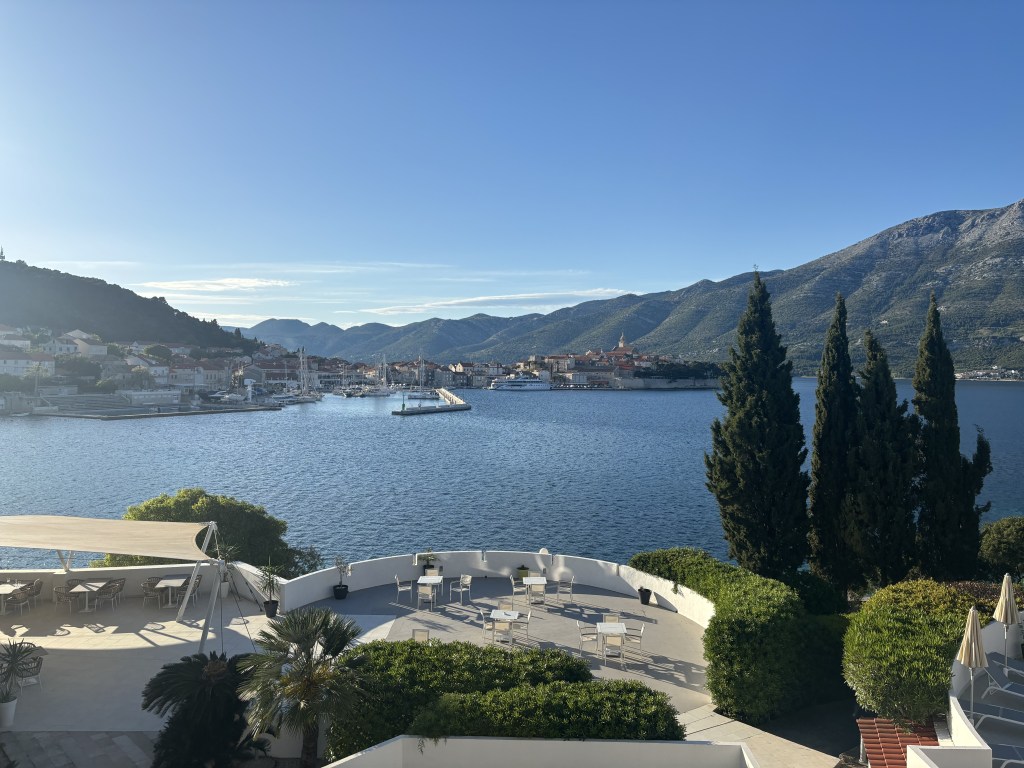
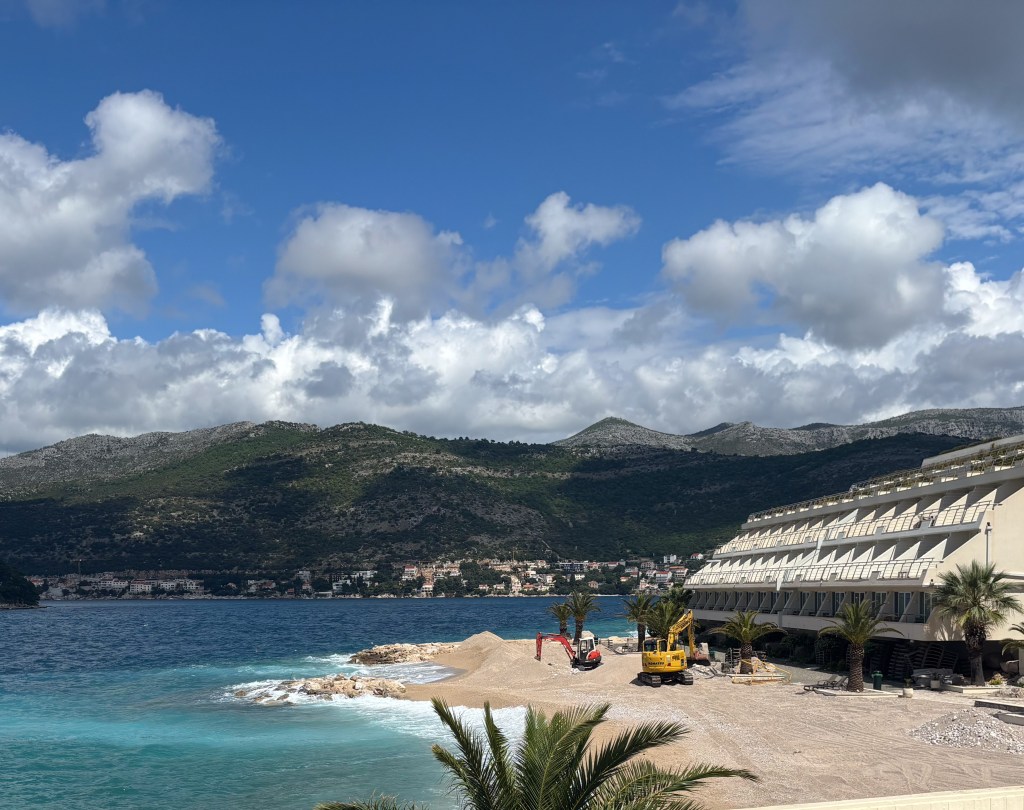
From Ston, we drove about an hour through dozens of vineyards, followed winding roads along the Adriatic Sea and caught a car ferry from Orebic (in the northern part of the Petjasek Peninsula) to Korcula (pronounced KOHR-chew-la). For the first time, the GPS on our phones didn’t work, so it was a bit of a challenge to find our hotel, but we were very pleased with where we stayed—the Aminess Liburna Hotel—looking across the water at Korcula’s Old Town. Here are some views from our balcony!


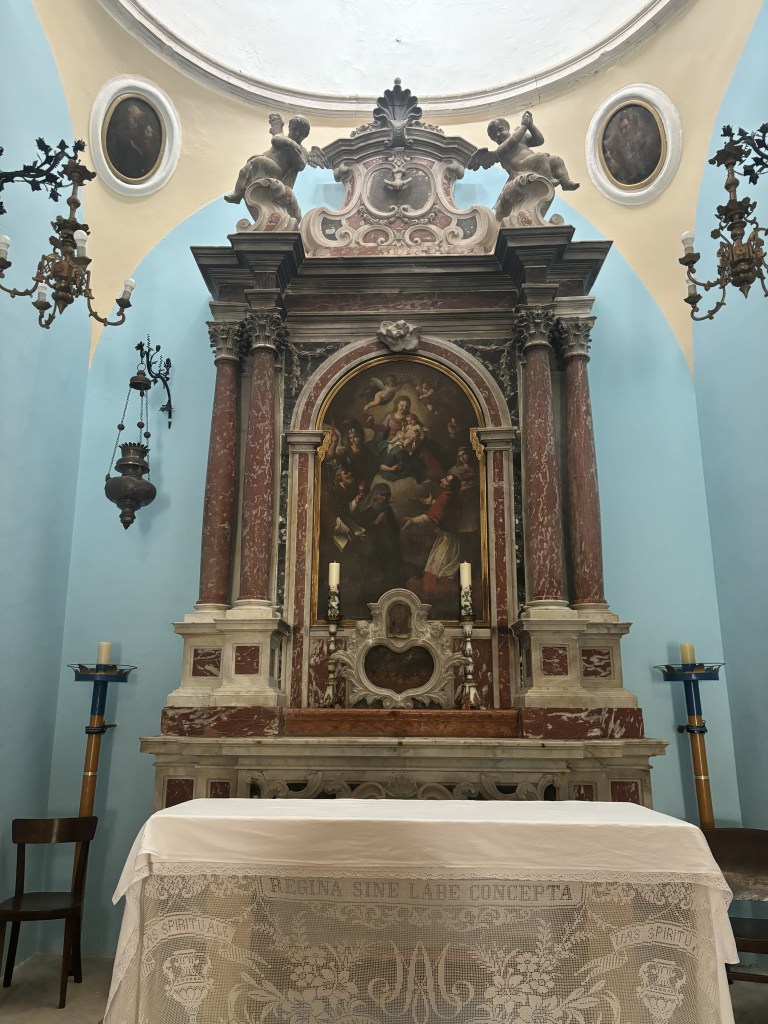
Touring Old Town Korcula was very fun. It was founded by ancient Greeks, later was part of the Roman Empire and eventually became a key southern outpost of the Venetian Republic, so there are many influences in building materials and architecture. It is very small, with narrow streets and even narrower alleyways. Shops and restaurants are tucked in beneath apartments. As usual, we are often drawn to the churches and cathedrals, and Korcula was no exception. The tiny St. Michael’s was very simple and inspiring (below, left), even more so than the larger landmark St. Mark’s, which felt like it had been added onto several times. Its paintings were quite remarkable, but its shape and the placement of its many altars was a bit confusing, distracting us a bit from the sacredness of this space.  


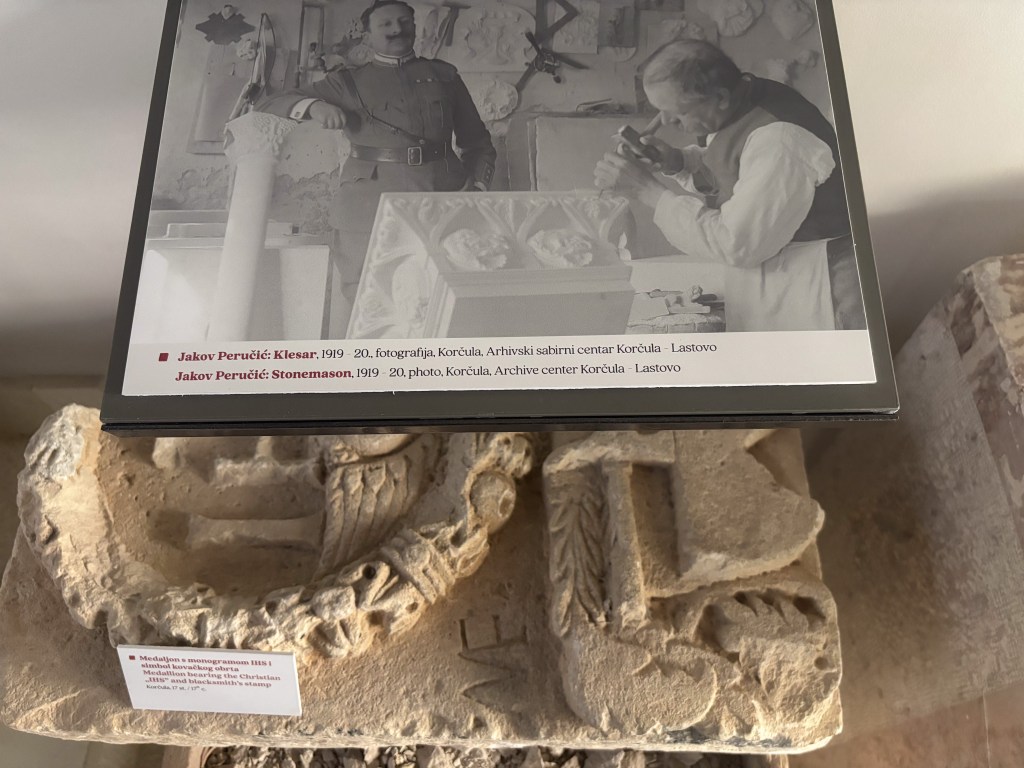
We also enjoyed the small Korcula Town Museum where many artifacts were displayed. I was especially intrigued with the large stone-lidded pot used to store olive oil in ancient times, and have a whole new appreciation for the craft of stonecutters who created so many of the embellishments on ancient buildings.


We enjoyed walking around the outside of the Old Town as well and of course took time to smell some of the beautiful roses that we’ve found blooming in every town we’ve visited.


The whole vibe of Korcula (the town and the long, skinny island by the same name) felt very laid-back. It was only an hour drive from our hotel to the other end of the island (Vela Luca) where we caught the ferry to Split, so we took a few detours along the way (thank you, travel guide Rick Steves) to two small coastal towns (shown below). The first was Brna, a favorite harbor for super-wealthy yachters, and the second was nearby Prizba where we passed several miles of “parking pads” for cantilevered rental villas (seen on the hillside, right), popular with many Central Europeans to enjoy an Adriatic Sea vacation. The waters and views were stunning.


Taking the ferry from Vela Luka, Korcula to Split was quite enjoyable. It took a little over 3 hours and we passed some of the other islands that are popular—including Hvar (below left) and Brac. They are both supposed to be quite beautiful (and more touristy), but we were happy to go on to Split (below right) and beyond. On the ferry, we sat with a man who spends winters in Split and summers on the small island of Lastovo, which we’ve since learned is quite exclusive and peaceful. He said he was “in construction—restaurants and such,” but we later found out he actually owns several restaurants, including one of the best in Croatia on Lastovo!

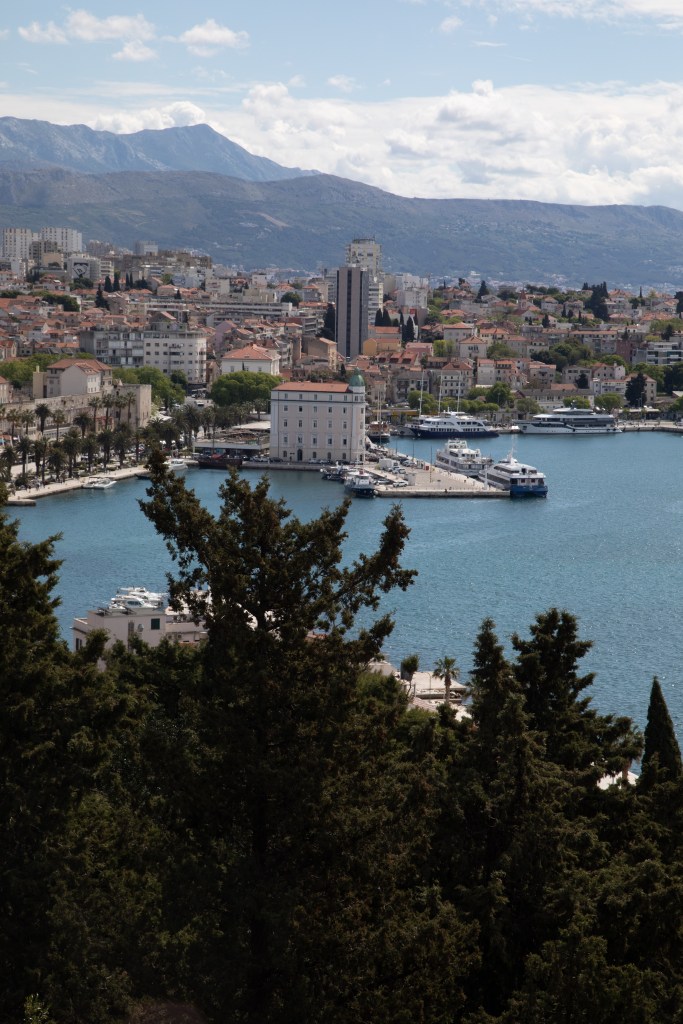
Split was much larger than we expected—over 200,000 people, second only to the Croatian capitol of Zagreb. It’s spread across a wide swath of land with very large mountains behind, protecting it from high winds that come from the east. There were a surprising number of tall, newer buildings that some locals call the Yugoslav-era “concrete blight,” so different from the older parts that include charming, tree-lined residential areas and the sprawling forested Park Marjan—a green oasis the size of NYC’s Central Park that is only for pedestrians and cyclists. Cherished by the citizens of Split, it covers the entire headland to the west of the port.
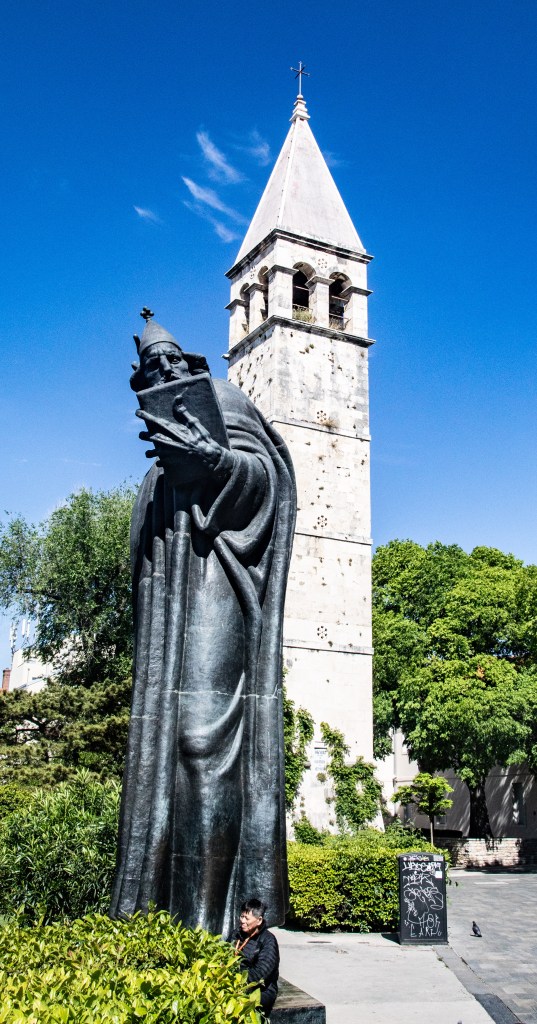
Our Lastovo friend recommended a tour guide who told us lots about the City and its history as he drove us throughout the older sections and alongside Park Marjan. The highlights included the ruins of the 2nd century Roman Emperor Diocletian’s Palace built as his retirement home. At the north “Golden Gate” there is a magnificent sculpture of St. Gregory the Great, the 64th Bishop of Rome from 590 to his death. Legend has it that if you rub his toes, you will have good luck.

This sculpture was the work of Croatia’s greatest sculptor, Ivan Mestrovic, who lived from 1883 to 1962 (having fled Communist suppression to South Bend, Indiana, where he died). There are two large galleries of his work in Split, but they were a bit out of the way and we didn’t take the time to visit them. We did enjoy seeing what was once the summer home of Marshall Tito—a large villa built in the 1930’s overlooking the sea. This is now the meeting place of the current presidents of countries belonging to the European Union (EU). Another intriguing site was the Renaissance Hermitage Monastery where monks built caves into the cliffs and have lived and practiced their faith inside for over four centuries.


We also drove along the large marina and harbor and its “Riva,” a relatively new promenade with beautiful landscaping, restaurants and shopping, catering to tourists as well as those who charter yachts or have their own. Embedded in the sidewalks here are metal plaques—one for each of the 150 Split residents who have won Olympic medals. Locals are very proud of their success in sports and are a bit fanatical about their “football”/soccer team (the HNK Hajduk Split) whose logos are found all over the city. We drove around to the south gate (Bronze Gate) of the Palace ruins and then had our tour guide drop us off at a wonderful little “Restaurant Sug” near our Splendida Palace hotel. They served a delicious Split specialty dessert there called “Paradizot”—a cup of vanilla custard with a bit of yellow cake on the bottom and marshmallow whip on the top. Yum!


This was a great way to end our touring of Split. We chilled the rest of the day, slept in, had a perfect breakfast at the hotel and then drove about 70 miles on a wonderful “A-1” divided highway to the seaside town of Zadar, which is at the north end of the Dalmation Coast. We’ll spend two nights there before heading inland to the waterfalls of Plitvice Lakes National Park and beyond.

We LOVE Croatia and now we see why so many people have raved about it. It’s a beautiful place with warm, friendly people and stunning scenery all along the deep blue Adriatic Sea and its many islands. The climate is quite mild—“Mediterranean”—and there is lots to see and do. If you are looking for a delightful place to vacation, the Dalmatian Coast is a definite a winner!

CROATIA – PART I – Dubrovnik (& Kotor, Montenegro)

April 21, 2024
It is only 337 miles from Budapest, Hungary to Dubrovnik, Croatia. We had
hoped to take a train, but it’s an 18-hour train/bus ride. Instead, we chose to fly.
There is no direct flight so we flew to Dubrovnik on a 7am flight with a 3-hour
layover in Vienna, finally arriving at our hotel (via taxi) on the outskirts of Old
Town Dubrovnik mid-afternoon. We stayed at the Dubrovnik President Hotel and
our room overlooked the deep blue, crystal-clear Asiatic Sea and some of the
nearby Elaphiti Islands. It is beautiful! We had a bit of rain and then super-sunny
skies but it was quite cool and breezy (6o’s), in contrast to the 80-85 degree
weather we had in Budapest. We like the cooler weather, so it’s all good!


We’re still doing a good job of pacing ourselves, so we took it easy the first day
(easy to hunker down in the rain!) and, once the sun came out, we walked along
the sea wall, enjoying the huge waves that poured over parts of it in late
afternoon (above). This was the only time we saw anything but a placid Asiatic
Sea and we loved it! (Apparently the waves cause lots of damage to beachside
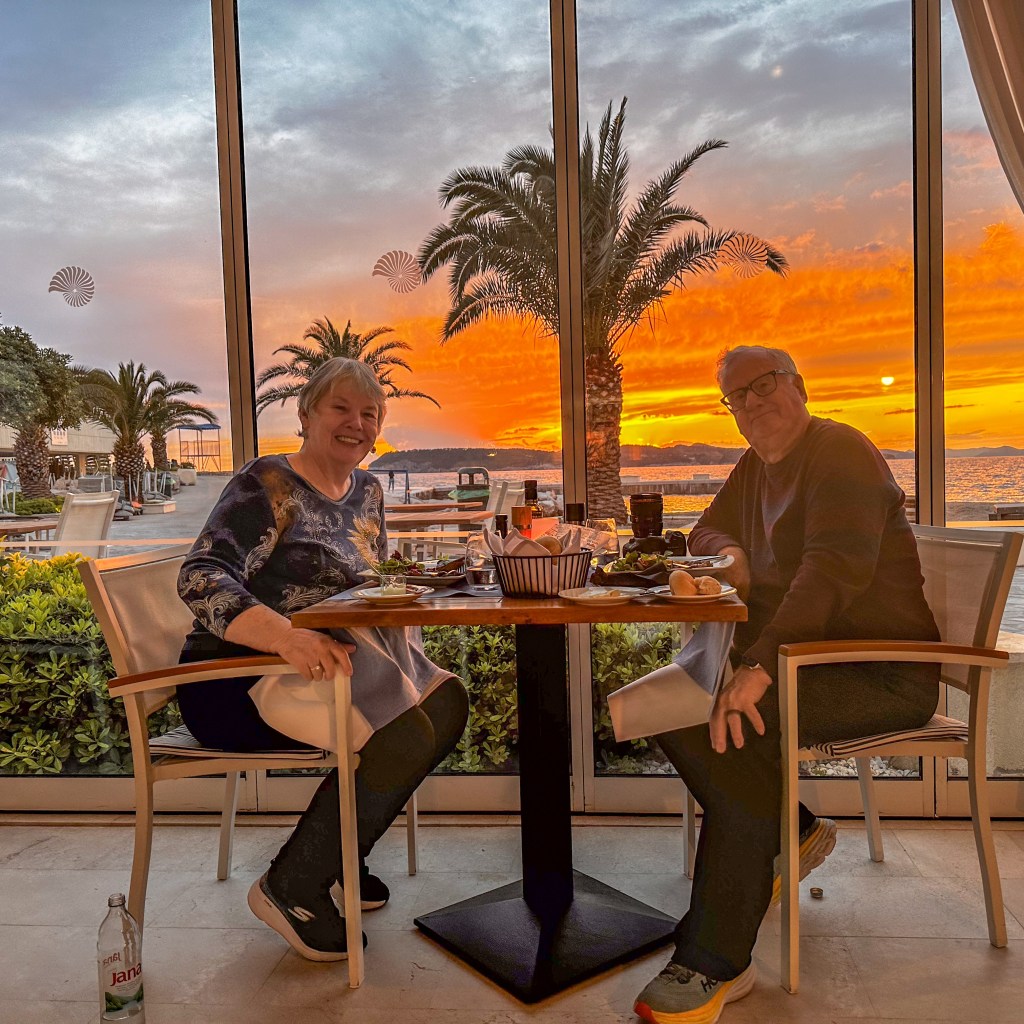
properties in the winter.) We also enjoyed the sunset! (How do you like my new palm hairdo?!?)
The next day we took another Tuk Tuk tour, this time in a larger, electric car with a couple from Ireland and another great guide. We learned a lot about the history of Croatia as we drove past the marinas and up to Mount Srd (and the top of a cable car run) to see Old Town from a different
perspective. All of Dubrovnik revolves around this unique center. It is contained within large walls built not only for defense, but also to keep the water out.


It was fun to see it from above before taking a walking tour through its squares,
narrow streets and alleyways, past many cafes, bars & souvenir shops. (It seems
like there are more places selling jewelry than anywhere else we’ve been…not
sure why.) We learned that there are 40 churches within Old Town’s walls—one
is Greek Orthodox and all the others are Catholic. Dubrovnik has had many
earthquakes, so, for safety, no balconies are allowed on the main streets. All the
streets are paved with limestone, which has become quite smooth over many
centuries. There was a bit of a connection to ancient times as we walked along,
imagining all who have walked here before us over such a long period of time.


The town’s architecture displays very little evidence from the “Siege of
Dubrovnik” beginning in 1992, during which more than 2,000 bombs were dropped on the
town. The only hint of this is the presence of all the newly-tiled terra cotta roofs.
There were lots of people in town and quite a bit of traffic as we drove inside. We
can’t imagine how chaotic it would be in high season (June-July-August), so we
would recommend May or September as the best time to come…warm enough
to enjoy all the beautiful beaches but easier to get around and enjoy all
Dubrovnik has to offer. We most always prefer quiet, so we’re glad we didn’t stay
where all the tourists are. AND, we can certainly see why this is called “The pearl
of the Adriatic.” The deep blue waters are stunning!

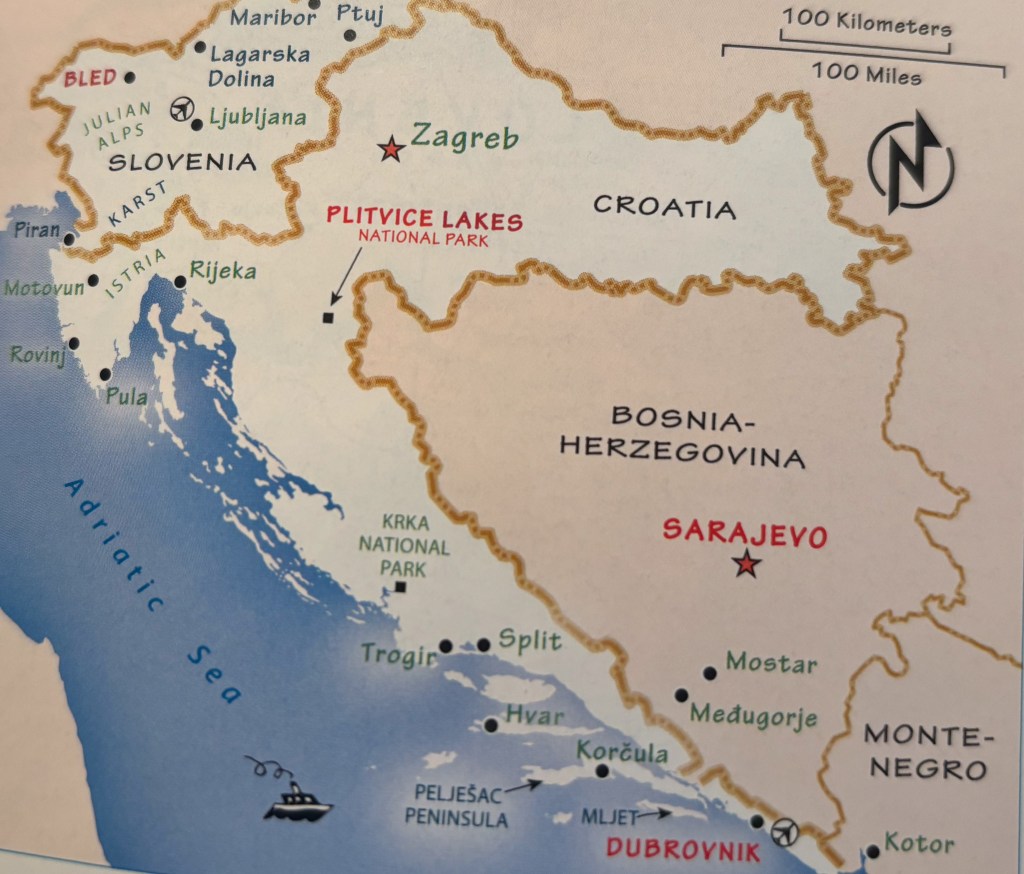
As you may know, Croatia is one of 6 republics that used to be called
Yugoslavia. The others are Bosnia & Herzegovina (including the city of Sarajevo),
Montenegro, Serbia (including the regions of Kosovo & Vojvodina), Slovenia &
Macedonia. All but the latter share borders with Croatia. As we were driving up to
the top of Mount Srd, I got a notice from Verizon welcoming me to Bosnia, and
found out the road briefly entered that country and everything to the east of us
was indeed Bosnia! That was a surprise! And so were the abundance of motor
scooters dodging in and out of traffic, often passing on both sides of the cars.


After a delightful 4 nights in Dubrovnik, we rented a car at the airport and headed
south over the Croatian border to Kotor, Montenegro (neighbors who’ve traveled
this area several times said it is “a must”). The roads were easy to drive (and
there weren’t any daredevil motor scooters this direction…yay). We’re glad we
weren’t in a hurry because the line of cars was very long at the border—it took us
over 1.5 hours to get through; they stamped our passports without question as
we left Croatia and again (1 mile later) as we entered Montenegro. We followed
the main road that wends its way through a variety of small seaside towns along
the coastline of a very steep-walled bay on a fjord-like inlet from the Adriatic Sea.
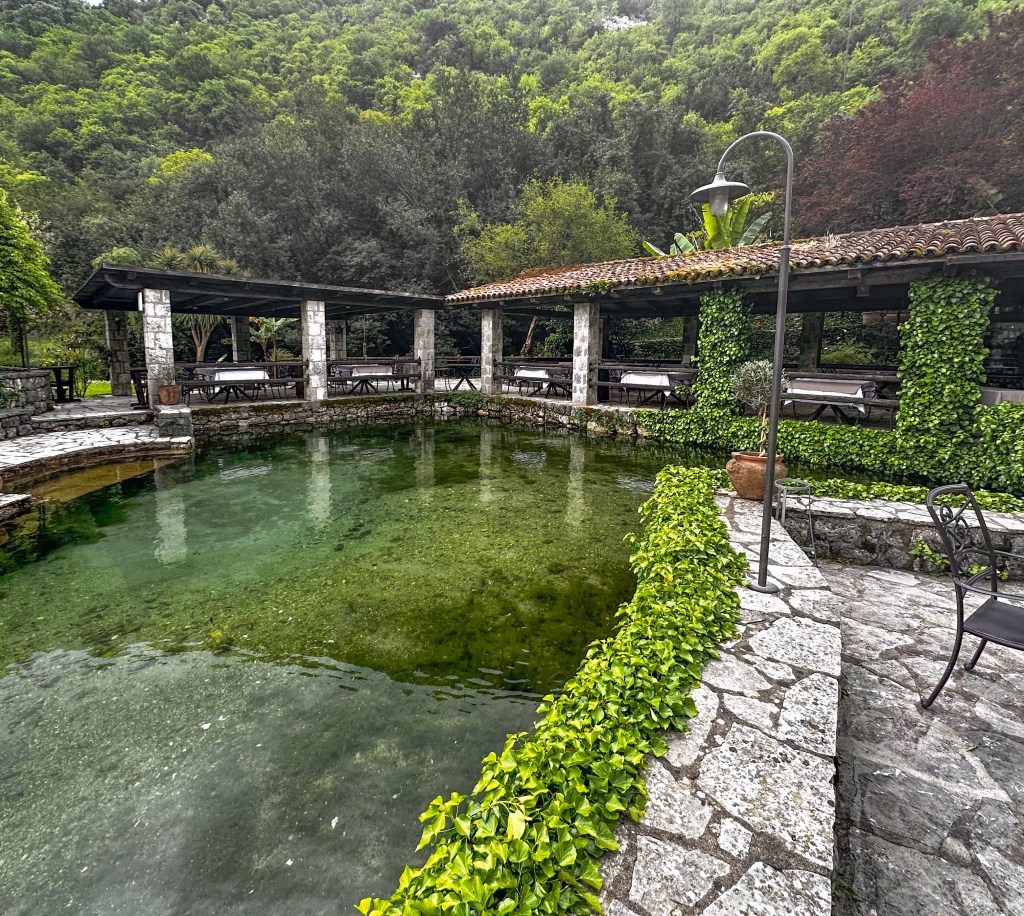
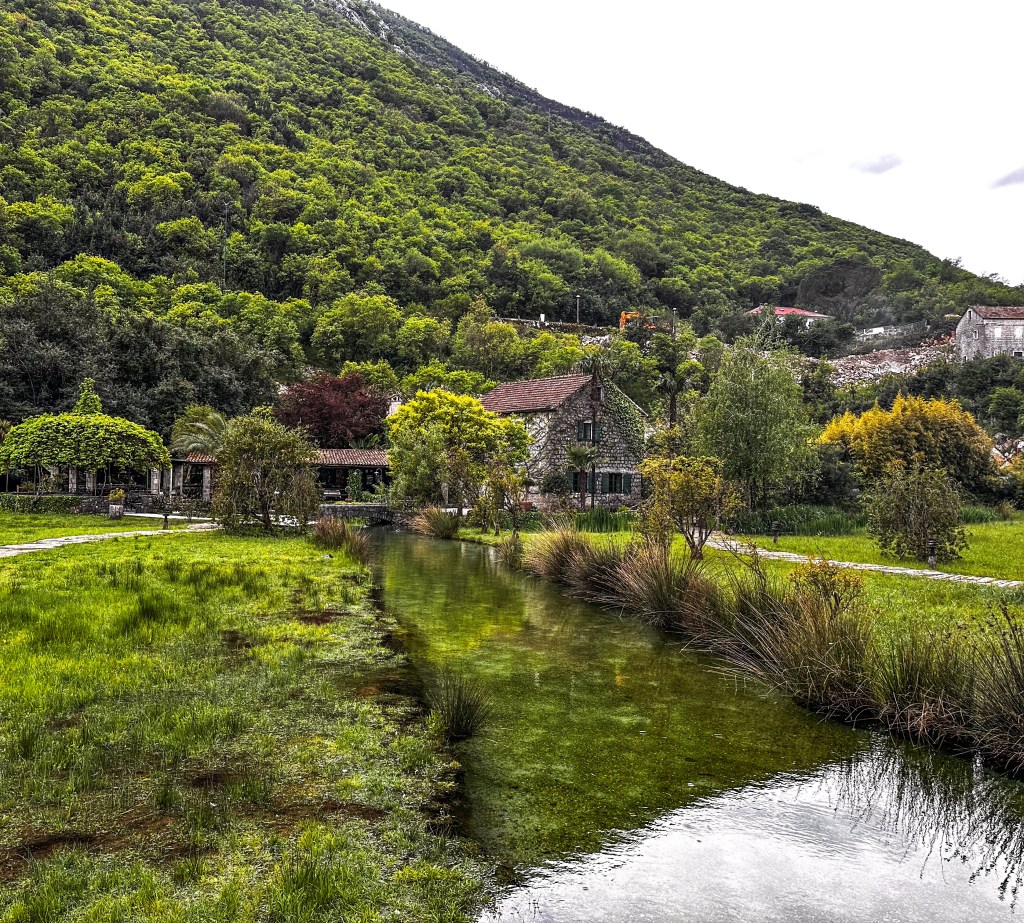
We stopped for a late lunch at a special restaurant in Morinj highly recommended
by my nephew Frank (Kanoba Catovica Mlini). The food was delicious and the
setting was especially memorable as we wandered along wooden pathways and
bridges enjoying its “magical ambiance” of small creeks, ponds and landscaping
as well as pairs of mallard ducks and geese.


We finally got to our hotel late in the afternoon, having driven through several
more small seaside towns plus the heart of Kotor and its walled Old Town
complex overlooking the very calm and peaceful Bay of Kotor. Some call this
“little Dubrovnik,” but it feels much different. Yes, it overlooks the water, and yes,
there is a walled-in Old Town and yes, there are many red-tiled roofs, but the
whole town butts up against huge mountains filled with a maze of fortifications
that climb zigzag right up the sheer cliffs. We got a better look of it from across
the Bay as we were leaving (below)…you can barely see Kotor (in the middle)
tucked between the calm waters and the sheer mountains.
There are lots of trees and lots of churches (mostly Orthodox, a few Catholic).
One of the things we’ll always remember about Kotor is the ringing of old-fashioned church bells every hour from 7am to 9pm (and more often Sunday morning). It got very cold and rainy the day we’d planned to do some touring, we chose to stay in and relax (Gary’s been a bit under the weather & had some eye troubles, which we now think was a reaction to down pillows in Dubrovnik.)
We did go out for a wonderful late lunch at a nearby steak house and that was
quite the experience: steaks were individually wrapped and aging in a refrigerator
right in the dining room and we picked out the steak they then cooked and served
us. They were huge, so we split one. It was delicious!


SIDE NOTE: A friend wrote and suggested we “enjoy The Balkans,” and I must
confess I wasn’t sure what that meant. Hooray for Google! The Balkans takes its
name from the Balkan mountains that stretch throughout the whole of Bulgaria. It
is a geographical area in southeastern Europe, corresponding partially with the
Balkan Peninsula, bordered by the Adriatic Sea (NW), the Ionian Sea (SW),
the Aegean Sea (S), the Turkish Straits (E) and the Black Sea (NE). By most
definitions the Balkans encompass Albania, Bosnia & Herzegovina, Bulgaria,
Greece, Kosovo, Montenegro North Macedonia, European Turkey, most of
Serbia and large parts of Croatia. Sometimes the term also includes Romania
and southern parts of Slovenia and perhaps the Province of Trieste in Italy. It’s
fun to research and find out about things I’m not sure of as we travel along!
We plan to spend the next ten days exploring lots more of Croatia. Stay tuned!

VIKING RIVER CRUISING – PART III – Austria & Hungary

April 15, 2024
There were many sights to see during Days 12 & 13 in the very large city of Vienna, Austria (2 million people). We were able to take in many of them on our favorite HopOn/HopOff Bus (called “The Big Bus” here), including the famed Hapsburg Schonbrunn Palace, plus remarkable museums and opera houses. What struck us most of all (other than the very slow-moving traffic) was the juxtaposition of so many ancient buildings with those that are quite modern. We especially enjoyed spending time in St. Stephens Basillica (note very modern building next to it, left).


Vienna, “The City of Music,” is an important cultural center, famous for its many musicians and composers (Haydn, Mozart, Beethoven, Schubert, Strauss) and the Vienna Boys Choir. AND, it is also famous for its Spanish Riding School, “Home of the Dancing Horses,” also known as the world-famous white Lipizzaner stallions. The facility was commissioned in 1729 by Emperor Charles VI and is the oldest of its kind in the world. A portrait of Charles VI is displayed in the opulent baroque hall—the riding school’s performance venue. Every time a rider on horseback enters this hall, for trainings and performances, s/he stops, turns toward the portrait and tips his/her hat—forever grateful for this amazing program and the Emperor who made it all possible. We also got to take another horse carriage ride around the town as part of our tour! So much fun!


We had two opportunities to experience these magnificent Lipizzaners—first on a special “shore excursion” where we got to see the horses up close in their stalls, visit the tack room and performance venue (above) and learn about the training of both horses (8-10 years, starting at age 4) and riders (about the same, starting at age 16+). We also learned that performing classical dressage horsemanship comes naturally to these specially-bred horses—they are strong, agile, highly intelligent, gentle, and adored by the Hapsburg family. The Lipizzaners only perform on weekends at the School, and this excursion didn’t include seeing any of them in action. However, we went back the next day to witness a one-hour training and that was awesome. We weren’t allowed to take photographs here, and we didn’t get to see any fancy jumps, but we were spellbound as we watched 2 sets of riders and horses go through relaxation exercises, “the refining and perfecting of lessons and the targeted strengthening of muscles” (including the advanced long-rein training) and the cool down, all accompanied by classical Viennese music. If you ever have an opportunity to see a Lipizzaner performance, I highly recommend it. I saw them with my two daughters many years ago in Washington, DC and have always been in awe of them. There was a video playing during our excursion tour that I caught with my iPhone to share with you, but after many attempts to import it here, we can’t seem to figure out how to do it. Apologies! Maybe you could get one on Google! 🙂

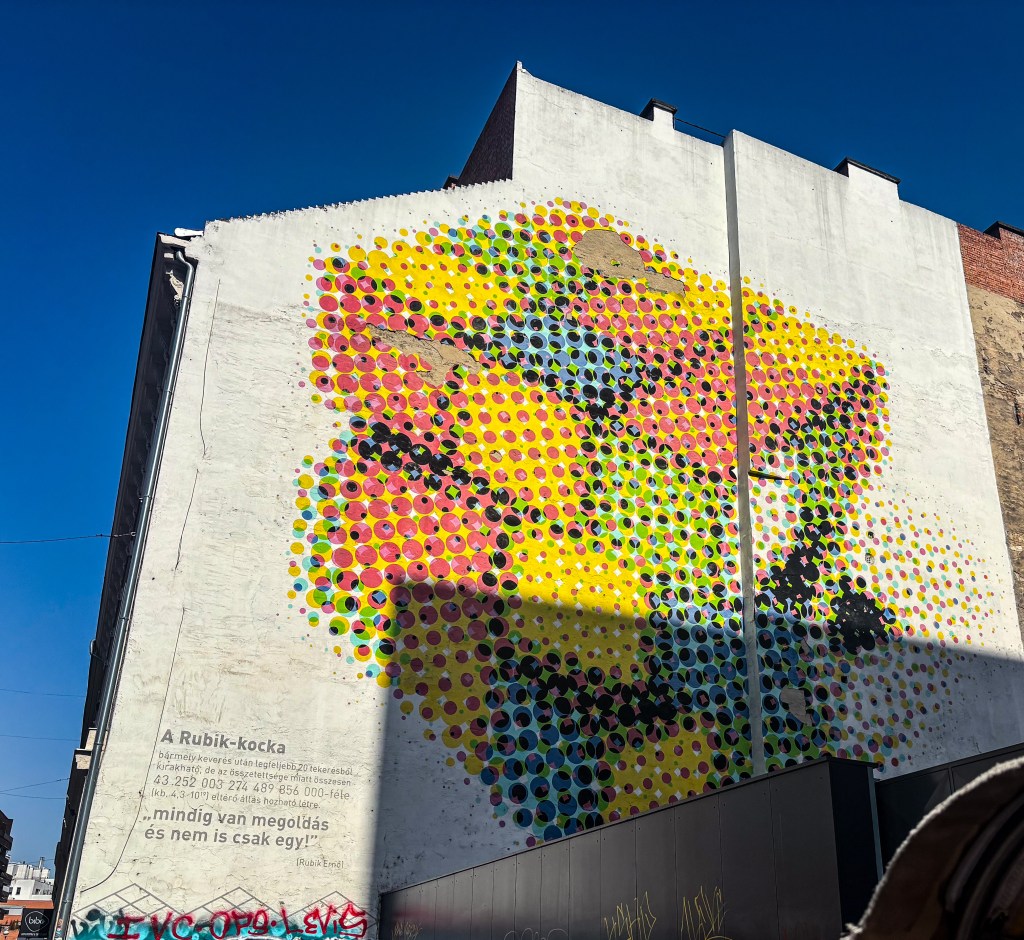
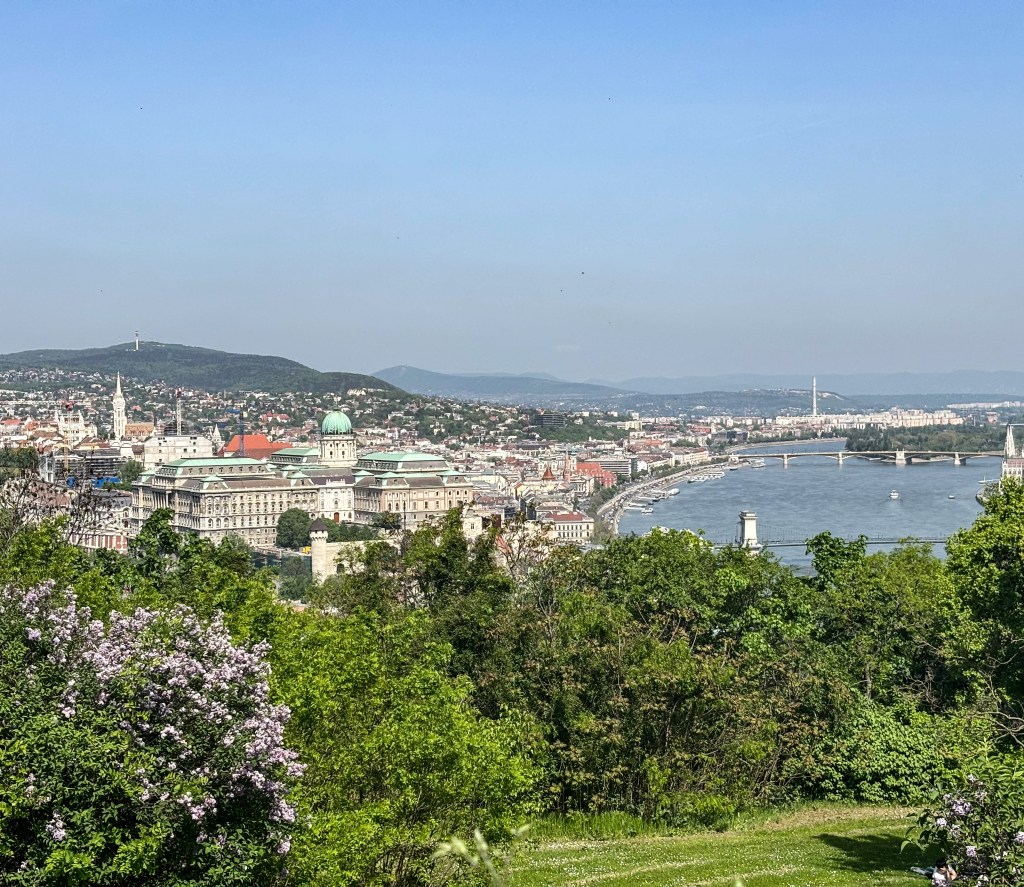
Day 14 we docked in Budapest and took our final shore excursion—a panoramic tour of this beautiful city, with hilly Buda and its awesome castle on one side and the flatter, more populated Pest (pronounced Pesh) on the other side of the Danube River. This gave us a wonderful overview not only of the history of the city, but also about its highlights, including the massive Parliament building and Buda Castle, St. Stephen’s Basilica, the Jewish Quarter and its Great Synagogue, together with its many statues and tree-lined avenues and parks. We also learned a lot about the Hungarian people and their language—one of the most complicated in the world, most closely related to but unlike Finnish and Esthonian. Hungarians are quite proud of their culture, their creativity and “thinking differently.” It was here that Vitamin C was discovered and the ballpoint pen and Rubik’s Cube were invented. They also have 16 Nobel Prize winners.


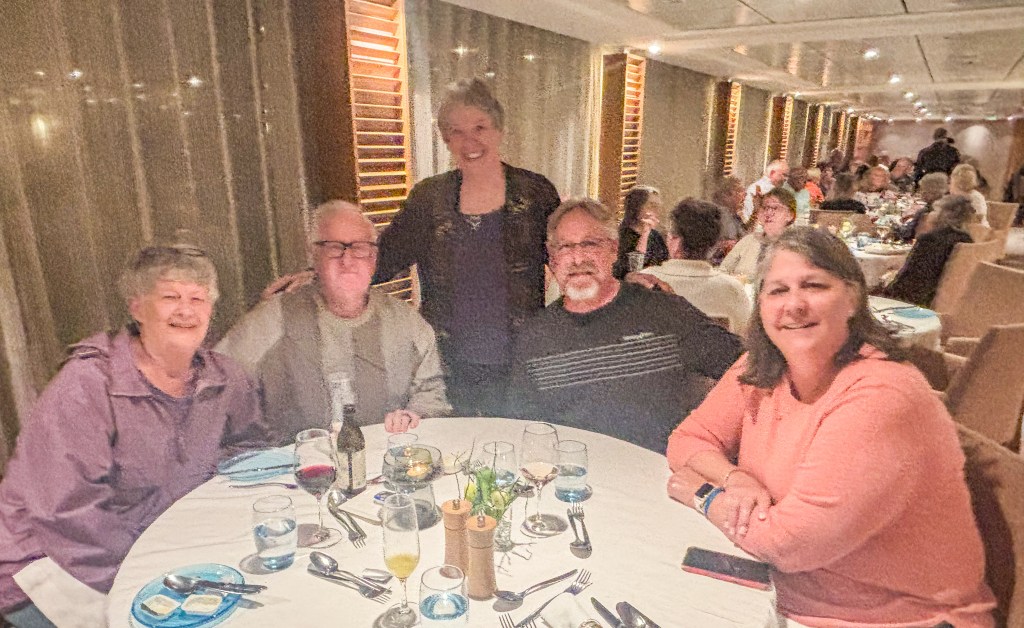
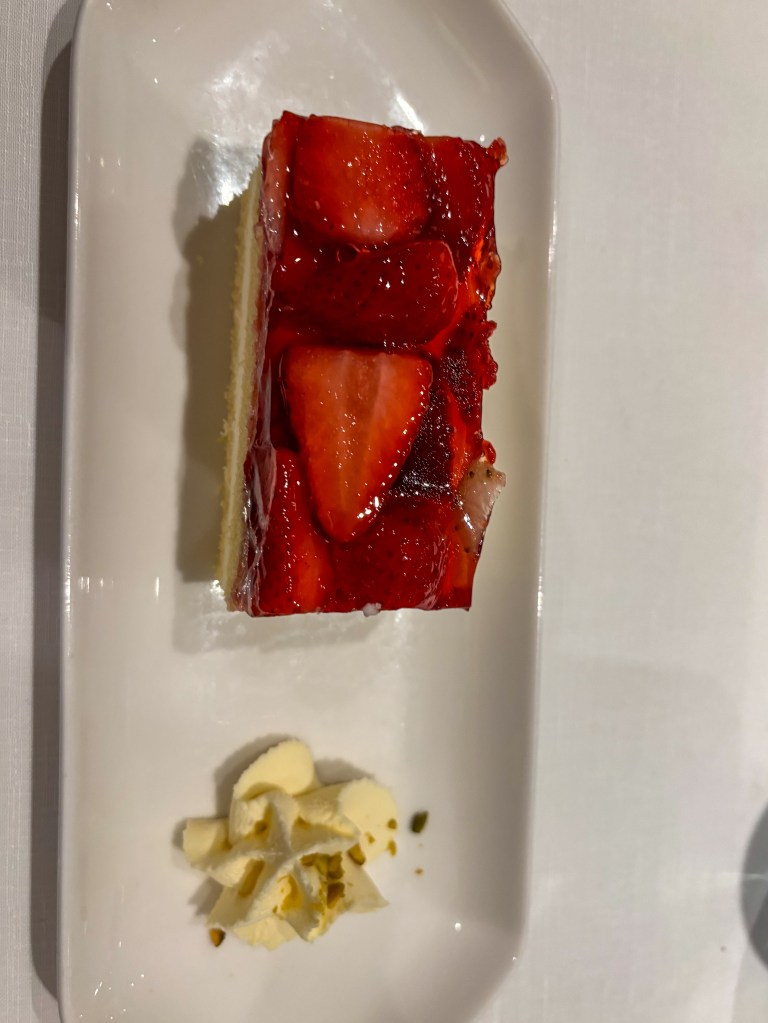
Our final dinner on the boat was delightful and a bit emotional. Once again we sat with our “adopted family” from Colorado (below). Everyone we know had such a good time and we loved the people who served us so brilliantly and joyfully the entire cruise. There were lots of photos and lots of hugs and farewells, as many people were taking very early flights the next morning. This would be a good place to mention the food we had onboard. 85% of it was scrumptious. For some, all of it was, but frankly I’m not too keen on meats that have been cooking for a very long time and featured in each country’s variation of stew or goulash. I much preferred the consistently delicious caesar salad, rib eye steak, roasted chicken, soups and pasta dishes. AND, the desserts were all superb! Below are some examples of what was offered. Note the famous Hungarian paprika on one side of the pickle!


As we conclude this amazing 15-day Viking River Cruise (we LOVE Viking!), we will always remember the people and the high level of service (and food!), as well as the beautiful scenery and how much we learned about this part of the world. We continue to LOVE river cruising…it is very soothing and peaceful and relaxing.

One more thing that was also very relaxing was doing a 1000-piece jigsaw puzzle I discovered in the boat library on the 3rd day. Over a dozen people worked on it for over a week—a fun way to get better acquainted with fellow puzzlers! It was a lot harder than we’d expected so we’d cheer each other on when we’d finally find a piece. Below is a buddy from Ohio who probably found the most pieces.


Even though Gary and I weren’t disembarking until 1pm on the last day (Day 15), we had to put our luggage in the hallway and be out of our room by 9am. We made ourselves at home in the lounge and had both breakfast and lunch on the boat since we couldn’t check into our hotel until 2. We are very glad we chose to spend 5 more days in Budapest, a city of 1.7 million yet feeling much smaller than Vienna. We stayed at the Casati Hotel, a small boutique hotel right off of Andrassy Avenue, the “Budapest Champs-Elysees.” We were fascinated with its modern, creative décor, inside an 18th century building.


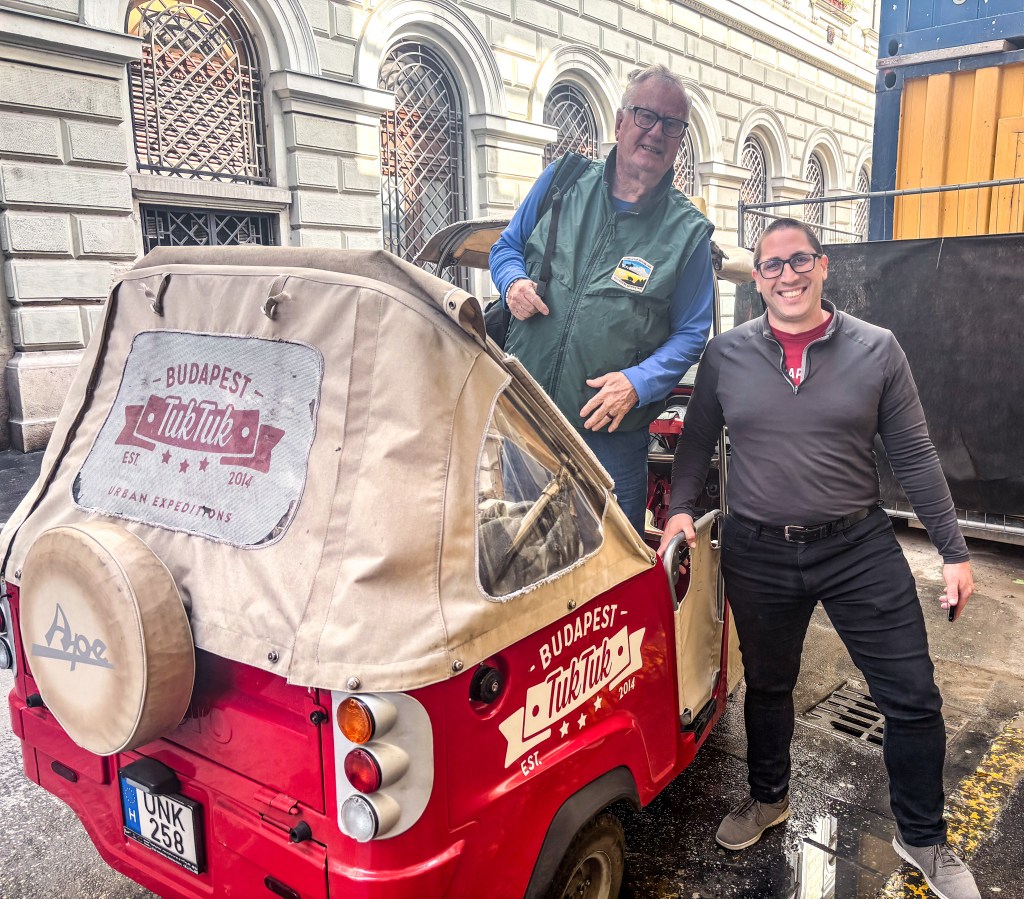
One of the most fun things we did the next day was to take a 2.5 hour “Tuk Tuk” tour around the city (named for the sound of its original motor). As you can see, it’s like a motorized rickshaw, just right for the two of us and a very entertaining driver who drove us to lesser-known places. He also zipped up and down the hills of the Buda side to show us the Lady Liberty statue (to celebrate democracy) and panoramic views of the City. I was particularly intrigued with the amazing Matthias Church in front of the Fisherman’s Bastion at the heart of Buda’s Castle District. I loved its exquisite “Majolika”-style roof with its 150,000 colorful tiles. It opened in 1255!


Another highlight was an audio tour of the new House of Music, which we’d heard about from a Korean couple we dined with in Salzburg. (We find a lot of treasures from suggestions we hear as we travel.) Its modern mushroom shape was designed by Japanese architect Sou Fujimoto and presents the history of music since its beginning in multi-faceted, interactive ways, beginning with the sounds of nature and the drum. We heard everything from 6th century Gregorian chants, church hymns, folk music, opera and symphonies to jazz, rock and pop. The exhibit also traced the development of instruments, written music and the recording of sound and other technologies. We now have a greater appreciation of how music has affected everyone in the world, from cradle to grave, and can create a common language among all people, often transcending everyday realities into a realm far more enlightening and often mystical. This permanent exhibit is called “Dimensions of Sound – Musical Journey Through Space.” It was quite the experience and we highly recommend it. Afterward we had lunch at TGI Fridays, which used to be a favorite restaurant in San Jose. It was good to have some “American” food, including their famous loaded potato skin

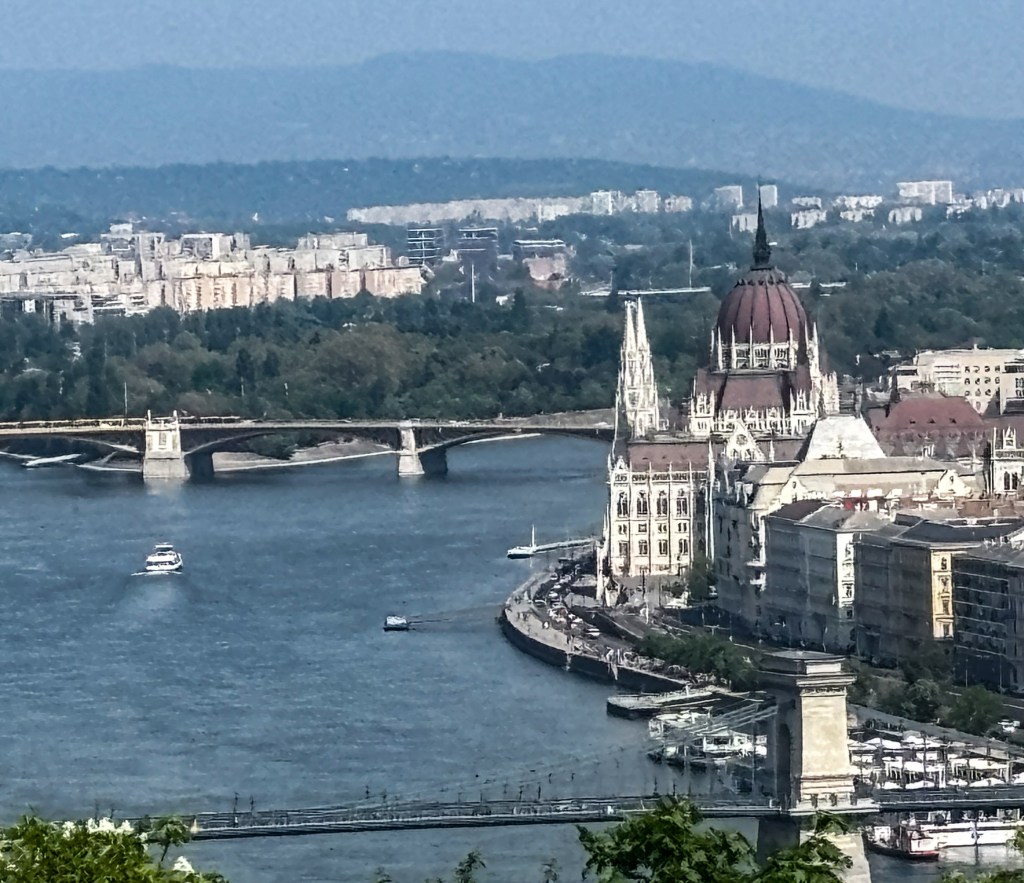
We purposely planned two quieter days before heading to Croatia—the next chapter of our journey (that we are VERY excited about!). On Sunday we slept in, had a late breakfast and then both had 90-minute massages in the hotel’s spa. Ahhhhh, was that wonnnnnderful! After short naps, we showered and headed for our last scheduled Budapest tour—an evening cruise along the Danube. The boat was a bit “tired” so that was disappointing, but the views of all the magnificent buildings and bridges lit up were quite beautiful. Below is the Parliament Building and Chain Bridge.


We slept in again on our final day in Budapest, very, very grateful for all of the experiences we’ve had and the wonderful people we’ve met along the way. Thanks again for cruising along with us. Hopefully you are enjoying it too!

VIKING RIVER CRUISING – PART II – Germany & Salzburg April 7, 2024

As we continue cruising on the rivers—first the Rhine, then the Main, through the Main-Danube Canal and now down the mighty Danube—it’s hard to remember the details of all that we’ve seen and experienced since our last blog. Thank goodness we have the Viking printed itineraries and Daily News to remind us what is scheduled and what we have done. I’ve also learned to jot down information in the “Notes” on my iPhone to capture more as we go along, but it’s taking time to get it all organized in my mind to share with you.

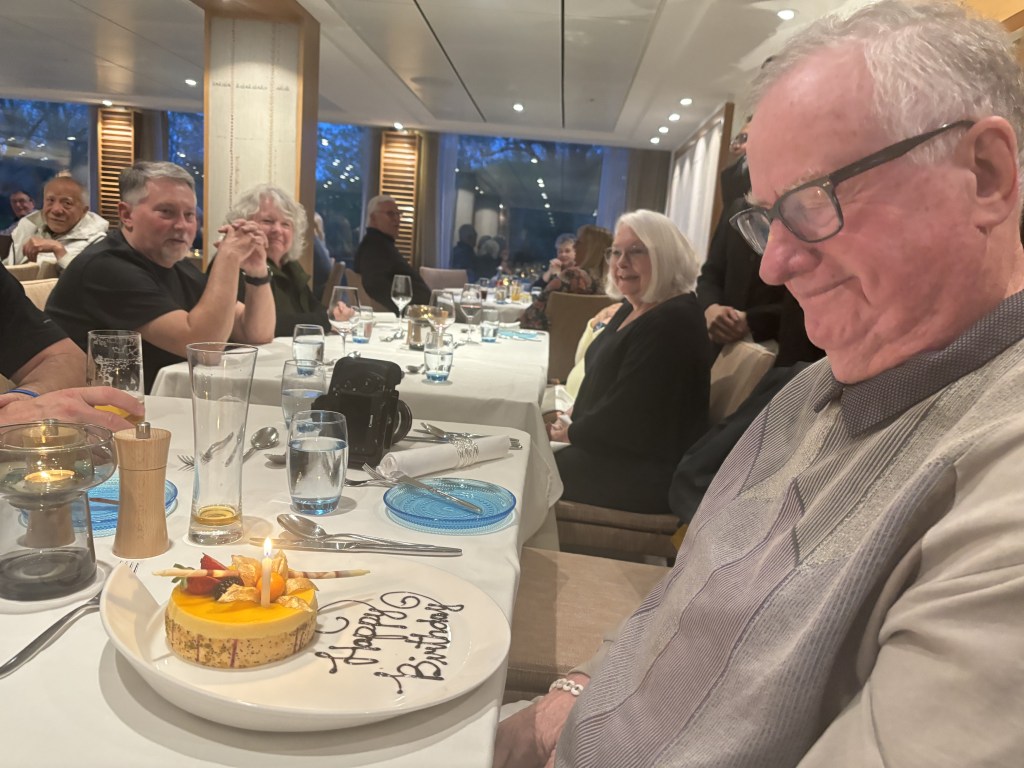
After leaving Miltenburg, we spent a glorious day. First of all, it was Gary’s 81st birthday (April 2) and we had lots to celebrate. All 190 passengers plus all the wonderful servers sang to him at dinner and our table shared a delicious mango custard birthday cake.

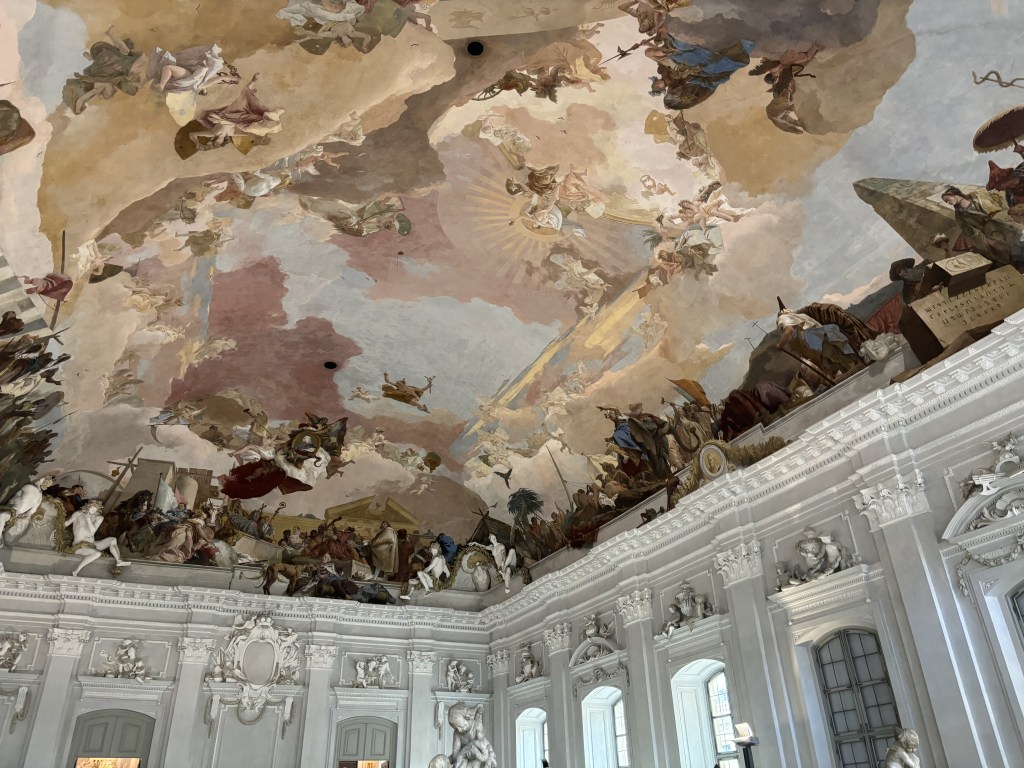
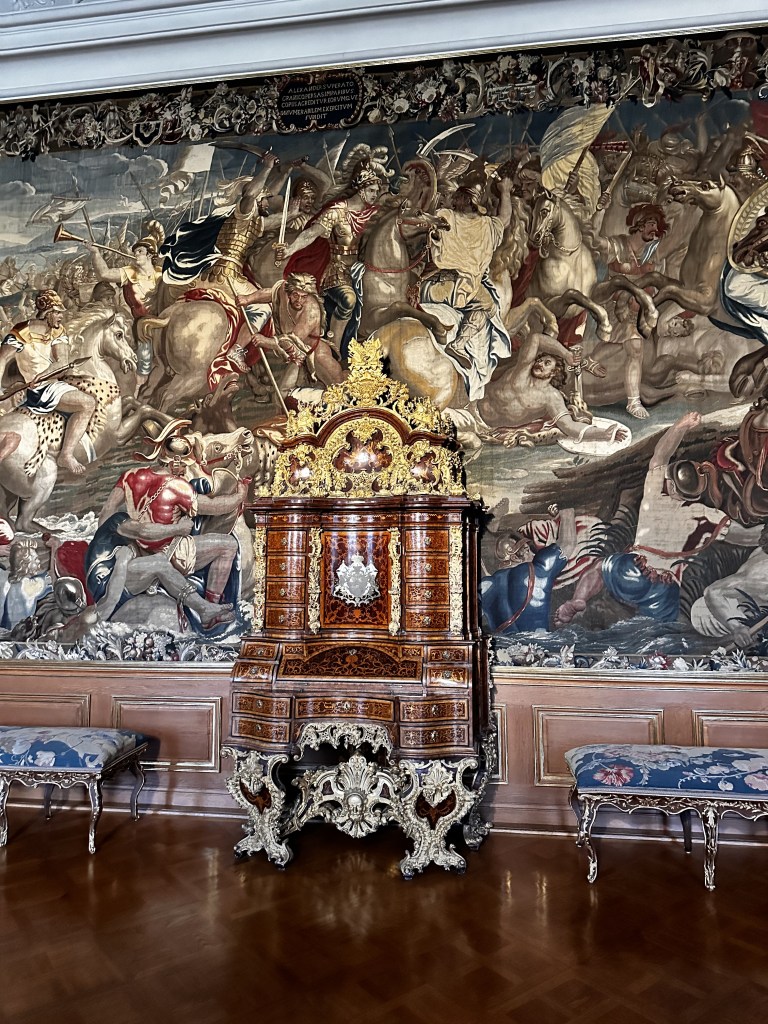
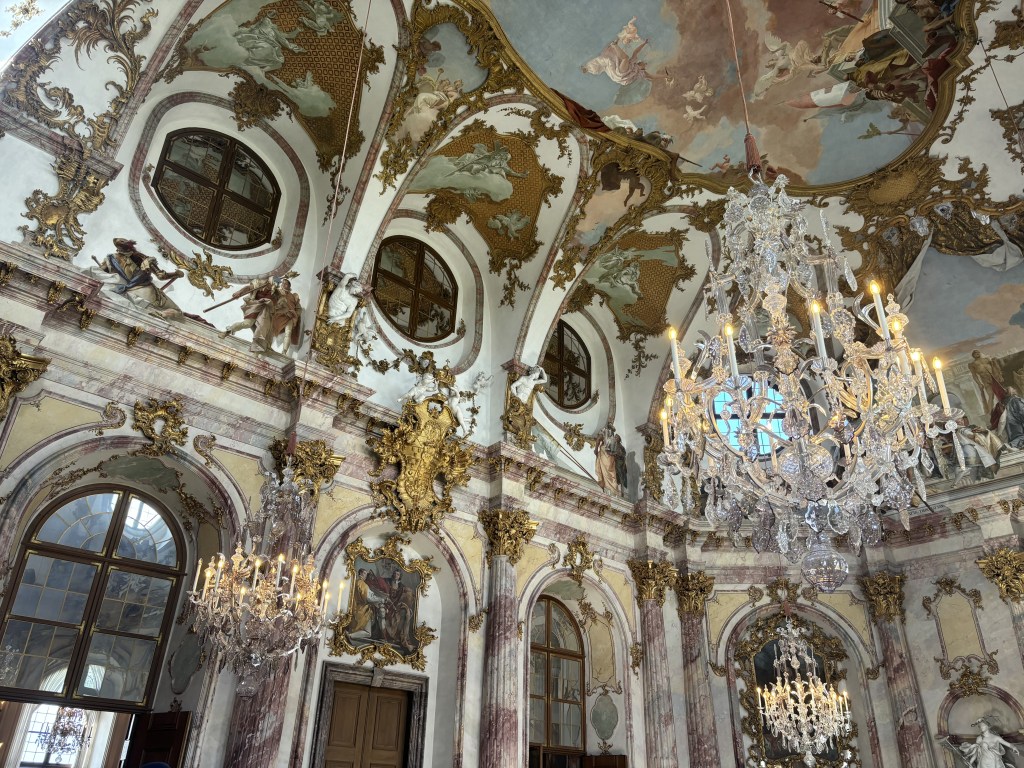
We spent Day 6 in Wurzburg, a town neither of us had ever heard of. The primary focus of this guided walking tour was going through parts of the 360-room “Residenz” of the Wurzburg prince-bishop, one of the most important baroque palaces in Europe. It took 60 years to complete (from 1720-1780) using the same architect who built Versailles (Louis Le Vau) and many superior craftsmen (many from Italy). The palace was badly damaged in WWII bombings, but its meticulous restoration was completed in 1987, once again using superior craftsmen. We’ve never seen such lavish and ornate décor, with its rich (over-the-top!) array of furniture, tapestries, paintings and other 18th century treasures. The overhead ceiling frescoes were stunning, including the 6400 square foot “Four Continents” fresco by Venetian artist Giovanni Tiepolo (below)—the four continents at the time being Africa, America, Europe and Asia. The details and symbolism in this amazing painting were quite remarkable.


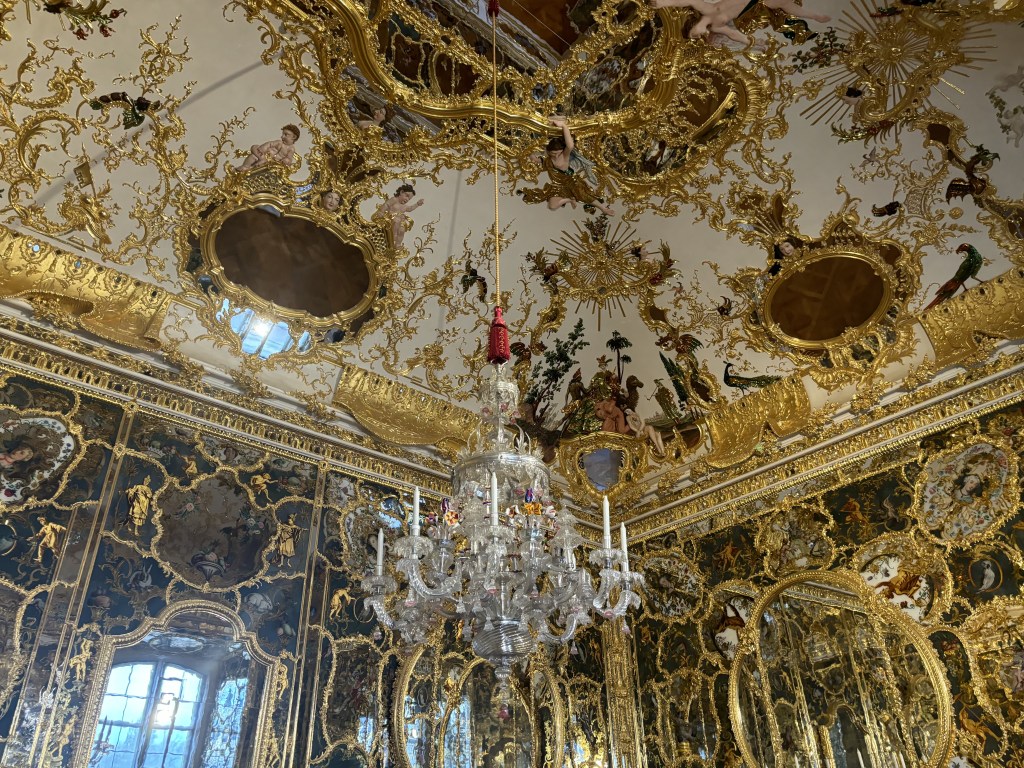
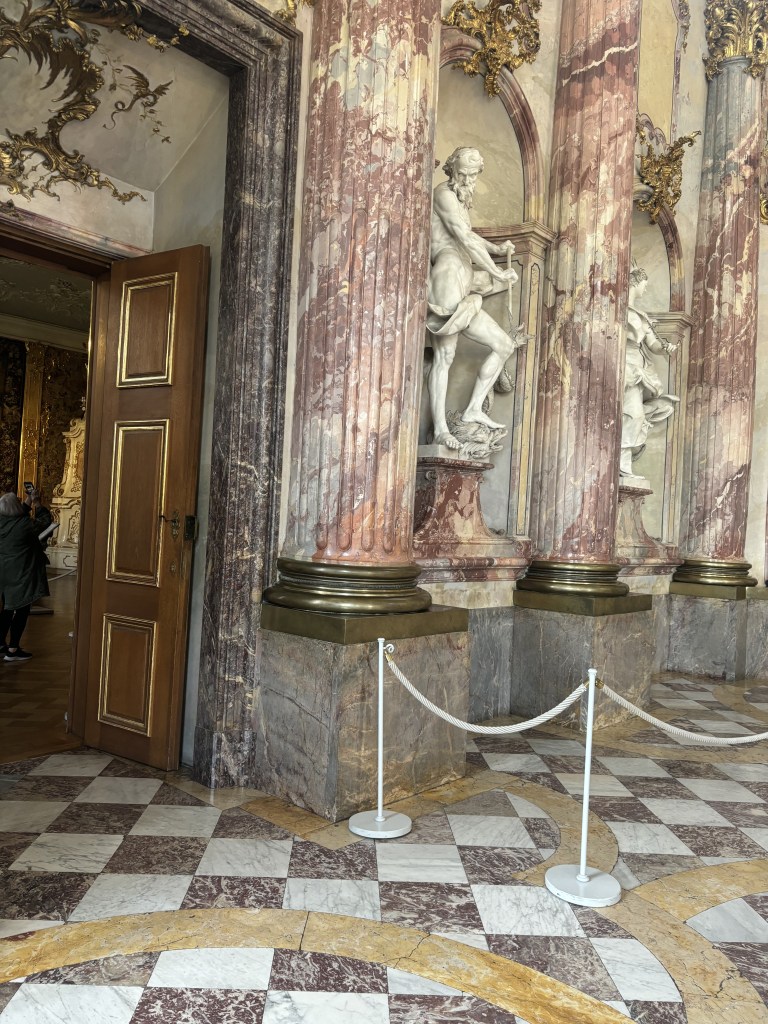
The gold ornamentation, rococo-like wall décor and crystal chandeliers were everywhere as were huge pillars painted to match the real marble flooring. We only saw about 15 rooms and each one seemed more lavish than the next. Frankly, it was a bit overwhelming, but certainly worth the visit. We also have come to realize that the restoration of palaces was partially the result of the reformation—the Catholic church (and the Hapsburgs) wanting to show off its creations of paradise and tributes to the Most High and not lose its members to other religions emerging.


As part of our self-care, Day 7 became a day of rest for both of us. We missed a walking tour of Bamberg, known for its “smoky beer” (rauchbeir). It is one of the few cities not destroyed during WWII, so we missed many medieval structures remarkably preserved.

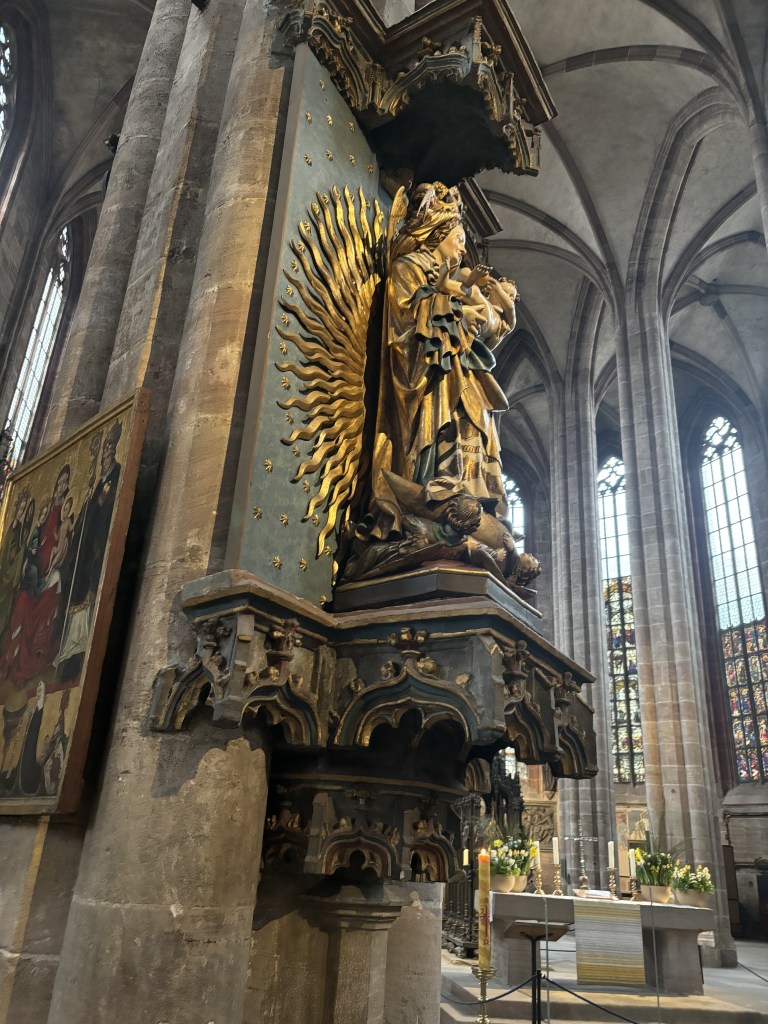
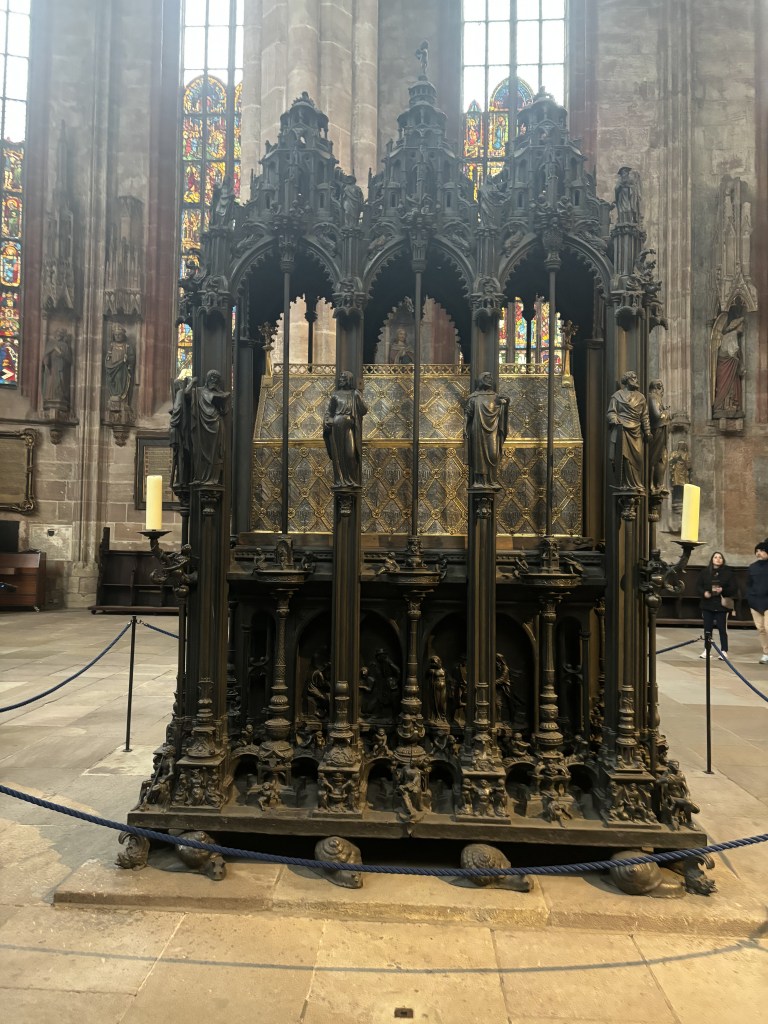
After a leisurely morning, the highlight of Day 8 was a fascinating walking tour called, “Surviving the War—Art in Nuremberg.” We thought it was about paintings, but it was far more than that. We actually went underground to one of the many heavily-insulated bunkers (ceiling, below, middle) that had been converted from a medieval beer cellar. This is where many treasures from centuries-old churches were hidden, together with the Holy Roman Emperor’s Crown Jewels (which are now in Vienna–long story). We also saw a video showing how many of the church statues & tombs too large to move were encased in wood then surrounded by sand to protect them from damage.
We then visited the Gothic church of St. Sebald (below left) where saved works of art have been returned to their original home and where larger wood-encased statues survived roof collapses and bombings. It was also fascinating to learn about all the tunnels, secret passages and subterranean shelters that helped many survive the WWII bombings. Nuremberg is the 2nd largest city in Bavaria, filled with half-timbered houses and Gothic churches with intricate spires. It is most famous as the site of the Nazi war crimes trials. Most of it was destroyed by Allied bombers in WWII, but later painstakingly reconstructed using the original stone.


SIDE NOTE: We’ve discovered why some German cities end with “-burg” and others end with “-berg.” Burg means castle so any city ending in -burg has a castle; -berg means on a hill (no castle) so that’s why the spelling is different.   

We chose to rest again on Day 9 (in Regensburg). We missed “the oldest city on the Danube,” but I injured my knee late last fall and it’s not yet completely healed, so pacing is an even more important part of self-care. It’s been frustrating at times to be one of the slower walkers (since I’m usually at the head of the pack), but I’ve done a pretty good job of adjusting (most of the time!). Besides, I wanted to make sure I was ready for our special shore excursion on Day 10, a trip to Salzburg, Austria, the City of Mozart and “The Sound of Music.”

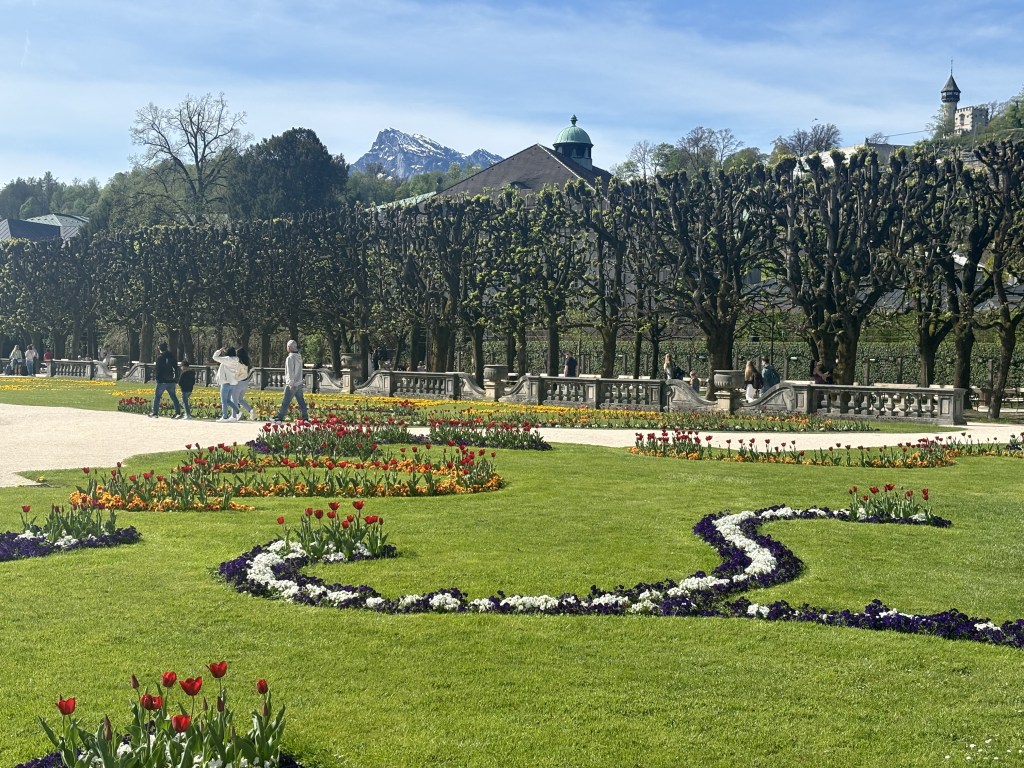
Our 2-hour bus ride from Passau to Salzburg was well worth it, especially when, beyond the rolling and beautiful countryside and charming villages, we first saw the snow-covered Alps up ahead of us. What a glorious site! (These were the mountains the Von Trapp family fled to from the city, and we saw several places here where filming took place, as well as the cemetery that inspired the movie scenes that took place in a cemetery.) What fun! For the third time (first in Edinburgh, then in Cologne), we came across hundreds of padlocks fastened to fences, often on bridges (also below). Lovers write their names on a padlock, lock it on a public fixture and throw away the key. During our free time, we toured part of this sweet town in a horse & carriage—something we always enjoy. What made it even more delightful was having lunch at Austria’s oldest restaurant while four very talented, classically-trained musicians sang many songs from The Sound of Music. It was wonderful as we all sang along!

One more photo from Salzburg. In the middle of a large square, there is a beautiful statue of the Virgin Mary. If you stand back far enough (as photographer Gary did), you can make it look as if the angels holding a gold crown (on a wall over 50′ behind the statue!), are placing that crown upon the head of the Virgin Mary! Pretty awesome, huh?!? (The advantage of having a good tour guide!)

On Day 11 we felt good enough to take a guided tour of the charming city of Melk (midway between Strasburg & Vienna) that lies at the confluence of the Danube and Melk Rivers. It’s at the base of the Wachau Valley (famous for its wines, and beautiful to cruise through). We spent most of our time at the 900-year old Benedictine Melk Abbey, another stunning example of baroque architecture, with its 365 windows, expansive balconies and extensive library still used by scholars from all over the world for its rare manuscripts, diaries and more than 125,000 volumes. We also learned about the extensive Rules of St. Benedict including the Four Cardinal Virtues (Wisdom, Justice, Fortitude & Temperance), and The Basic Rule: Pray, Work & Read. It was here that we saw the most extraordinary example of visual illusion art called “trompe l’oeil,” (pronounced “tromp loy”). The fresco on the ceiling (below) was painted to look very high, but it was actually flat! The French term literally means, “deceives the eye,” which is a perfect description. We were definitely deceived, in a most wondrous way!


Having completed our 100-mile journey through the Rhine and the Main-Danube Canal, we are now on the beautiful Danube River, “the river of superlatives,” because of its power and beauty—in its earliest times a symbol of genius and the vital, creative force of progress. It is also known to be more treacherous, with fast currents. There is less barge traffic and it is harder to navigate, but quite delightful for passengers to enjoy, and we’ve seen many other Viking long ships specifically designed to cruise all of these waters. The Canal itself was originally conceived by Charlemagne in 793AD, but many attempts over many centuries were made and failed. The construction of this Canal took place from 1960-1992. Its importance to river traffic is enormous because it permits traffic to flow between the North Sea and the Black Sea, allowing both people and freight to move across the continent by water, traversing 11 countries, 2 time zones, past ancient capitals, modern dams & locks and broad agricultural valleys.

Since leaving Amsterdam, we have gone through 67 locks—some quite small (with only inches to spare between our ship and the concrete walls) and others large enough to fit 4 Viking ships (463’ long and 36’ wide). In some, we only went up or down a few feet, in others, up to 90’. We LOVED going through the locks—it brings back lots of memories of our earlier America’s Great Loop Adventure where we went through 153 locks (mostly quite small)—50 in the eastern United States and 103 in Canada. Seeing the variety of “bollards” (used to tie up a boat) brought back even more memories. The photo above, right, includes part of our Viking Vali long boat.

We’re about two-thirds of the way through our Viking River Cruise, with final stops to come in Vienna (2 nights) and Budapest, so we’ll close for now.

Thank you again for cruising along with us. This has been quite the journey, through beautiful country sides, amazing cities and where a lot of history has taken place. Stay tuned for our final report on this phenomenal River Cruise…and beyond!

VIKING RIVER CRUISING – PART I – Netherlands & Germany April 1, 2024

What a treat to be on a Viking River Cruise! It’s been quite wonderful from the first moment we boarded. Our stateroom is quite spacious (for a boat), with a king bed, desk, 2 chairs and plenty of storage for our clothes, plus our own veranda with 2 more chairs & a small table. The boat is 463’ long with 3 decks plus a sundeck (we’re on Deck 3). There’s a large lounge where we meet for briefings and entertainment, and a dining room that easily accommodates all 190 passengers.
We were surprised to learn that almost everyone is from the United States, with a few others from Canada, Australia and New Zealand. That’s it. There’s a staff of 53 from 13 countries and everyone is very friendly. The very first night we had dinner with a couple and her mother, from Monument, CO (just north of Colorado Springs, where I went to Colorado College), and we’ve already “adopted” each other, often dining together…lots of good conversations and much laughter. We’re enjoying many others as well.
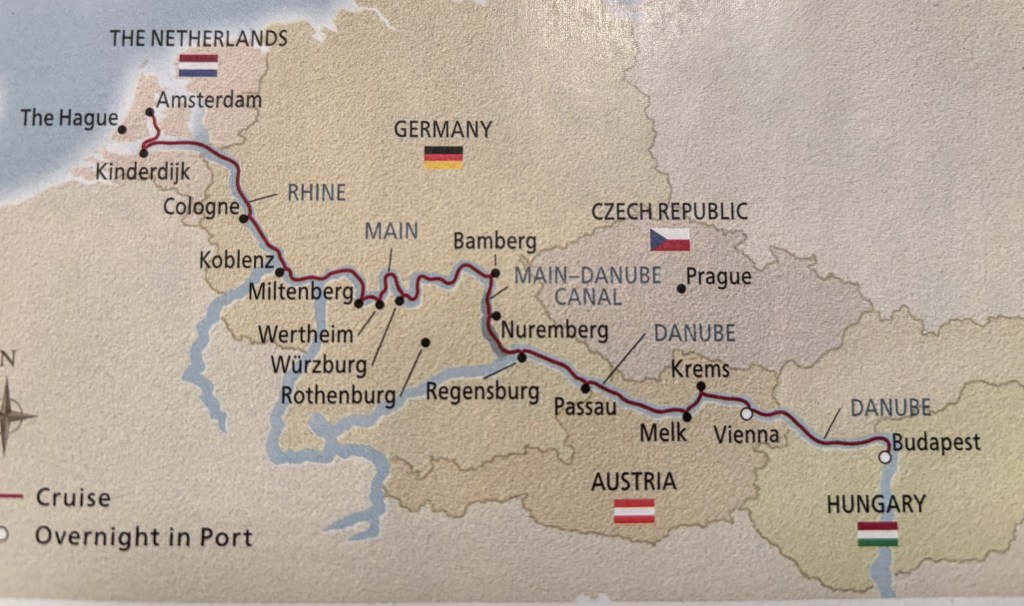
Below is the route of our Cruise. It’s about 1200 miles from Amsterdam to Budapest and in the catalogs it is called “The Grand European Tour.”


We didn’t leave Amsterdam until 11pm (Day 1), and it was a delight to see this city at night from the canal. AND, we were so excited to be back on a boat again that we found ourselves out on our veranda off and on for several hours, watching the landscape and lights go by. We didn’t get our usual 8-10 hours of sleep, but happily went on our first “shore excursion” early the next morning (Day 2). We walked to a vintage barge in the small town of Kinderdijk and, as we cruised past the iconic windmills, we learned how important “water management systems” are to the Netherlands, where more than half the country is at or below sea level. Most of the windmills we saw were built in 1738-1740 and were used exclusively to pump water. We also got to take a guided tour of the oldest one (below, built in 1640), with the “miller” who lives there and maintains it.

To manage the levels of the water, powerful pump stations have taken the place of windmills, but these windmills have been preserved through the years for all of us to enjoy. When not in use, the “wings” on the windmills were used as signals. For example, a wing positioned to the right of the center door meant there was cause for celebration—a birthday, an anniversary, an accomplishment; positioned to the left meant there was a death. And the mourning period was always 1 year + 1 month + 1 week + 1 day. It’s fun to learn these tidbits!
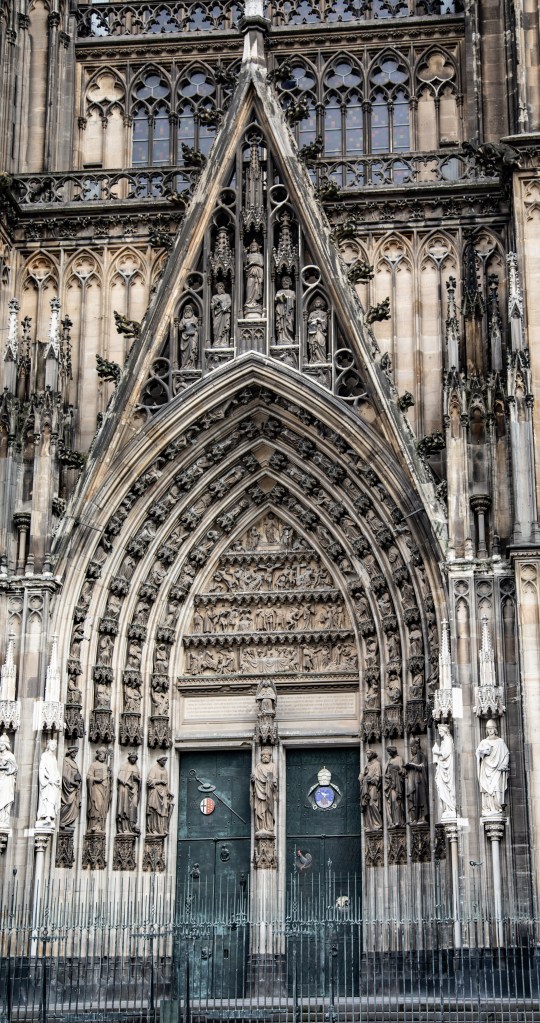
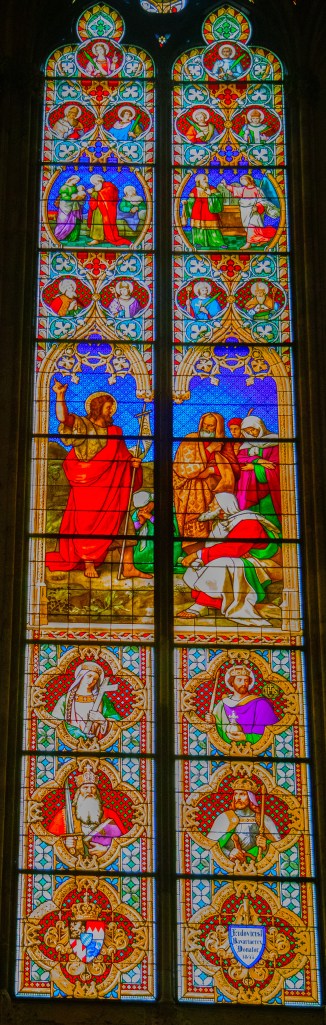
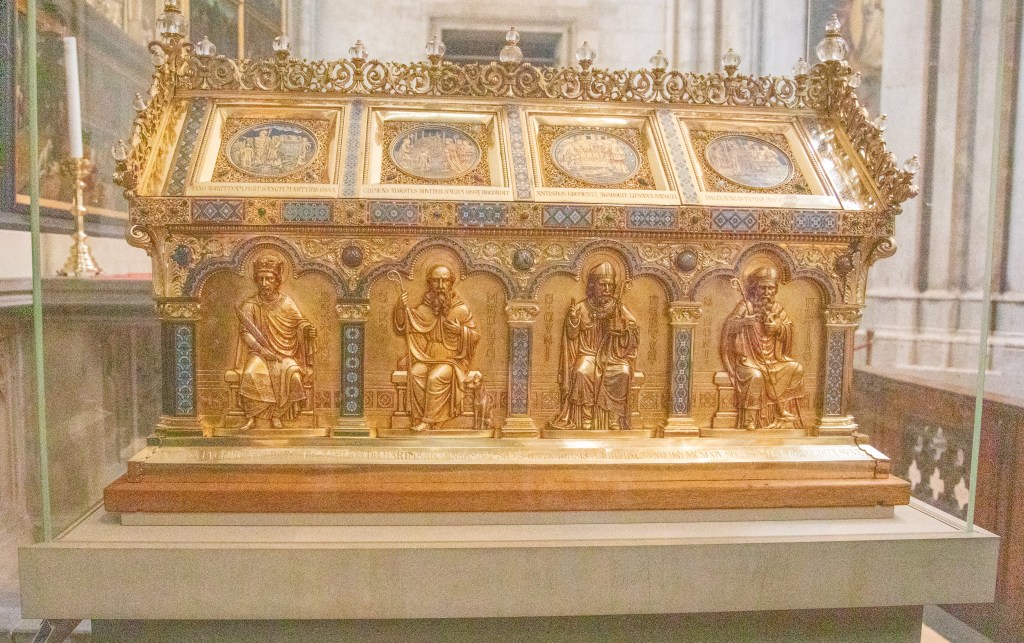
Day 3 we did a walking tour of Cologne, the 4th largest city in Germany. The highlight was the magnificent gothic Cologne Cathedral, which took seven centuries (yes, centuries!) to build. With its towering twin towers (550’ high) and 1700 spires, the foundation stone was laid in 1248 and it was finally completed in 1880. This renowned monument is quite plain inside, but there are 11,000 square feet of stained glass windows that are very moving. One is quite modern, using small squares of all 73 colors that appear in the other more traditional windows (below, right). A large and magical gold box was on display, supposedly containing the bones of the Three Wise Men—the Magi. We also enjoyed the sidewalk art in front of the Cathedral reminding us that we are One Human Race. As we left Cologne that evening, we were able to capture the Cathedral at night, and that’s an image we’ll remember for a long time.


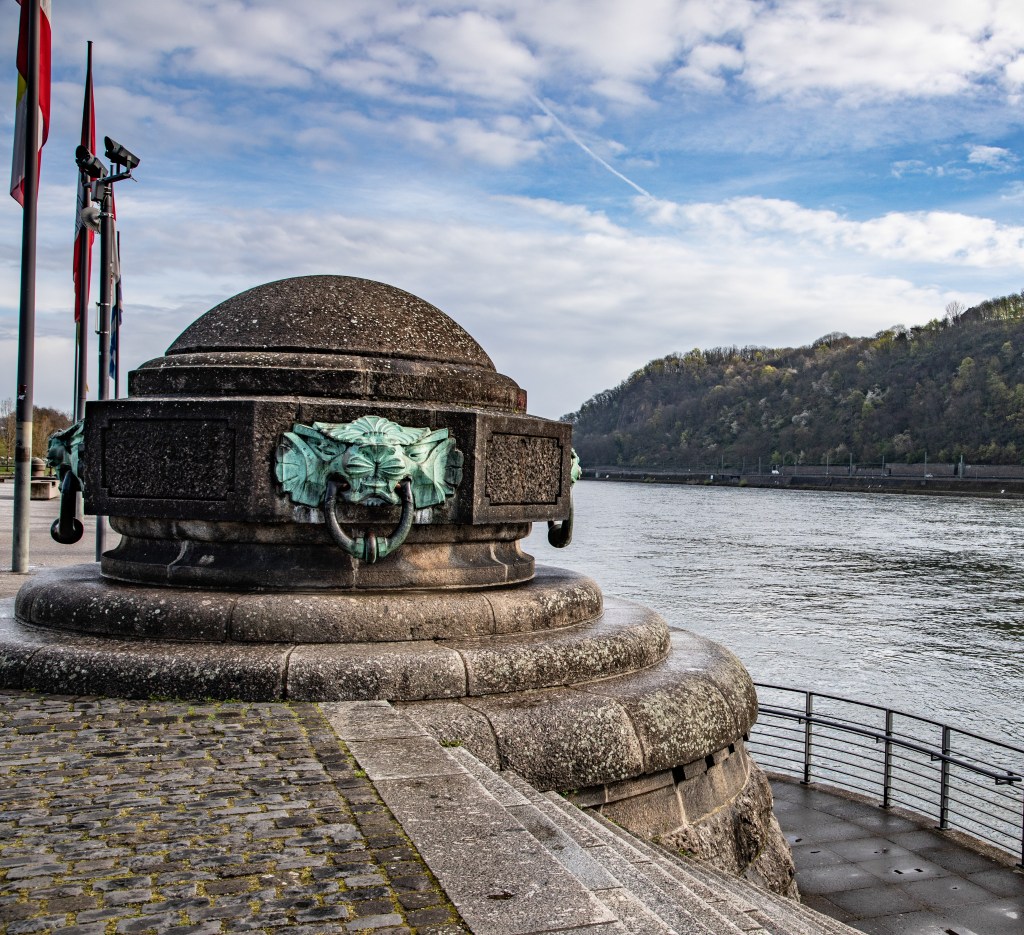
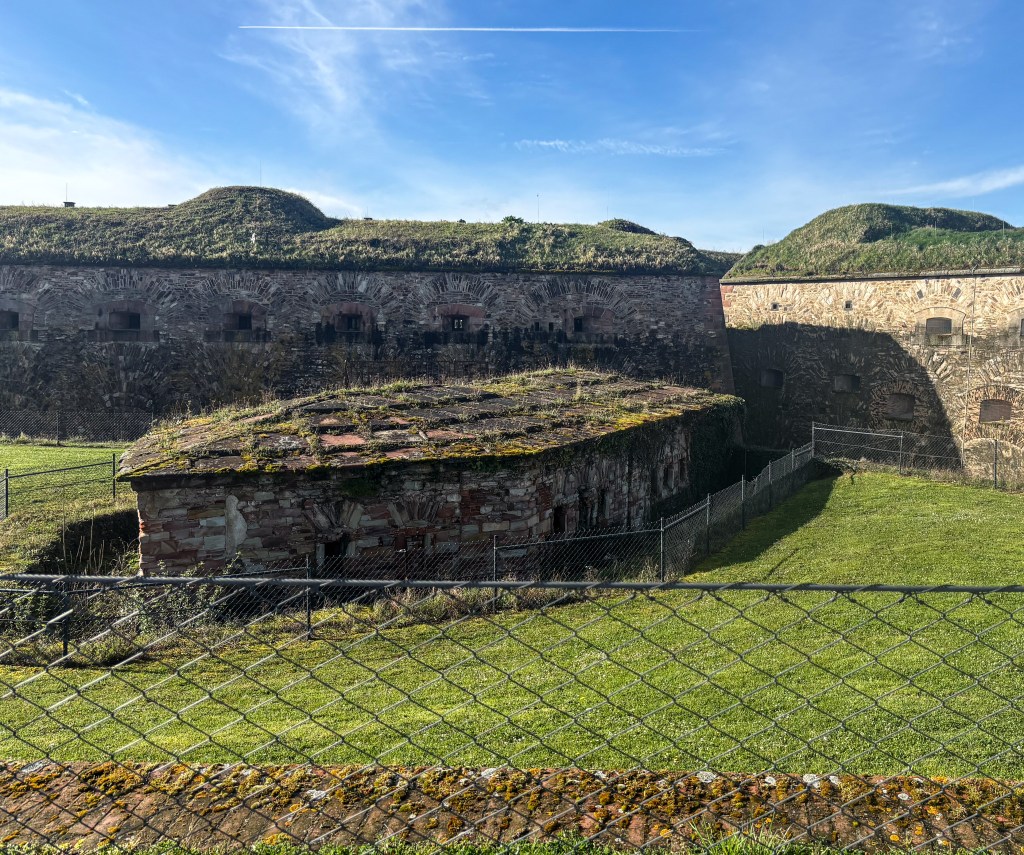
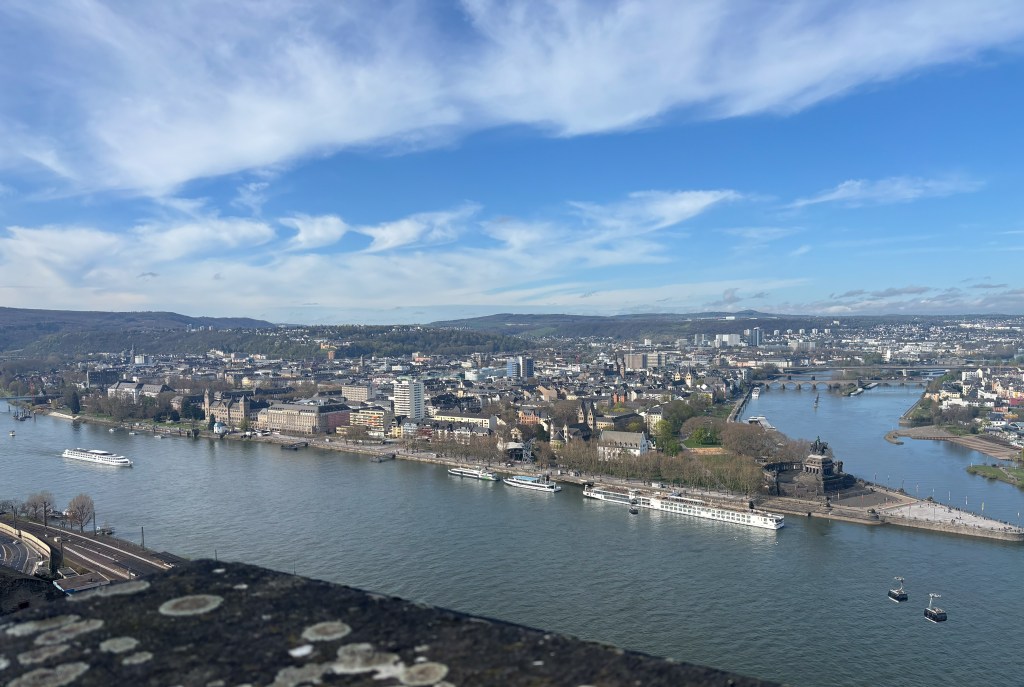
Day 4 was a day of rest for Gary, but I had a wonderful time touring the mighty fortress of Ehrenbreistein (below), an excellent example of Prussian military fortifications built in the early 19th century to protect against the French. Our tour guide was a delightful costumed actor who took us back 200 years to describe the walls, buildings, tunnels and moats of this fascinating citadel, with its strategic doorways and windows for canons and rifles. Set high on a hill, we also enjoyed the magnificent views of Koblenz at the confluence of the Rhine & Moselle Rivers and a fun “sky glide” (gondola) back down to river’s edge. Two gondolas can be seen on the lower right of the river view.


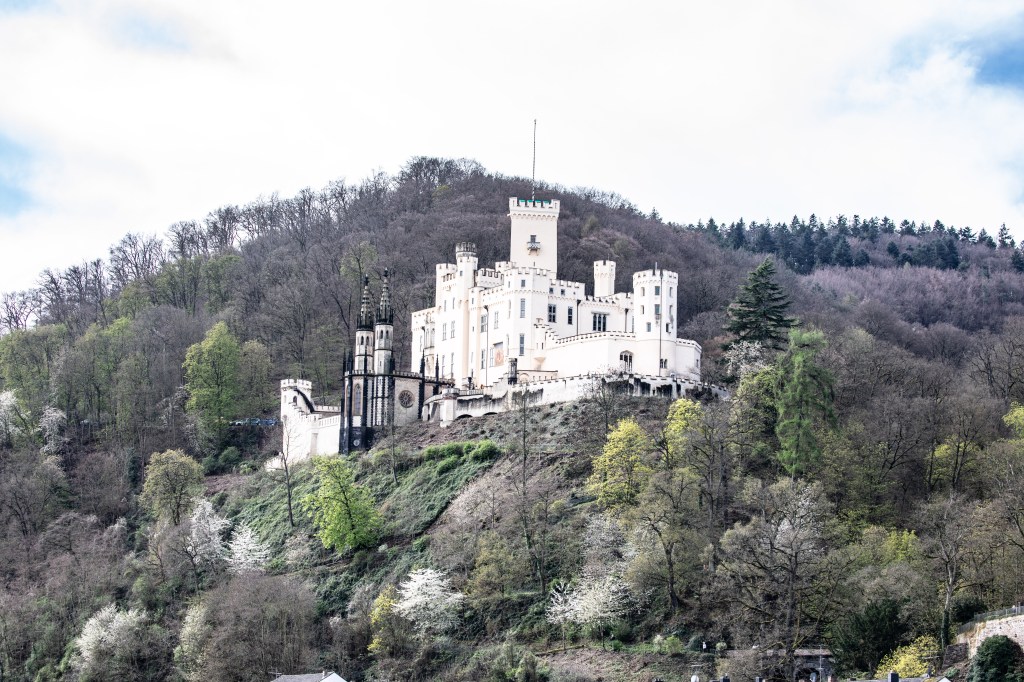
In the afternoon, the sun was shining brightly and we spent a wondrous 3 hours lounging on the sundeck as we cruised down the famous Rhine River Valley. We were in awe not only of the variety of castles and beautiful river towns, but of the hundreds of vineyards scattered on the very steep, rocky hillsides. How in the world they tend to and harvest these vines is a mystery, but they certainly are beautiful. The Rhine Valley is known best for its Reissling wines. That evening we found out the sundeck would be closed for the next 5 days (to go under many low bridges and through many locks), so it made this sundeck experience all the more appreciated. Not only are all the deck railings and canopy posts hinged so they can be flattened, but even the wheelhouse has a hydraulic lift that allows it to be lowered as well. There has been quite a bit of barge traffic, and we’ve been a bit surprised by the number of campers parked alongside the rivers.


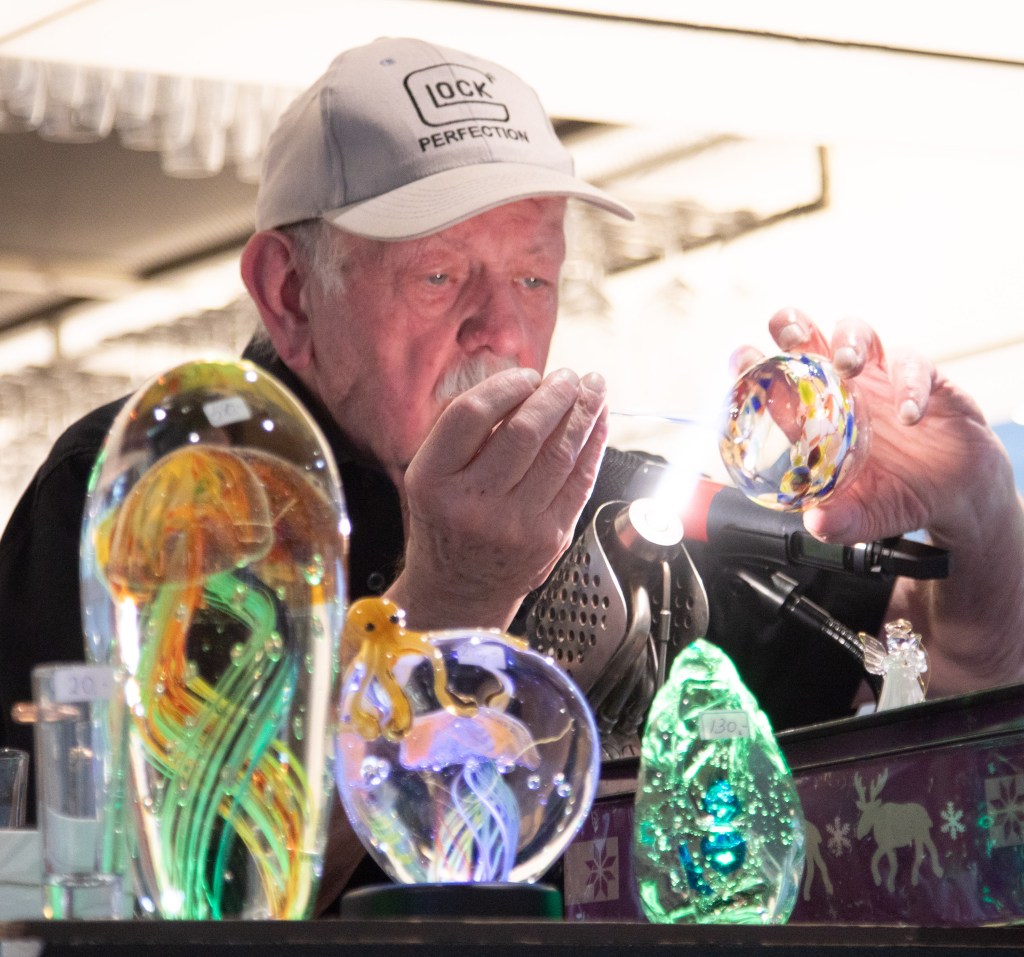
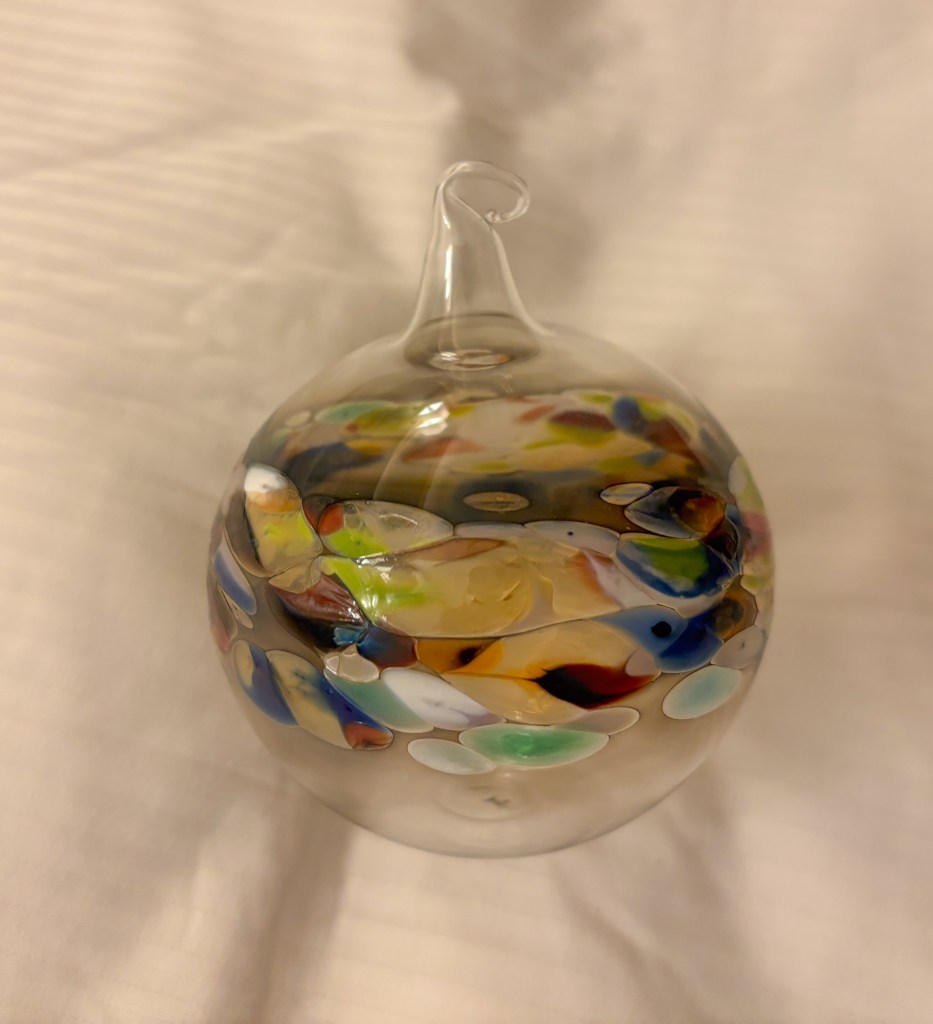
Day 5 was the first day we didn’t have to set an alarm for a tour—a nice break. AND, we were very excited to watch a scheduled glass-blowing demonstration in the lounge at 10am. We were fortunate to have front-row seats because Gary got selected as the glass-blower’s apprentice and I was able to capture part of it on video (below). Gary was gifted with the beautiful glass ornament that he had blown into form (also below, together with some of the artist’s “masterpieces.”). This artist is a 6th generation glass blower and he only works with the very durable pyrex glass, so hopefully it won’t ever break. What a treasure! (Excuse the extra space here–we’ve had some issues inserting photos.)


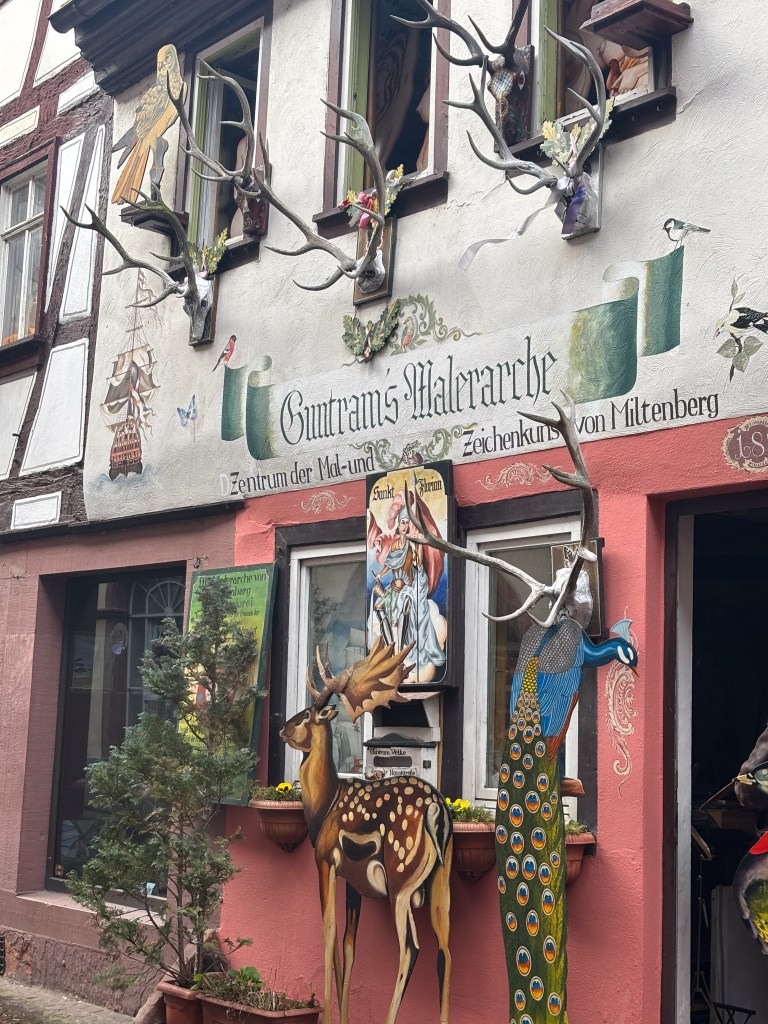
For the first time, our shore excursion was in the afternoon—a walking tour of the charming little town of Miltenburg, which is in the state of Bavaria. It was the day after Easter (a national holiday in Germany) so shops were closed, but we followed narrow, cobble-stoned streets past medieval houses, breweries and a variety of Easter decorations in windows and the town square. It had quite the fairy-tale atmosphere. Note the fountain below, decorated with eggs and flowers.


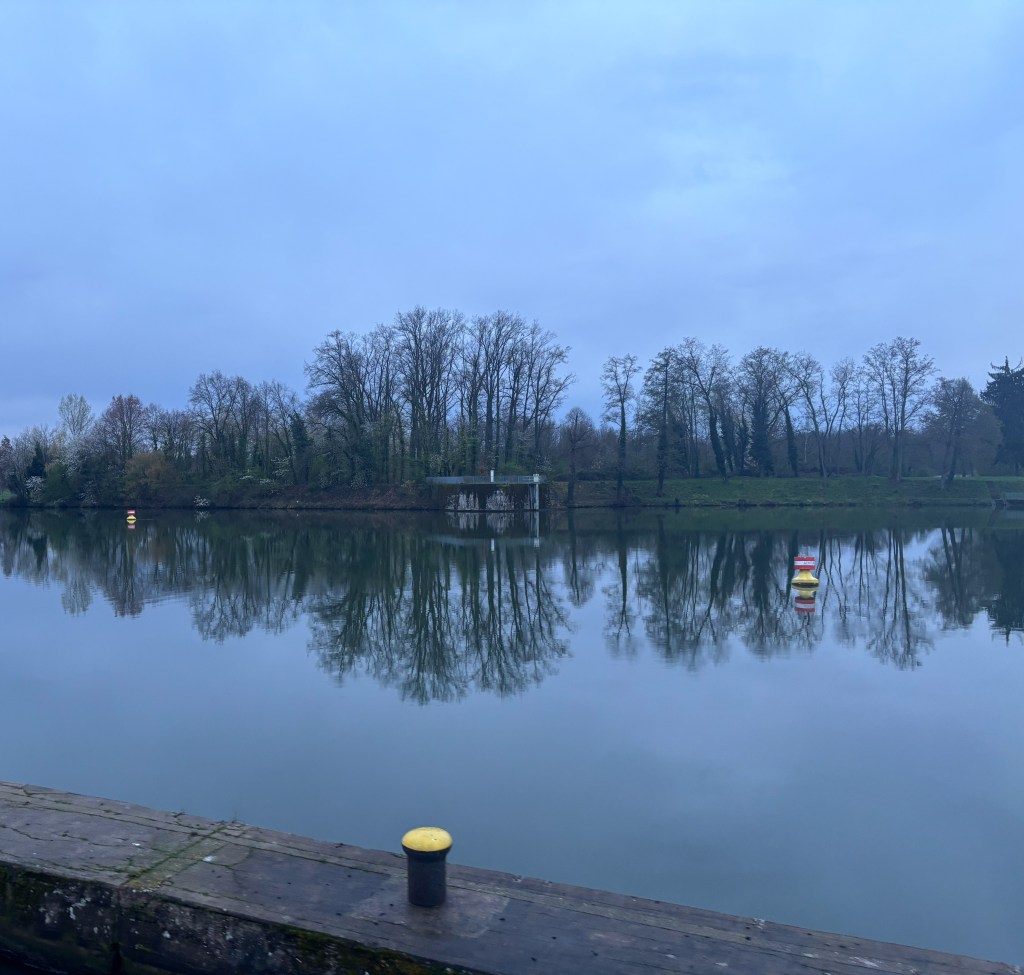
The scenery both day and night has been beautiful and much of it quite rural, which we love.. We especially enjoy the early morning reflections (above) and listening to a variety of birdsongs. The natural beauty (often seen from our veranda) is very soothing as we continue to wend our way on the Main River (pronounced “Mine”) toward the Main-Danube Canal.

As you can see, there is a lot to share about this cruise, so we’ve decided we’d better divide our blog posts into several parts. Next time we’ll tell you about our experiences in Wurzburg, Nuremberg and beyond. In the meantime, thank you again for cruising along with us. We hope you are enjoying it as much as we are. Blessings always!

SAN LUIS OBISPO TO DALLAS TO BOSTON TO AMSTERDAM

Greetings from The Netherlands!
Have you ever been on a flight headed to the same airport as Air Force One? We were due to land in Dallas (DFW) at 6pm but around 4pm our plane slowed way down and started circling and circling and circling. The captain announced we were on hold until Air Force One landed (5:45, we later found out). When we finally landed (6:35), we could see AF1 on the far tarmac surrounded by floodlights and police cars, “under tight security.” We thought we would miss our connection to Boston, but luckily all of DFW was on hold and our flight didn’t leave until 8pm. (Biden was attending two private fundraisers in North Texas.) An interesting way to start our latest adventure!

We got a good sleep after getting to our hotel at 2am. It was very chilly so we chose to “chill” in our nice warm Marriott Copley Place hotel room and then had a very fun dinner with younger daughter Laurie and 3 of her 5 kidlets who drove in from Tolland, CT—about an hour southwest. We look forward to seeing them again when we return home through Boston in late May—we’re all going to Fenway Park for a Red Sox game and also do part of the Freedom Trail.


We flew through JFK on Jet Blue to Amsterdam where it was also very chilly (plus windy and rainy), but that didn’t stop us from touring. The first day we went to Keukenhof Botanical Gardens, one of the largest gardens in Europe covering 32 hectares (about 79 acres), where we saw thousands of tulips, hyacinths, daffodils, crocus and even a large pavilion of orchids. We’ve never seen so many varieties & colors. It was stunning!


After another day of rest (we’ve gotten really good at pacing ourselves), we took an evening canal cruise that was delightful. Then we totally enjoyed an all-day tour to The Hague, Delft and Rotterdam. As we entered The Hague, the median strips were filled with very tall, white flagpoles, with flags for each of the 193 members of the United Nations. We drove past many embassies and especially enjoyed visiting the Peace Palace, which houses the International Court of Justice. On nearby benches the word “peace” is cut into the stone in every language and there is a beautiful World Peace eternal flame (below). It was all very moving and inspirational.


We also loved going through the Royal Delft factory and seeing how their pottery is made. The most expensive pieces are hand painted. Less expensive versions use transfer patterns that are fired on, and all the designs are quite remarkable. Delft also makes amazing architectural tiles, and there was also an exhibit of Picasso creations. I had no idea he was into ceramics.


This tour also included a harbor cruise in Rotterdam. The harbor is 19 miles from the North Sea accessed through the “New Waterway.” It is the third largest port in the world (after Shanghai and Singapore), big enough and deep enough for the largest ships. It is about 25 miles long, 6 miles wide and 500 feet deep. Over 30,000 ocean-going ships and 130,000 smaller vessels visit each year. Most of the larger vessels are on very large mooring buoys rather than at a dock (below). All but 2 buildings in Rotterdam were destroyed by the Nazis in WWII (and occupied by the Nazis from 1940-1945 until the Canadian army liberated it—who knew?!), so there are mostly newer buildings.


We traveled with a lot of nice people from all over the world. Fortunately almost everyone speaks English. We especially enjoyed a mother and 2 sons originally from Cuba who now live in Austria (son Melvin is pictured above, who is studying hotel management), as well as a couple from South Africa. AND, it was nice to get back “home” to the Hotel Jakarta.

We’ve enjoyed staying at Hotel Jakarta, an architectural masterpiece honoring the historical maritime connection between Amsterdam and Indonesia. It is on Java Island, overlooking a large canal (which we saw from our room, where, from 1910 to 1970, large ocean liners transported goods and passengers to the Dutch East Indies. The hotel itself features Indonesian food (including lime leaf ice cream—yum!), subtropical gardens and is the “greenest hotel in the Netherlands,” constructed primarily of renewable and reusable resources such as wood and bamboo. It also has many clever and sustainable energy-saving features. Even the clothing worn by the Hotel Jakarta staff is recycled every three years and made into chairs used in the lobby (below)! AND, it was very easy to talk about “the elephant in the room,” one of many driftwood pieces on the property. Hotel Jakarta was a convenient, peaceful and friendly place to stay.


We took it easy again on our last day before boarding our cruise ship, but did take a Hop On/Hop Off bus around Amsterdam so we could learn more about its history. We visited the Gannon Diamond headquarters and had hoped to see the Van Gogh Museum, only to discover it was sold out. We’re spoiled in the USA where we can usually walk into any museum any time. Oh well!

Amsterdam is a vibrant city with an arts scene that has flourished since the Middle Ages. It is bursting with flowers, carved by canals, and everywhere we look there are bicycles, so we’ve had to stay very alert while walking about! Our first taxi driver said there are 22 million people in The Netherlands and 24 million bicycles! In Amsterdam there are almost 1 million people and 2 million bicycles, as nearly everyone owns two or more (they ride their older bikes into the city). Our favorites were the bicycles with small carriages on the front, often carrying young children.


There are also over 1500 bridges so the local boats are designed to be able to cruise under them.
We were surprised by the number of houseboats permanently tied up along the canals—2500 of them, many over 80’ long. They were first allowed because of a housing shortage, but no more permits will be granted.


We also learned there are 167 nationalities living in Amsterdam and there is great respect for each other. 44% are Muslim and are currently fasting during Ramadan, meaning they cannot eat between sunup and sundown. From another taxi driver, we learned that Ramadan is not only about fasting “to cleanse the body and the mind” and to be in better health, but it is also a time to dine and bond with family and to give to and pray for those who do not have enough food.

We’ve enjoyed our Netherlands experience a lot. It is very flat so no wonder there are a bajillion bicycles! And, by the way, is Holland the same as The Netherlands? The answer is, “No!” North Holland and South Holland are two of twelve provinces of the Netherlands, officially called the Kingdom of the Netherlands. Most of the areas we visited were in the two Holland provinces.

Once we board our “long boat” (463 feet!), we’ll have one more day in Holland, and then spend 2 weeks cruising down the Rhine, the Main and the Danube Rivers to Budapest (from March 28 through April 11). We’ve heard a lot of good things about Viking Cruises and we’re really excited about being on the water again and seeing a different part of the world. We’ve scheduled an excursion almost every day so there will be lots of mini-adventures along the way that we look forward to sharing with you. We paid extra for some, but most are included in our cruise tickets. Away we go!

Thanks for cruising along with us! It’s nice to know you are “there!”