November 19, 2024 from Los Osos, CA
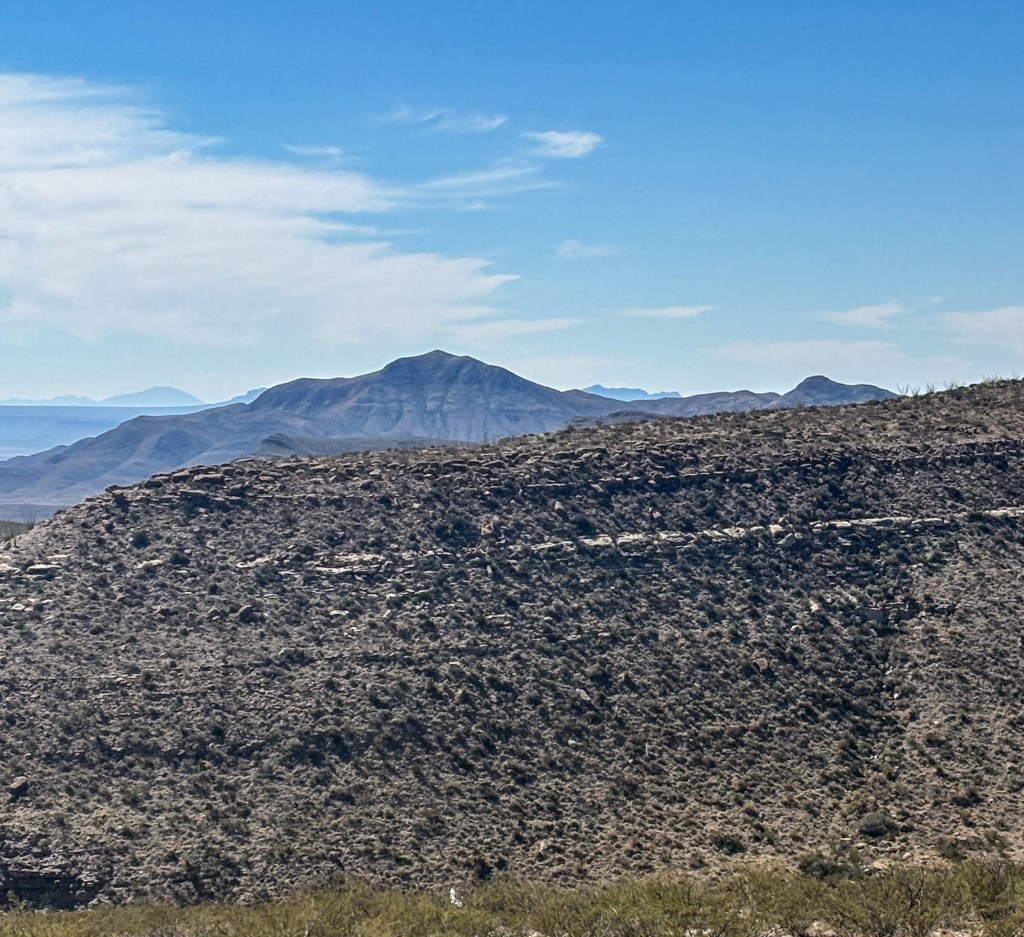
We’ve done quite a bit of “recalculating” for various reasons during this trip, and we’re still finding ourselves changing plans some. Our next 2 stops after Big Bend were Guadalupe Mountains National Park and Carlsbad Caverns. Because they are an easy drive from the city of Carlsbad, NM, we ended up with a welcome 4-night stay at another very nice KOA Campground there. The Caverns are in New Mexico, but are part of the Guadalupe Mountain range set on the Texas/New Mexico state line. The Visitor Center for Guadalupe is actually back in Texas, so that’s where we went our first day. This Park is a land of tall peaks and arid Chihuahuan Desert landscapes, with limited access by car (and a haven for serious hikers). It’s best known for its 8749’ Guadalupe Peak, the highest point in Texas (below, left, harder to photo from the road). Much closer to the road is the massive cliff face called El Capitan that has guided Native Americans, western explorers and settlers for centuries.

We really enjoyed the dioramas in the Visitor Center showing the biologically diverse canyons and the special wonder of the Guadalupes. The harshest of desert conditions prevail in the lowest elevations and driest canyons; at higher elevations a variety of grasses and woody plants dominate, including oaks, junipers, pinon, sumac and century plants. It was pretty fascinating.
The next day was one of our favorites on the trip—a visit to Carlsbad Caverns National Park, carved out of limestone and boasting the largest cave chamber in the world (larger than 6 football fields!) plus a network of caves that continue to be discovered…(135 passages so far). As mentioned in the handout at the Visitor Center, “Away from the sunlight, away from the flowering cactus, away from the songs of the desert birds and howl of the coyote lies the celebrated underground world of Carlsbad Cavern. It is an incomparable realm of gigantic subterranean chambers, fantastic cave formations and extraordinary features.”


We were a little nervous about taking an elevator down 725 feet (although it was certainly more appealing than walking a 1.25 mile switch-back cement path all the way down and back UP!). However, the ride was surprisingly easy and, after a few minutes of adjusting to the lower light level, we were pleased to follow a well-lit, cement sidewalk with sturdy brass handrails on both sides, wending its way through chambers of various sizes, each more astonishing than the one before. We did choose to walk the shorter self-guided 1.5 mile loop so we missed some of this 8.2 acre (!) Big Room, but most of the ceilings were 100+ feet high, so we never felt at all claustrophobic and everywhere we looked was amazing. See for yourself what we tried to capture with our camera/iPhones:
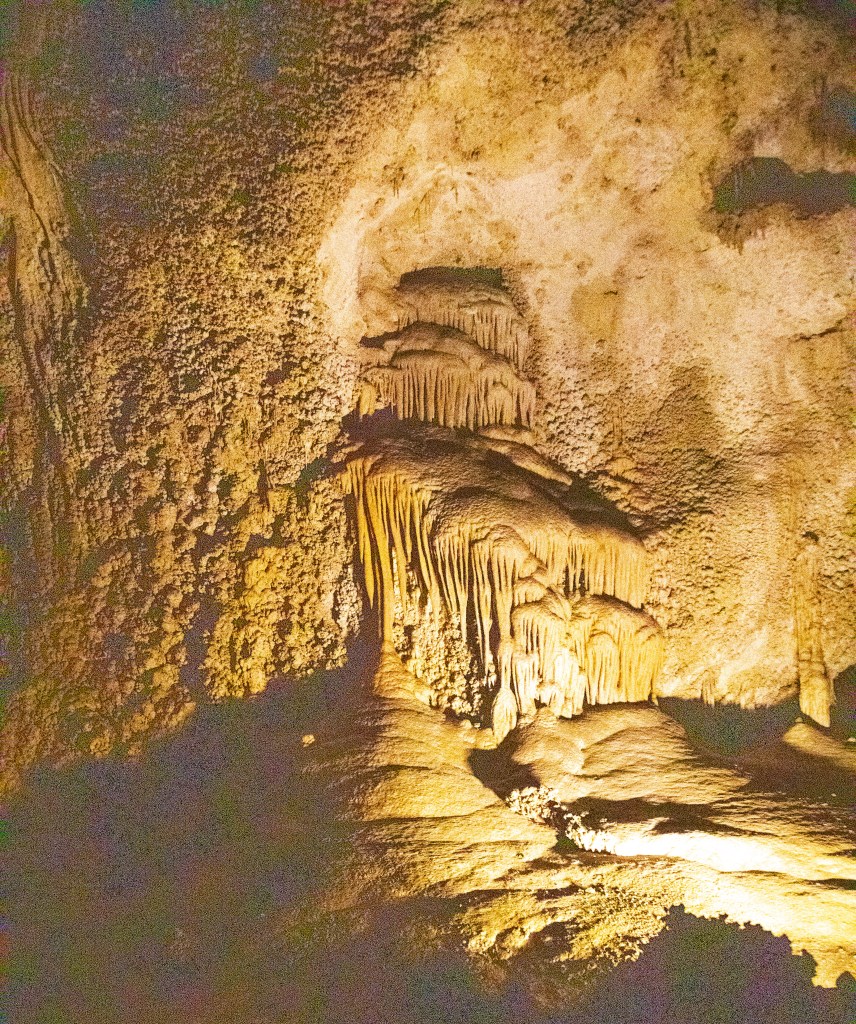


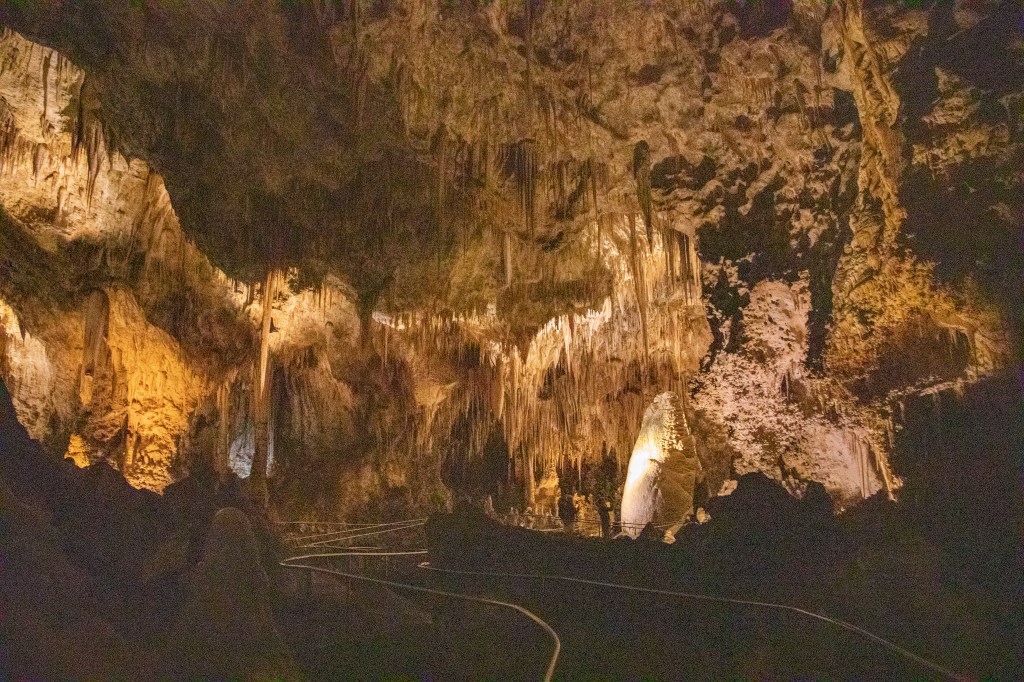


What we saw were a variety of stalagmites (up) and stalactites (down)—(I think of a mighty thumbs up to remember which is which)—together with formations called soda straws, draperies, flowstone, columns, lily pads, cave pearls, popcorn, etc., some quite small and some HUGE!!! It’s hard to briefly describe how all of this was formed, but basically it all began slowly over 500,000 years ago, after the cavern had formed—at a time when a wetter, cooler climate prevailed. Creation of each formation goes through a rather complicated chemical process that results in drops of calcite-laden water “depositing its tiny mineral load as a crystal of calcite. Billions and Billions of drops later, thousands of cave formations had taken shape.” The popcorn was formed differently, where water evaporated and left behind aragonite—similar to calcite but with a different crystal structure. All of it was absolutely jaw-dropping amazing!
It was nice to have some extra days in Carlsbad to relax and catch up on such things as laundry, emails and blog-writing. We’re still a bit slow in posting, but eventually we’ll get them all done. Writing blogs is easy, but the rest is way more time-consuming than we anticipate, especially since we try to edit and choose the best photos possible to go along with our words. Then it’s a 4-step process to export and import these photos to Word Press. Thanks again for your patience.
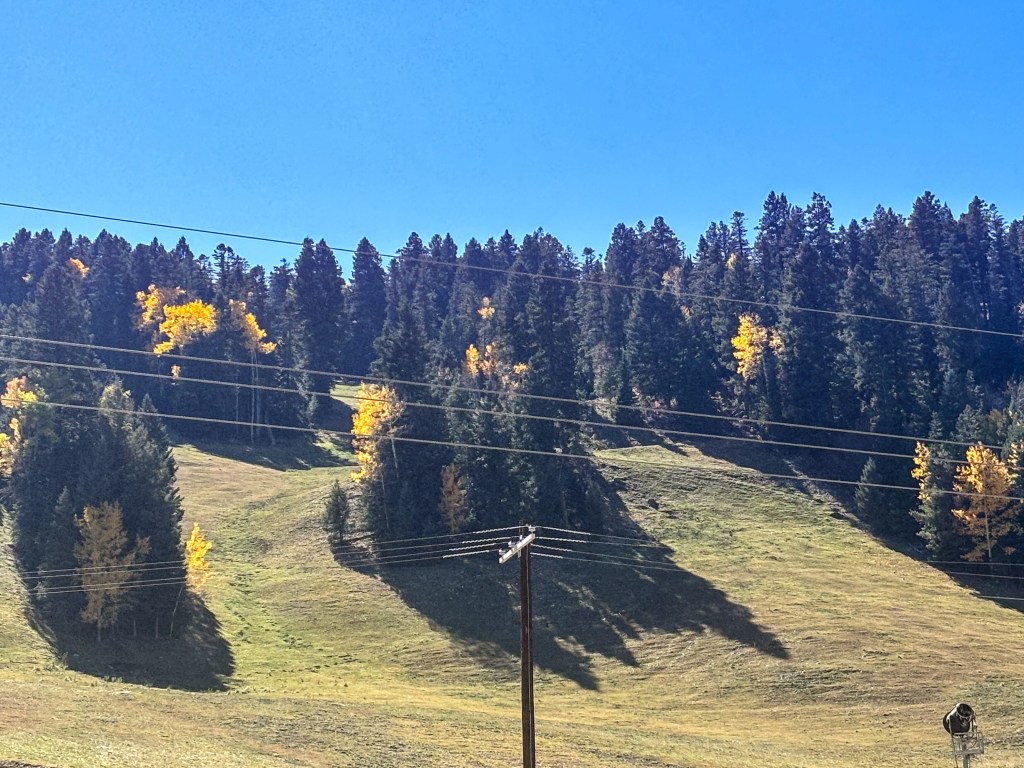
The drive from Carlsbad to White Sands National Park was far different than we expected. For many days (since leaving San Antonio) we drove through hundreds and hundreds of miles of flat, vast desert expanses across West Texas to Big Bend (elevation 1800’), continuing alongside the Guadalupe Mountains and up into southeastern New Mexico to Carlsbad (3295’) and beyond. We continued through these arid desert landscapes until about 50 miles before we got to White Sands. And suddenly we found ourselves driving up, up, up a very long, mostly divided highway, passing lots of green pastures (plus horses and cattle for the first time in days), more and more trees and eventually dense evergreen forests (for the first time since Arkansas), providing a backdrop for the stunning golden aspen. At the summit we discovered a very classy Ski Cloudcroft—New Mexico’s smallest and southernmost ski area at 8400’! What a glorious surprise!

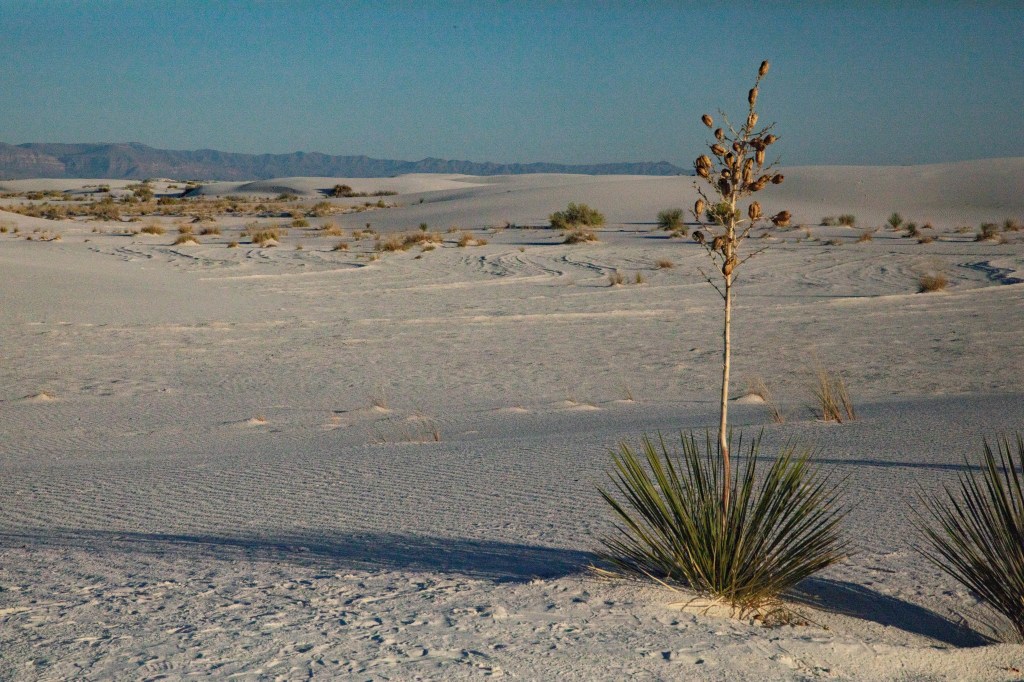
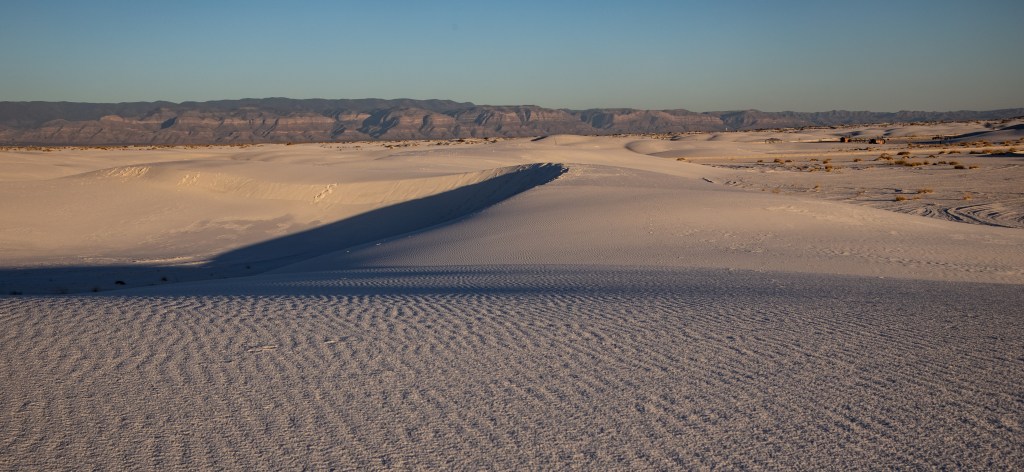
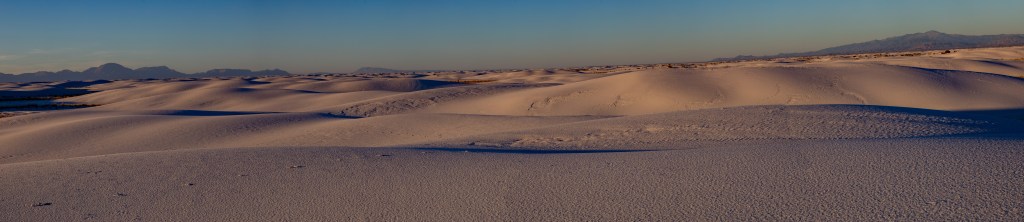
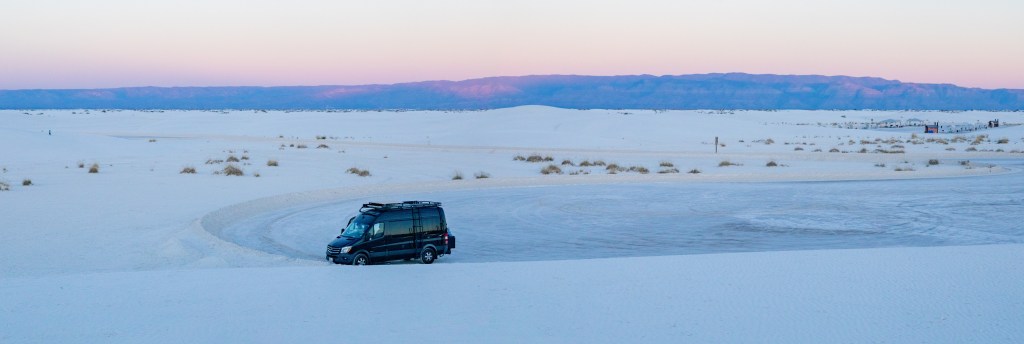
When we descended, we were treated to the vastness of the New Mexican plains and our first peek at White Sands (above right). With the little we’ve seen so far on this trip, we’re beginning to see why New Mexico is called “The Land of Enchantment.” And once again, we found a welcoming KOA Campground in nearby Alamogordo (where most businesses are) to spend 2 nights. Photographer Gary got very excited when he discovered there were so many photo possibilities at White Sands National Park at sunset, so we took off fairly soon the same day to see what we could find—about a 30-minute drive. We were surprised at how wet the sand was (and how hard it is to climb, since it’s very loose). We also discovered that White Sands is the largest gypsum dune field in the world, shelters over 800 species of animals and is described as one of the world’s great natural wonders. It was especially fun to watch some families sledding down the dunes (we passed on this) and also to photograph our very long shadows (love those long, skinny legs!). Here are some of the photos we took:

We didn’t realize (or had forgotten) how many scientific and military activities have happened and are happening around Alamogordo. Holloman Air Force Base (established in 1942) is home to the world’s longest (almost 10 miles) and fastest (almost 10,000’ per second or Mach 9)) test track. It also plays a key role in training F-16 and Reaper (drone) pilots from the U.S., U.K. and many other allied countries (including Ukraine). Nearby White Sands Missile Range (one of the key locations for the highly secret Manhattan Project—led by J. Robert Oppenheimer –and where the first atomic bomb was tested in 1945) covers 2.2 million acres in this area of Southern New Mexico and has evolved into the U.S. Army’s largest military testing area and firing range. In addition, we discovered and visited the modern New Mexico Museum of Space History (below) with amazing photos, films and exhibits that bring the story of man’s race to the stars alive, from the earliest pursuits… remember the space chimps HAM & Enos?!? This whole area is considered the birthplace of space exploration and we really enjoyed learning more about it. It was also fun to be entertained at the campground that night by a group of retired Air Force men who enjoy singing, telling stories and playing their guitars. Great fun!

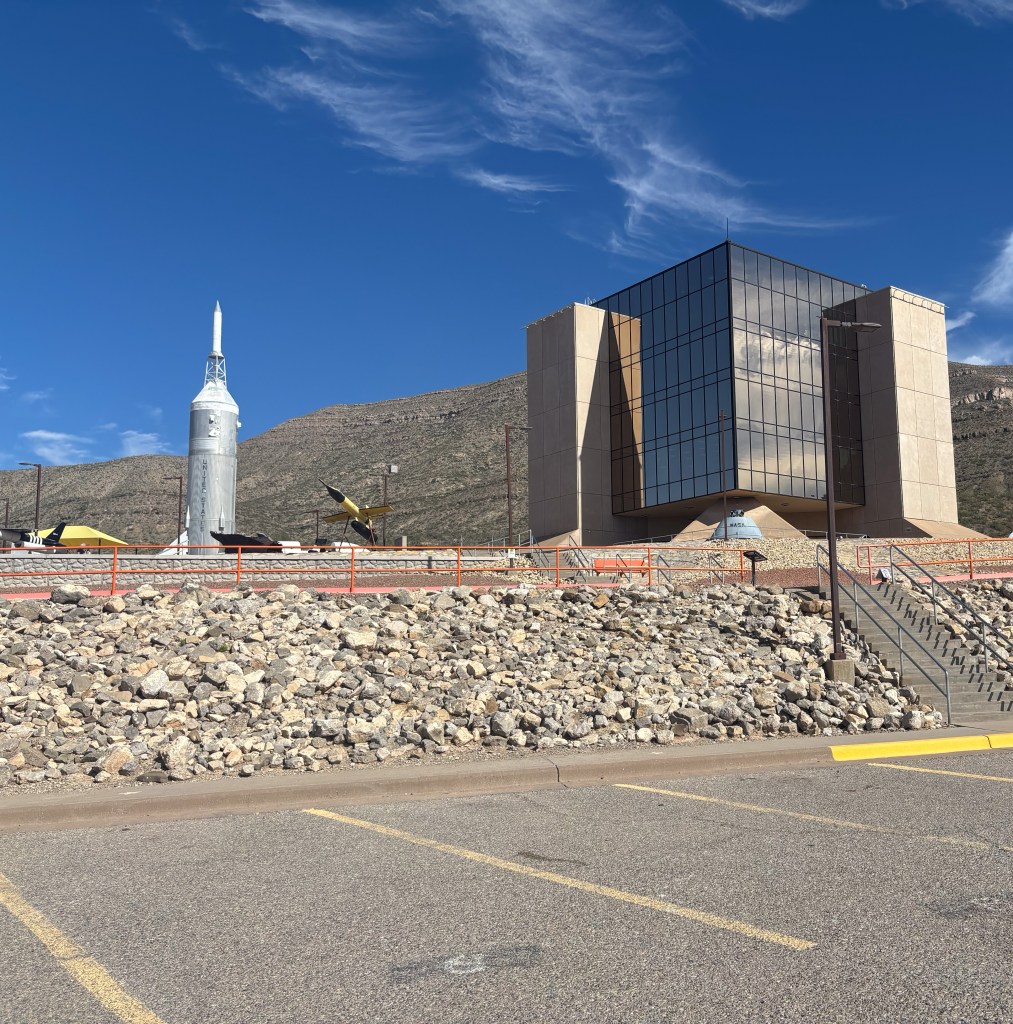

This whole area has a much different vibe than places like Santa Fe and Taos (which we also love), and spending a little time in this part of New Mexico has been a fascinating and delightful experience.
(Footnote: Little did I know that when setting an intention last January to spend more time being “creative,” I could produce such creative spacing in our last blog! I think we’ve finally solved that glitch too, but it does give me an opportunity to practice “Oh-Well-ness”…as in, oh well!)
 Cruising with Gary & Annie
Love these reports!
>
LikeLike
Karen and I enjoy reading and learning about places and events in your travel blog. Google search: Stalactites are icicle-shaped mineral formations that hang from the ceilings of caves, hot springs, or man-made structures:
To remember the difference, I think of stalagmites as little “mites” crawling on the floor and stalactites hanging “tightly” from the ceiling.
LikeLike