September 13, 2024 from Grand Morais, MN
Feeling very uplifted after our visit to Mile Hi Church, we ended up driving all the way from Lakewood, CO through Cheyenne & Fort Laramie, WY (where we had planned to stay the night) to Wind Canyon National Park in South Dakota! We arrived after dark (a new experience), but that made it easier to rearrange the next few days so that Gary could go to a Celebration of Life for his favorite cousin in West Los Angeles on September 4. Fortunately, Rapid City, SD is central to all 4 places we planned to visit in this area and had convenient flights via Denver to LAX and back, so we were able to see everything we’d originally planned AND Gary got to be with lots of family members for the service at UCLA.
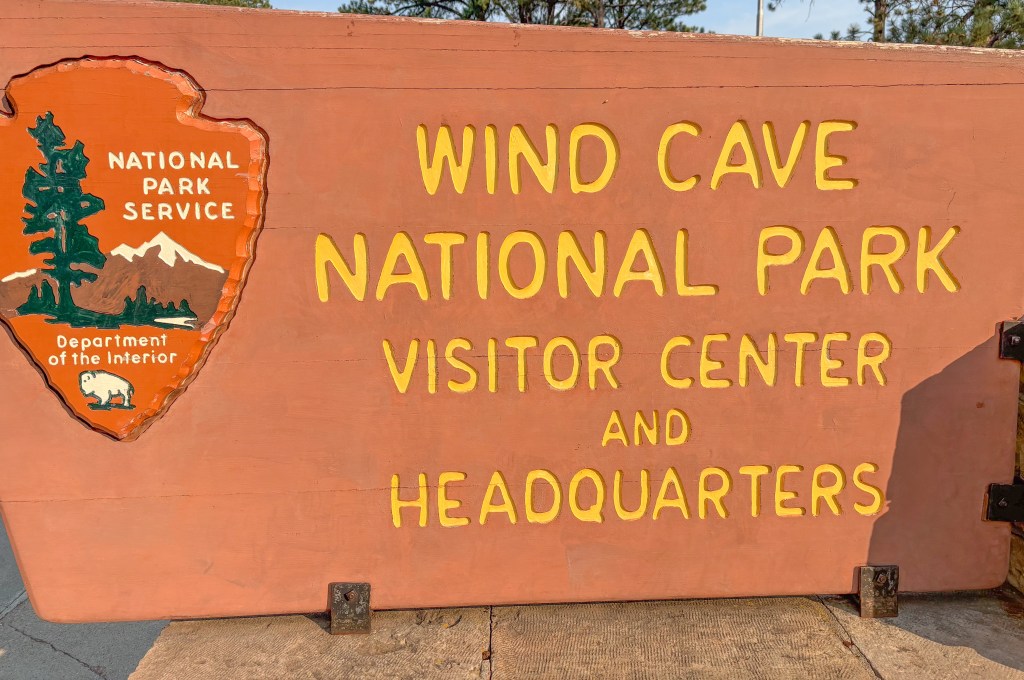
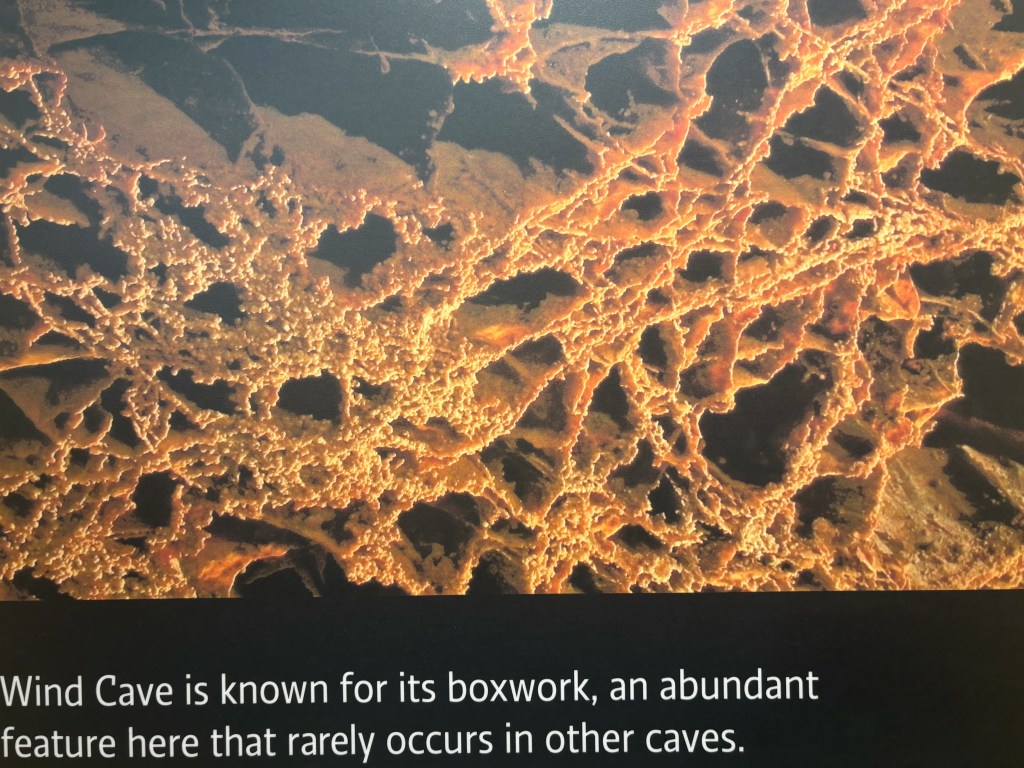
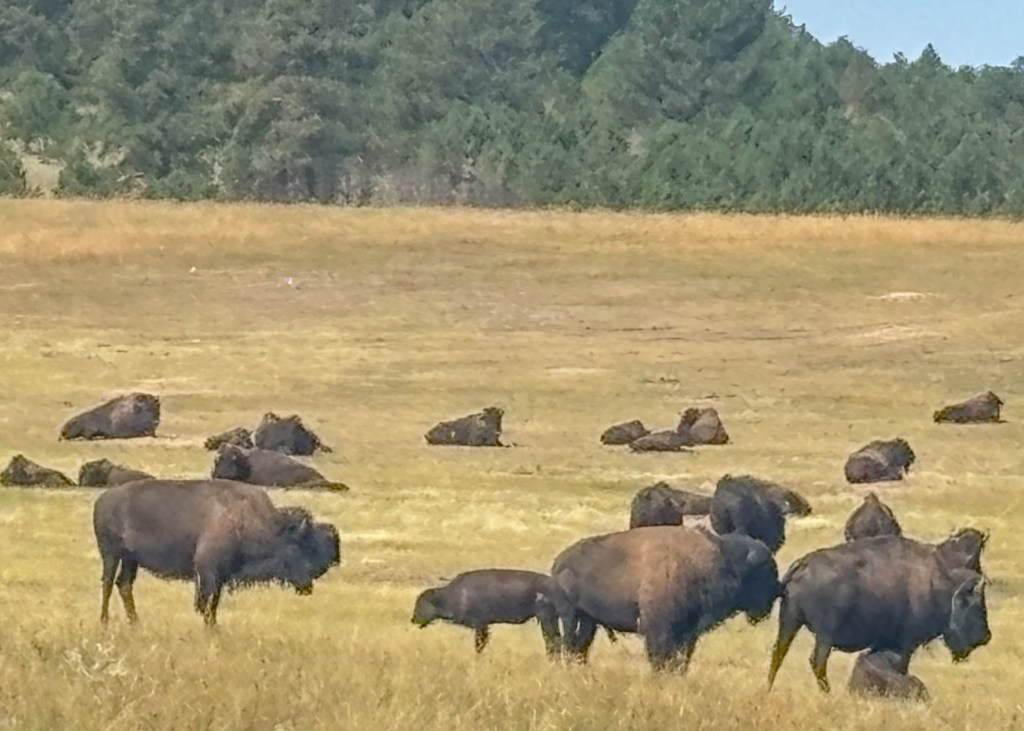
We had never heard of Wind Canyon National Park before we started planning this adventure. It is in the southwestern corner of South Dakota and was discovered in the 1880’s when 2 brothers heard a loud whistling noise and traced it to the cave’s only natural opening, where the wind from the cave blew the hat off one of the brothers. This strong wind (which gave the cave its name) results from the difference in atmospheric pressure between the vast cave and the surface. It is home to one of the longest and most complex cave systems in the world, rich in honey-comb-shaped calcite formations known as “boxwork” (right, below). We enjoyed looking at the photos at the Visitors’ Center, and frankly, neither of us was disappointed when we were told the elevator (going 238’ deep into the cave!) was out of order. We both are a bit claustrophobic and we were happy to enjoy the photos and the extensive grasslands and ponderosa pines on top of the cave! As we proceeded to the nearby 18-mile Wildlife Loop, we saw our first bison on this trip, together with white donkeys and several large prairie dog towns.


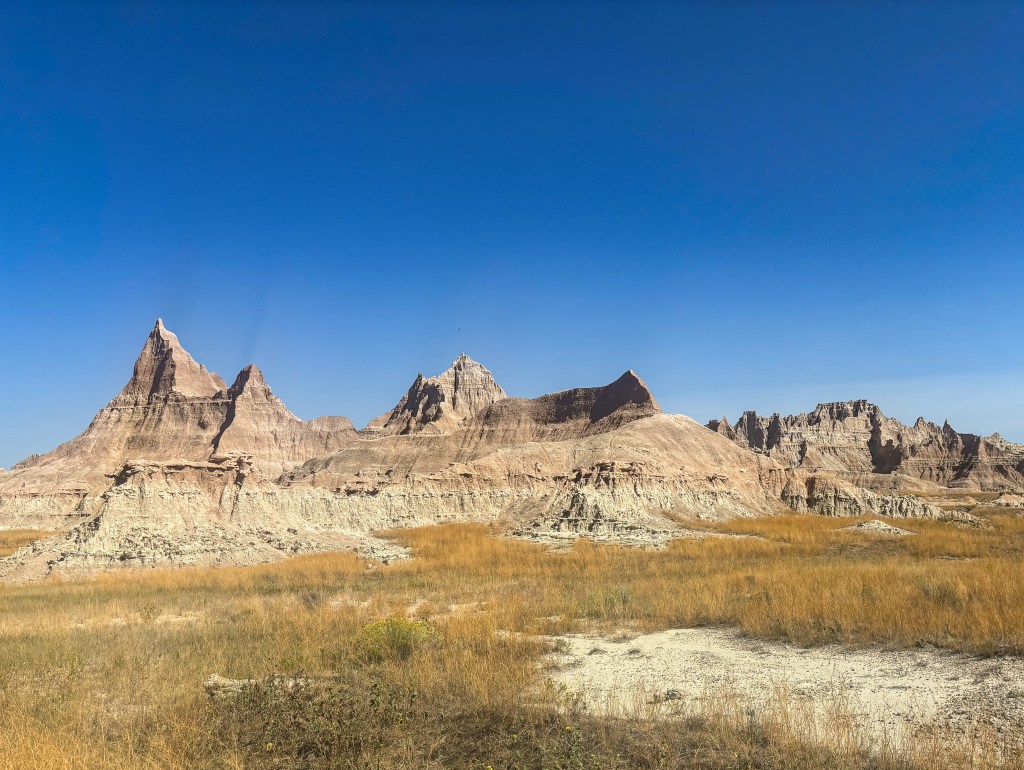
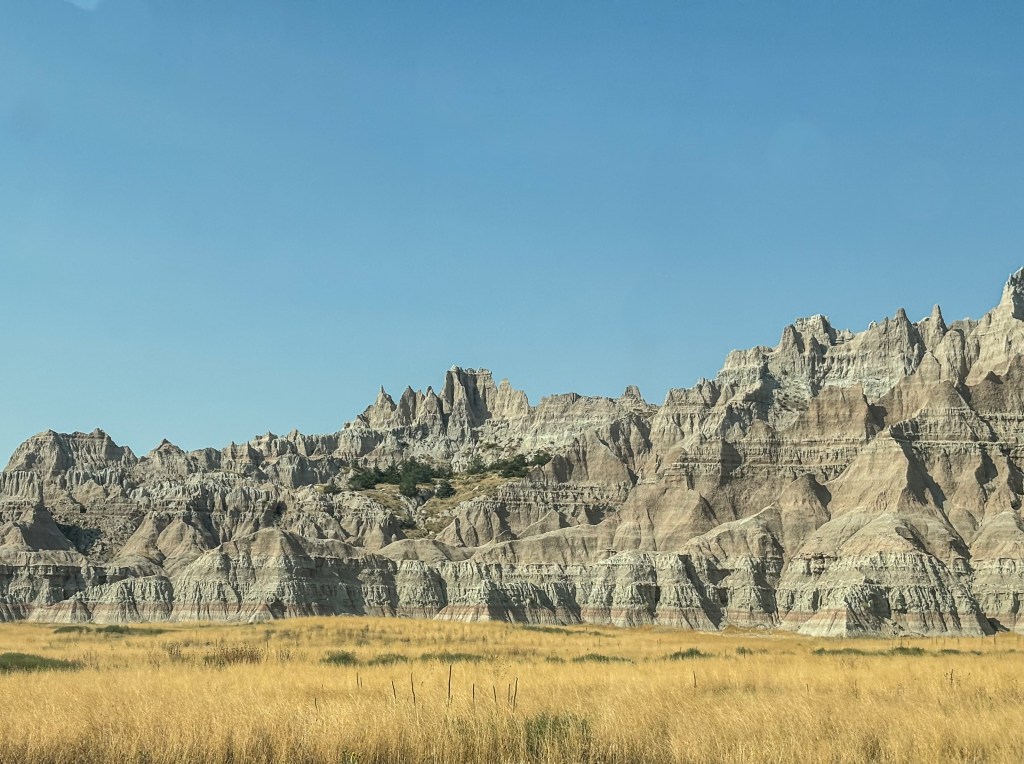
We then drove to Badlands National Park (88 miles southeast of Rapid City), learning that it’s called “badlands” because the fur traders saw them as “bad lands to travel across,” with deep canyons, jagged buttes, pinnacles and spires (that were quite inSPIRE-ing!), juxtaposed against the extensive mixed-grass prairie—the largest in the country. It felt a bit eerie and otherworldly. It was also very hot (high 90’s) so we stayed in our air-conditioned van most of the time, stopping several times along the Badlands Loop State Scenic Byway to capture some of its rugged beauty. We were happy to find a nearby KOA campground—the only place with shade. Whew! In the evening we also enjoyed an Interpretive Ranger’s talk about the area and the night sky, and took in the cool breezes at the local amphitheater.


We opted to stay at a Courtyard Marriott in Rapid City so I had a safe and comfortable place to stay for 3 nights and the airport was only 20 minutes away so Gary could go to LAX and back pretty easily. I enjoyed lots of “being” time and also watching some of the U.S. Open Tennis Tournament, as well as writing our first blog and reading up on some of the places we were going to go from there. (Gary usually figures out the stops and then I do most of the research to help us decide what to see and do.) After he got back, we took a full day to just “chill” together (hot weather, but nice air-conditioned room with a great restaurant). We then drove west to one of our favorite campgrounds so far, Timber Ridge, where we stayed 2 nights and toured Mt. Rushmore and the Crazy Horse Memorial, both in “The Black Hills” of South Dakota, named for the inky shade of their ponderosa pines and considered sacred by the Lakota Sioux for millennia. Because of the passions of a few artists creating these two memorials, the land has become hallowed in a different way
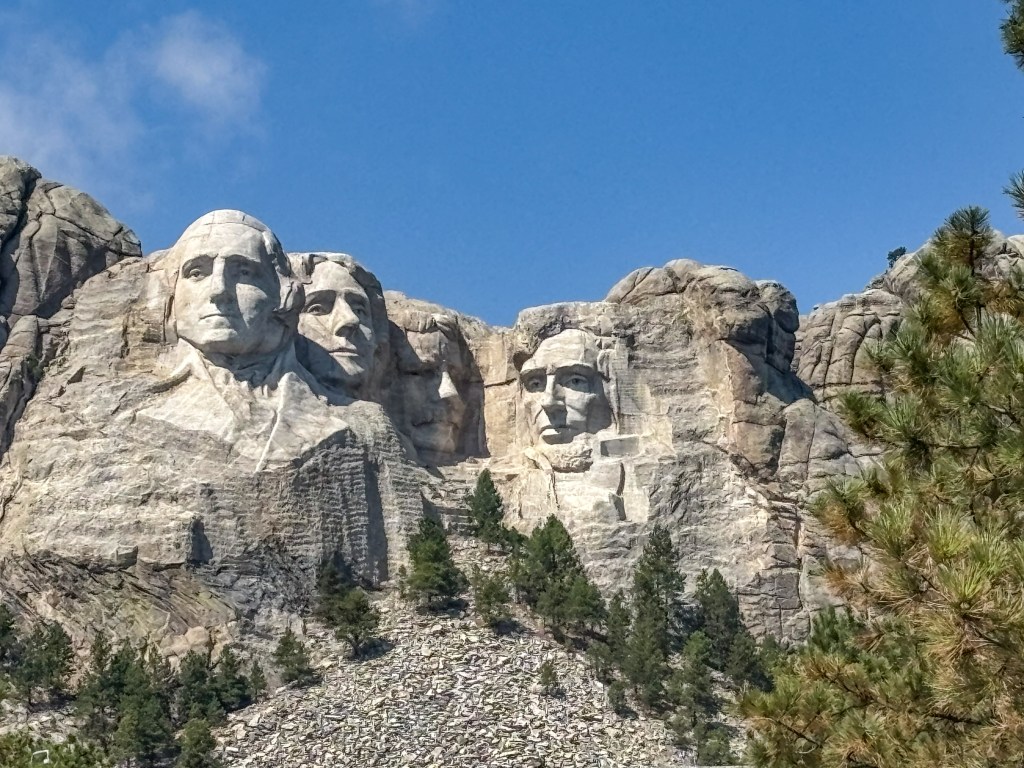
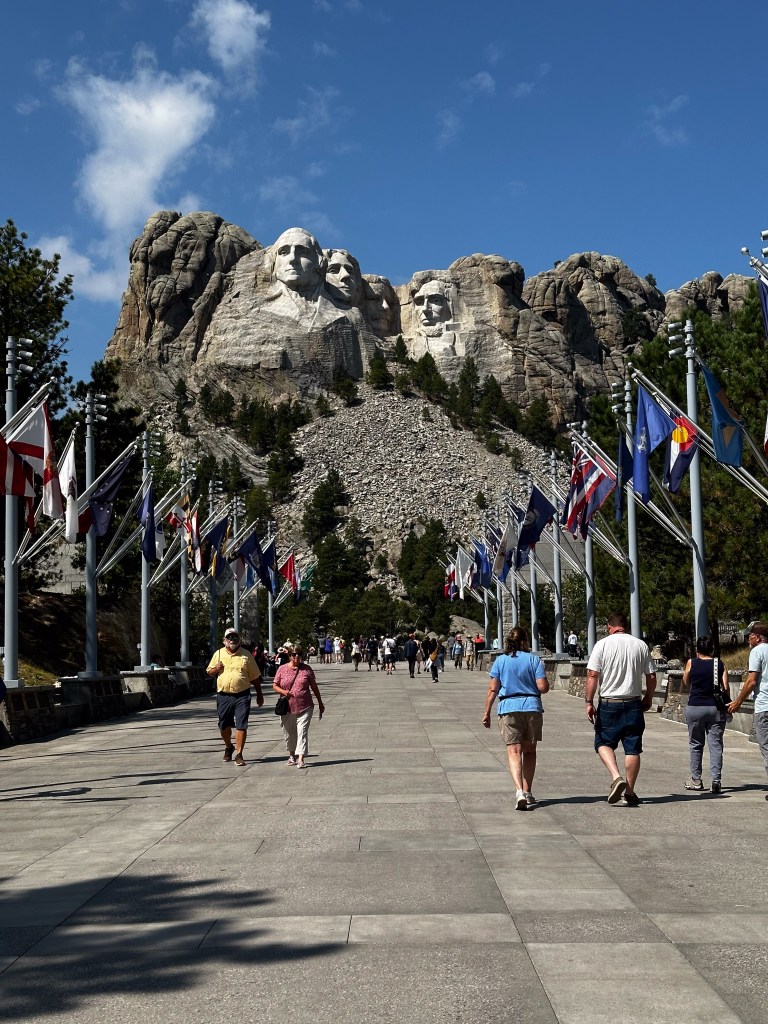
We had been told by several people that the Mount Rushmore National Memorial was “really small and disappointing,” but we were in awe of it and fascinated with the displays that showed how it was created. Conceived in 1924 by Danish-American sculptor Gutzon Borglum, the monument was to be a “Shrine of Democracy,” tracing the country’s history by way of its leaders, from its birth (Washington), through its early growth (Jefferson), preservation (Lincoln) and later development (Teddy Roosevelt)—“an impressive tribute to freedom and democracy in America.” The faces are 60’ high (6 stories), carved into the naked granite and were completed in 1941 (when funding ran out before the upper torsos were completed). It was also fascinating to see a photograph of the rock formation before the work began (below left). We discovered that 90% of the “carving” was done with dynamite. Borglum and his son worked from a studio model that was 1/12th actual size, as they coordinated the efforts of local drillers, hard rock men and dozens more. I think the reason it looks “small” is because the viewing center is quite some distance from the monument, but the viewing entrance walkway included the flags of all 50 states and all U.S. territories, and for us it was quite beautiful and very inspiring.


The Crazy Horse Memorial was also fascinating and inspiring in an entirely different way. It was the vision and dream of Chief Henry Standing Bear and Boston sculptor Korczak Ziolkowski to create a tribute to the Native Americans and to showcase a great hero, the Oglala Lakota warrior Crazy Horse who defeated General Custer at the Battle of Little Bighorn in 1876. The dedication blast took place in 1948 and, since Korczak’s death in 1982, his children and grandchildren continue to oversee the blasting and sculpting crews year-round as they work to complete what will be the largest mountain carving in the world—563’ high and 641’ long, depicting Crazy Horse seated upon his spirited steed. The studio model being used is 1/34th actual size. Only the head (over 80′ tall) and part of an extended arm are finished. Below are images of how it looks now and what it will look like upon completion. It could take a very long to finish when you consider they’ve already been working on it for over 70 years!


The adjacent Indian Museum of North America was also very inspiring, with its extensive collection of art and artifacts (11,000!). We learned that Crazy Horse is “a mountain and so much more,” including an Indian University and other programs to preserve the culture and educate youth so they have a positive impact on the world. The tagline for Crazy Horse is FOLLOW YOUR DREAM. Before we left the Museum, we were invited to a talk and a healing “jingle dance” by a Lakota woman and her daughter, closing with a poignant Lakota teaching that we hope more and more people become aware of and believe:
MITAKUYE OWASIN (pronounced Me-da-ku-ye Oh-wa-say”) meaning
ALL LIVING THINGS ARE RELATED, CONNECTED AND ARE ONE


We were reminded that everyone has a light within them, some quite bright and some (who have been deeply hurt) quite dim. Those with brighter lights (who have overcome their hurts) are encouraged to shine their lights on everyone so we can all help make the world a better place. Amen!
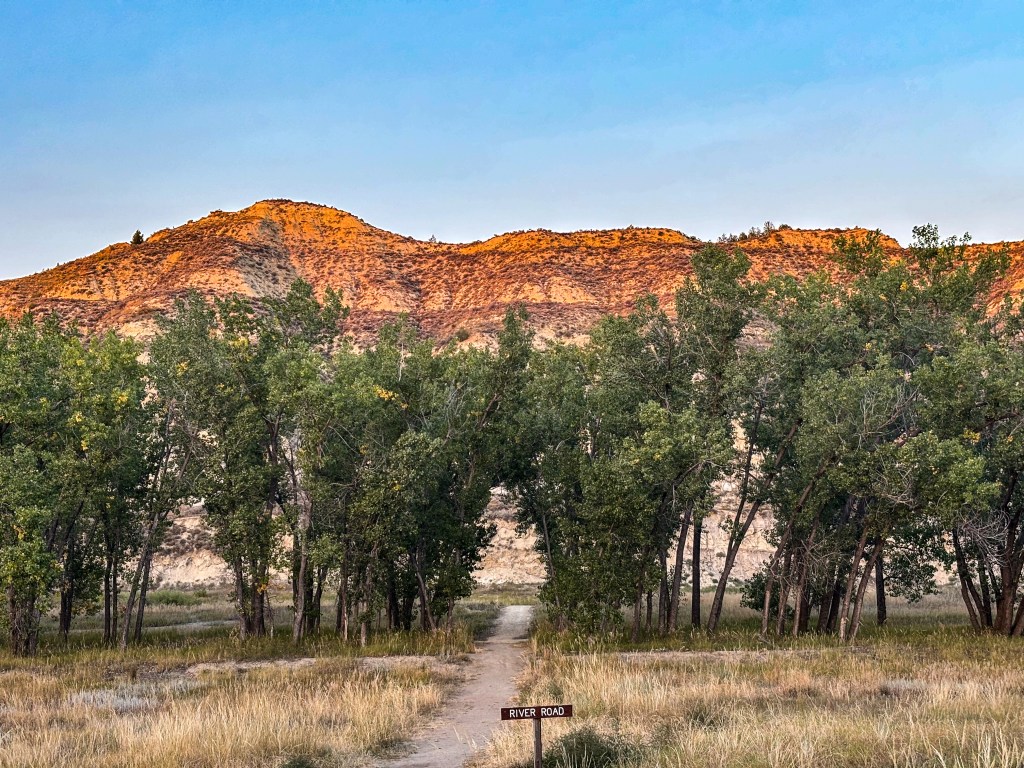
Our next stop was 275 miles north at the Medora Campground in North Dakota to visit Theodore Roosevelt National Park. We’d been listening to a biography of Teddy since leaving Colorado and learned so much about him and his family before we got here. Teddy was fascinated with every kind of living thing from the smallest bug to the largest mammal and originally he had come to North Dakota to find a trophy bison bull. He was successful, but he found great peace and a “lonely freedom” in this wild country known as the badlands. This deepened his appreciation for the natural world and all its beauty and led him to become a true conservationist. As our 26th President, Roosevelt established the U.S. Forest Service and backed legislation to create wildlife refuges, national forests, national parks and national monuments, placing over 230,000 million acres under public protection so that these natural wonders could be preserved for many generations to come. Only part of the Scenic Rim Drive was open, but we certainly enjoyed the stark beauty of this strikingly shaped landscape among the trees and grasslands. We also loved seeing the “feral” horses who live here (not mustangs, but former ranch horses who refused to leave). There was a huge herd of them as we approached our campground and later we saw a group on the Rim Drive.


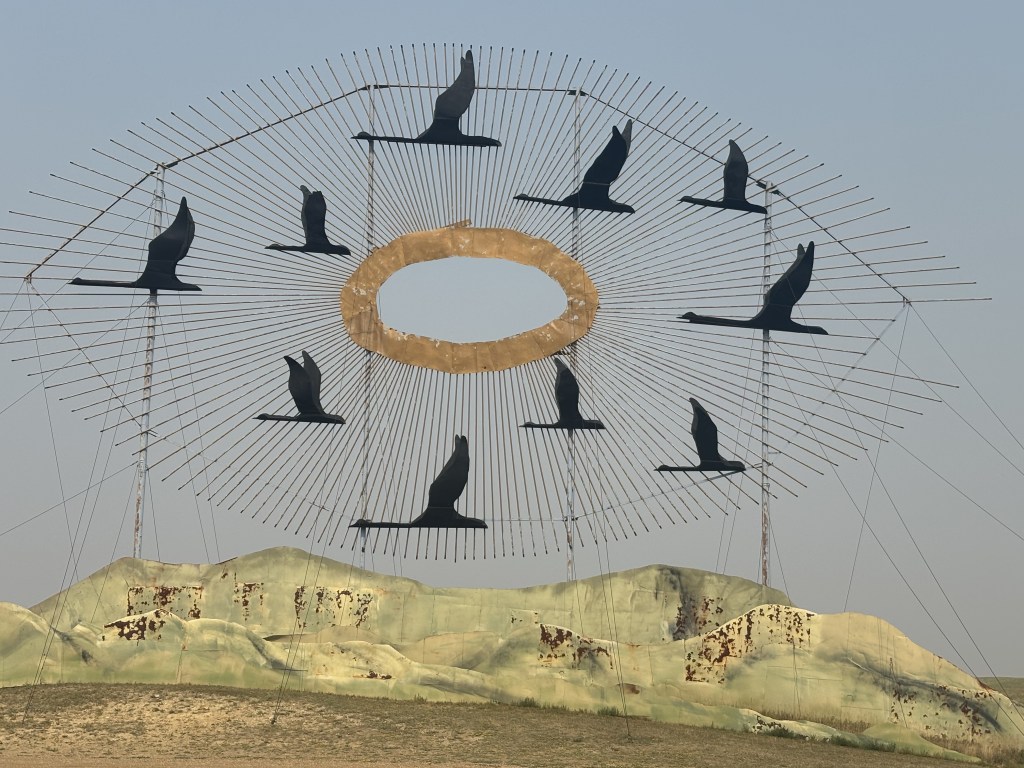
The next morning we awoke to very smoky skies (from fires in Wyoming to the west)) and we were very grateful the skies had been clear when we were driving the Scenic Rim Drive the day before and cleared soon after we turned east toward Fargo ND. We took a short but highly recommended detour called “The Enchanted Highway,” and came across seven huge metal sculptures over a 32-mile road, all created by a self-taught metal sculptor named Gary Greff (who happened to be in the gift shop at road’s end so we could sing his praises). Below are some of his sculptures, some taking over 6 years to complete. The last one (Geese in Flight) is over 100’ high and can be seen where the Enchanted Highway meets the main interstate. All of these sculptures were amazing—the largest scrap-metal sculptures in the world—and we’re very glad we chose to take this detour!


PHOTOS OF METAL SCULPTURES
We now go on to Minnesota, Wisconsin and Michigan, where we’re sure we’ll find more and more beauty. We also get to meet up with three or our favorite couples whom we met on our America’s Great Loop boating adventure 2021-22. More coming soon! It’s very fun to share some of our experiences and photographs with you!
 Cruising with Gary & Annie